
An Interview With ‘I Didn’t Ask For This’ Writer Jennie Wood
by Rachel Bellwoar
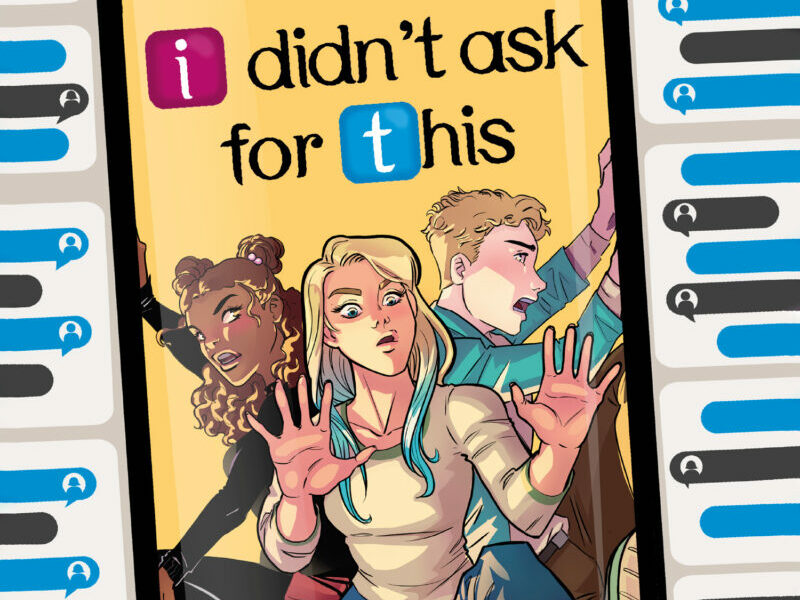
“Who wouldn’t want to be famous?” is one of those broad generalisations people like to make but Daisy knows a thing or two about being internet famous, and it’s not all it’s cracked up to be. While there have been cases of parents relying on their kids for income since the Our Gang shorts, writer Jennie Wood and artist Josh Cornillon‘s upcoming graphic novel, I Didn’t Ask For This, addresses a relatively recent phenomenon: parents who make money off of sharing content of their kids online. With colors by Michael Wiggam and letters by Charles Pritchett, here’s what Wood had to say about the project:

Rachel Bellwoar: There’s this tendency to make out like young people are the ones addicted to technology and yet in I Didn’t Ask For This it’s the parents who seem the most unwilling to acknowledge their reliance on social media. Do you think this comes from a larger disconnect between adults who remember a time before the internet and young people who have always had access and maybe are more willing to address its flaws?
Jennie Wood: In this book, the influencer parents’ reliance on social media is for income, to pay the mortgage, to support their families, so it’s not just an addiction. It’s on another level than most adults. It’s their livelihood. And they’re not just relying on social media; they’re depending on their kids for content, which is extremely unfair to their kids. It puts way too much pressure on the kids. So I think it’s less that the parents are unwilling to acknowledge their reliance on social media. It’s that they are completely dependent on it for their income. Also, I think the older a lot of us get, the more we fear change, no matter how damaging the current situation is. The social media parents in this book fear change; they fear losing their lifestyle, their house, and their way of supporting their family. And those are valid concerns. Then there’s Shane’s non-influencer mom, who still uses a paper daily planner instead of her phone, just to show us that other parents exist even in the world of this book.
Bellwoar: Unable to convince her family of the importance of setting boundaries, Daisy finds comfort in staying at her best friend Shane’s house. Did you always want Shane’s family to act as a counterpoint to Daisy’s and what was it like establishing their very different homes, from how they eat meals to their body language when together?
Wood: I basically lived with my best friend for the last two years of high school, so I pulled from that experience for Shane’s family. I still remember going to my friend’s house and the stark contrast to mine – they all ate meals together, they had disagreements, but they weren’t fighting all the time. The entire mood was different, much more relaxed and joyful. I drew inspiration from that when fleshing out Shane’s family versus Daisy’s family. And yes, from the beginning, Shane and their family are meant to be a refuge, a place of solace for Daisy, a complete contrast to her family. She’s seen by Shane and their family in a way that her family doesn’t see her, and she needs it.
Bellwoar: Do you feel working on this graphic novel has changed how you look at influencer content or made you more discerning?
Wood: Writing this book made me more aware of certain kinds of influencer content that I would have never been exposed to otherwise. I’ve always been really careful about the kind of content I consume on social media. Working on this book reinforced that boundary even more for me.
Bellwoar: One thing I think this book does really well is balance having multiple characters and finding time for individual moments. Was it difficult deciding which characters to spotlight when, and are there any backstories you wish you could’ve kept in but had to cut?
Wood: No, it wasn’t difficult deciding which characters to focus on, and because of that, we didn’t have any backstories to cut. Former Maverick Senior Editor Lauren Hitzhusen and I knew very early on which characters we wanted to highlight. We wanted things to center around Daisy, a teenage girl who’s in a tug of war with her social media influencer mother. From there, we gave Daisy a best friend who was a refuge for her. We did need the Not Your Baby Anymore group to be a decent size, but we knew we couldn’t feature them all as main characters. It was already going to be a big book with lots of locations, characters, and their families. So, for scripting, I needed to narrow down which group members to focus on. Casper and Tommi came naturally because they are the group’s co-founders and leaders. Then I fleshed out Byron and Sasha, two characters that added some much-needed action and visual locations to balance all the group Zoom meetings in the book.
Bellwoar: Thanks to the internet, Daisy is able to connect with other children who have been exploited by their parents. Did that present any challenges visually, since a lot of those meetings take place virtually?
Wood: When Lauren first reached out to me about writing this book, that was my biggest concern – all those Zoom meetings would need to be balanced out. So, as I just mentioned above, I fleshed out Byron and Sasha with that in mind. Byron’s parents are extreme sports influencers. They have him travel with them. Byron records his parents doing their stunts, which provides a chance for action sequences. It also gives us a window into Byron’s trauma – he’s recording his parents risking their lives. Sasha’s family travels the world reviewing amusement parks. This allows for a variety of locations and experiences for Sasha to react to and learn from. Also, the reader sees Daisy “offline” struggling to find her footing as a musician in Chicago and Casper auditioning as an actor in Madison and at theater schools in NYC. I made these choices when scripting to, yes, advance the story and the characters, and also to balance out all the Zoom meetings that the group needed to have. It was a tall order for an artist, but Josh handled it all so beautifully.
Bellwoar: I Didn’t Ask For This is primarily about the kids, not the parents, but it is fascinating to see how differently the parents respond when their children take their grievances public. How was it getting to explore those relationships, which can be complicated at best, ugly at worst?
Wood: It was fun to explore the different reactions. I think double standards like these need to be explored more. A lot of us adults expect kids to “do as we say, not as we do.” If it’s something we wouldn’t do – or something that we wouldn’t have wanted done to us as kids – why put our kids through it?
Bellwoar: The graphic novel length also really allows you to address all the different angles of this issue, because it’s not just enemies who don’t always understand what it’s like to have your childhood broadcasted to the world. Even friendly faces occasionally question whether it’s that big a deal. What do you wish more people understood about this problem?
Wood: I wish more people understood how much damage it does long-term to a kid who doesn’t have any say about the content that’s put out there about them. There’s the internal damage to a kid’s sense of identity and to their self-image. Then there’s the external damage, exposing them to harmful comments and, in some cases, predators. These kids have no say about their lives being out there for the world to see, judge and comment on. We need to advocate more for them.
Bellwoar: One of my favorite pages is the homage to René Magritte’s This Is Not A Pipe. Where did the idea for that image come from?
Wood: Magritte is my all-time favorite artist, so the idea popped into my head when I got to that point, writing the script. His images forever live somewhere in my mind.
Bellwoar: The legal process can be intimidating at any age, not to mention disheartening. How important was it to you to show Daisy and her friends trying to reach out to their local representatives to create changes?
Wood: It’s so important to show that reaching out to local representatives is an option and show ways in which you can go about it. It’s equally important not to sugarcoat it, to show that while it’s not the easiest thing to do, it is possible to get your local rep’s attention and that it’s worth the effort!
Bellwoar: Thanks for agreeing to this interview, Jennie!
I Didn’t Ask For This goes on sale April 15th from Maverick.

