‘Daredevil’s “Grand Design” Wants Too Much Sympathy For Its Devil — Review
by Austin Gorton
It’s always nice when you can watch a series settle into a groove. After a bit of rocky start, Daredevil: Born Again has seemingly shaken off some of the lingering detritus from the previous season and turned in a series of episodes in which each is as good as or better than the last.
“Grand Design” is the latest entry in that progression, and while I have some issues with it, it’s another contender for “best of the season” so far, in large part thanks to the return of Elden Henson‘s Foggy, who imbues the flashback sequences with a charm and wit and effervescence that has been sorely lacking since the ill-conceived decision to kill off Foggy at the inception of the series. All else aside, it’s simply fun hanging out with Nelson and Murdock, even if Charlie Cox‘ flashback wig is an abomination.

The biggest issues with the episode stem from the [Kingpin voice] Vanessa (Ayelet Zurer) of it all. First of all, there’s the question of fridging. Plot-wise, it seems pretty clear that Vanessa’s death is meant to push Kingpin (Vincent D’Onofrio) into an even darker, more extreme place as a means to make his downfall easier to execute (i.e.: in his grief and rage, he’ll overreach, and do something so bad, so publicly, it’ll reveal his true nature to the city). In that regard, it’s pretty clearly a fridging, with a female character dying simply to further the story of a male character.
Yet, importantly, Vanessa is not innocent in this. Much of last season and this one has been about confirming Vanessa as a Queenpin, someone who, in her own way, is as morally reprehensible, by choice, as her husband. The whole reason she was targeted last episode stems from her having had Foggy killed in the first place (a fact underscored by having Foggy’s return to the series come in the episode in which she departs), a move she made entirely of her own volition and with her own agency. In that regard, her death here is merely a case of the character reaping what she herself has sown, making it less of a traditional fridging.
Similarly-complicated is the question of whether or not “Grand Design” is trying to make us feel sympathy for Kingpin. Certainly, his reaction to the attack on Vanessa throughout the episode is a bit of a zag from expectations, keeping the focus on his wife while she’s still alive and not on immediate retribution, and D’Onofrio continues to plumb new and varied depths in his depiction of the character which are, in terms of pure craft, entertaining to watch. But in presenting a more relatable, grieving spouse, the episode is seemingly inviting us to feel sympathy towards his situation and, frankly, that’s not really something I’m interested in doing. All else aside, Vanessa’s fate is a direct result of his actions: he wanted to draw out Bullseye and Daredevil, and rather than be honest with Vanessa, he played coy, such that she didn’t realize she was walking into a trap laid out by her husband when she inevitably turned up despite his best efforts. You play with fire, you get burned.

But more broadly, while I want villains who are three-dimensional and nuanced, I usually don’t want to feel sorry for them — at least the kind of villain Kingpin has been established as being through his actions both small and arch. At this point, I want him to get his comeuppance, not condolences. Yet it seems, in the desire to create a more humanistic portrayal of the villain, rather than presenting the death of Vanessa as a case of Kingpin being hoisted by his own petard, the episode ultimately seems to be asking us to view him as a sympathetic figure.
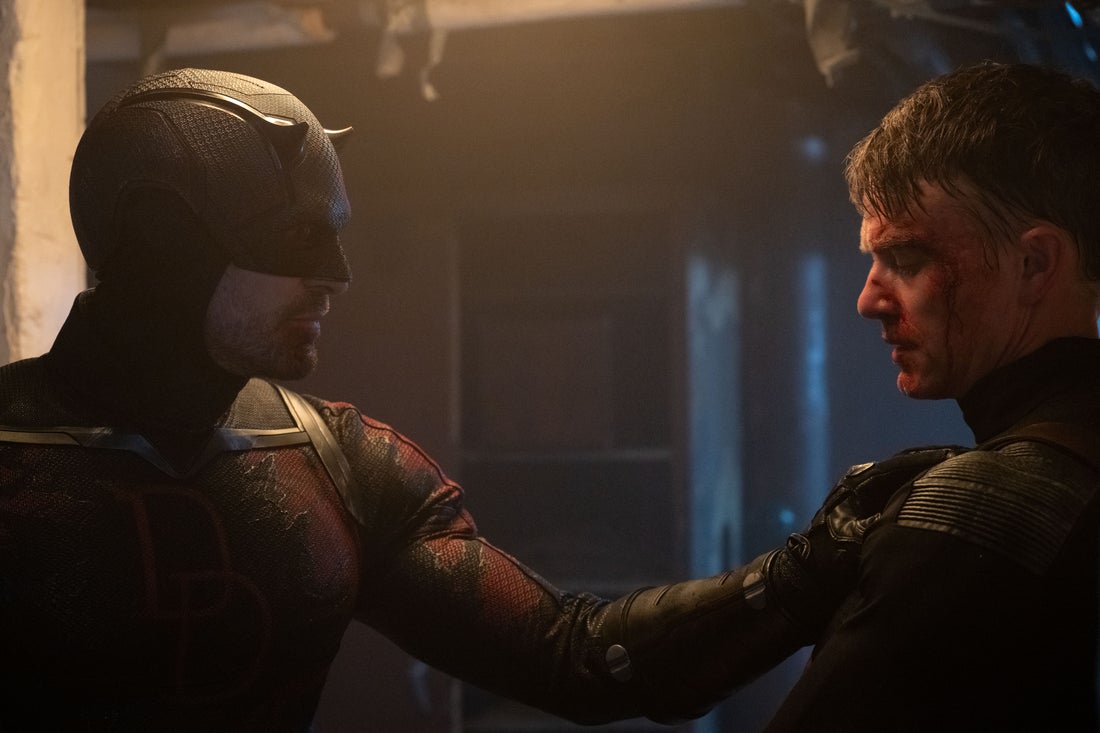
This is all underscored by the overarching theme of mercy that permeates the other two plotlines, the Nelson & Murdock flashback and Matt’s continued efforts to atone for his attempted murder of Bullseye (Wilson Bethel) by getting him safely away from the AVTF (i.e.: the hand-picked stormtroopers of the guy the episode also wants us to feel bad for). Both plotlines are about doing something good for a bad person — Foggy’s childhood bully and his later killer – but because this message is coming filtered through the worldview of heroic characters we like, it’s easier to accept.
Whether you agree with their actions or not, you can understand where they’re coming from. With Fisk, the episode simply seems to be saying, “well, he really loved his wife, so feel bad for him,” as if a grieving spouse is all he is, and we’ve forgotten that he has the city under martial law, that he locked up a bunch of people in cages ahead of show-trials, that the body Daniel Blake (Michael Gandolfini) and Buck Cashman/Dollar Dollarman (Arty Froushan) are burying in the woods in this episode was an innocent man trying to expose Kingpin’s crimes.
Killing Vanessa just to push Kingpin to even further extremes in vengeance does her character few favors, but it also does the narrative a disservice if it’s used to sand the edges off a truly monstrous villain (remember when he crushed the police captain’s head like a grapefruit with his bare hands?). Hopefully, the touch of humanity it’s trying to give to Fisk here simply makes the inevitable downfall all the more a victory for the heroes, and leads to an even more-earned sense of catharsis for the audience.
The Law Review
- One of the reasons the show has been cooking over the last few episodes is that it’s gotten leaner, with key characters staking out their place in the narrative and less critical ones fading into the background – not surprisingly, the best episodes of the season so far don’t include any instances of Heather (Margarita Levieva) staring at the Muse mask.
- I’m not sure what revealing that Buck came into Kingpin’s service via Daredevil season 1 major domo Wesley (Toby Leonard Moore) adds to things, other than as an excuse to pile on the flashback service.
- Matt tells Bullseye he knows a nurse he can take him to, a reference to Claire Temple (Rosario Dawson).
- Karen is one of the people whose general absence from the last couple episodes has been missed, but she almost makes up for it with the look Deborah Ann Woll pulls off Matt when he stumbles in, Bullseye draped over his shoulder; it somehow captures about 100 different emotions before settling on a combination of rage, confusion, and “oh, that silly guy of mine!”
- Speaking of Bullseye stuff, the bit where Matt just ditches him, steps out of the church, then goes back and the next we see him they’re gone was weirdly-executed. Like, I get that he remembered Foggy’s Nelson about mercy, but what prompted him to leave in the first place? And if it was that easy to come and go, why didn’t he just go with Bullseye in the first place.
- Ranking the notable wigs — Foggy’s was the best, and Buck’s was the worst, if only because Matt’s was so bad it circled back around to awesome.
- The CGI de-aging on Ayelet Zurer was also distractingly obvious (and largely unnecessary — all this CGI de-aging stuff has more or less hit [Ian Malcolm voice] “just because you can, doesn’t mean you should” levels).