
Talking ‘Penelope’s Escape From The Platypusary’ With Writer Arianna Irwin
by Rachel Bellwoar
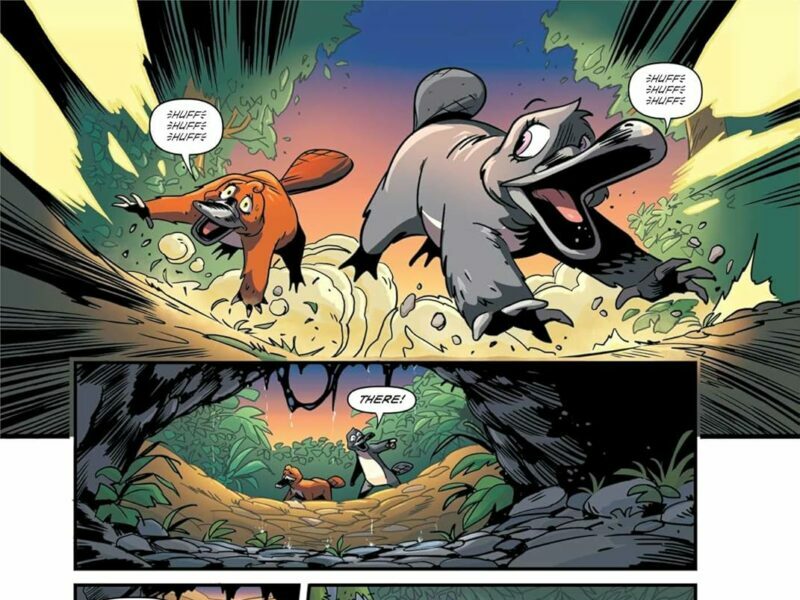
History fans will be forgiven if they’ve never heard of Penelope the Platypus before. It’s this fascinating human interest (or should I say “animal”) story writer Arianna Irwin and artist Prenzy have uncovered with their graphic novel, Penelope’s Escape from the Platypusary. With colors by Nicolò Laporini and letters by Micah Myers, here’s Irwin with more on Penelope’s’ development:

Rachel Bellwoar: How did you first learn about Penelope, the platypus who disappeared from the Bronx Zoo?
Arianna Irwin: Instagram meme while doom scrolling, hah! I was immediately intrigued and ended up doing a deep dive into her story.
Bellwoar: While I’m assuming the news articles about her are based on real stories that appeared in The New York Times, what was it like filling in the events between those stories?
Irwin: They are! The headlines you see throughout the book are the actual headlines from The New York Times and other press outlets featuring Penelope at the time. The articles just brought up more questions. So it was super fun imagining an entire animal world and operating society within the Bronx Zoo. I also just really wanted to give Penelope a hero’s tale with friends, adversaries, and trials that lead to her eventual freedom.

Bellwoar: While I’m also assuming the photos for the news articles are semi-based on the real photos used, it’s amazing the difference context and a facial expression can make because while I don’t know that the actual photos would’ve come across as sad, these definitely do. What was it like reinterpreting those?
Irwin: Unfortunately, some of the articles don’t have associated imagery. When they do, Penelope’s emotions are pretty unreadable, at least for me. So the illustrated images on those article pages in the book are definitely taking some creative liberties. But, I wanted to give my version of Penelope complicated feelings of confusion, homesickness, rebellion, desire, and grief. Prenzy did such an amazing job by bringing those emotions to the forefront with Penelope’s expressions and body mechanics on those pages and throughout the whole book.
Bellwoar: While the events of this story took place in the 1950s, the look of this book doesn’t immediately scream period piece, or lean on the tropes that would appear if this was a story about humans set at the time. Was that intentional?
Irwin: I do feel that Penelope’s story transcends her time, so I filled in the gaps of her story with action, vibrancy, and more modern thoughts and feelings. As for the look of the book, this is a fun, animal adventure tale for young adults, which I think calls for bold art and colors. Again, Prenzy and Nicolo absolutely delivered! They crushed it.

Bellwoar: In deciding which other animals to have Penelope interact with at the zoo, were there a lot of reference photos from the Bronx Zoo at that time that you could turn to for inspiration or to help with the character designs?
Irwin: So, from what I’ve seen, it looks like the platypuses were kind of cut off in their own exhibit, but I knew I wanted a koala to be Penelope’s ally from the beginning. I am not sure if the real Penelope had any koala friends or mentors, but Cuddlepot’s name is a reference to the first koalas that were ever brought over to the US. Their names were Snugglepot and Cuddlepie. They were brought to the San Diego Zoo in 1925 from Sydney. Phil the gorilla was inspired by the extra-large gorilla with the same name, who lived in the St. Louis Zoo until 1958. He has his own sculpture now. The rest of the characters are just my imaginings.
Bellwoar: Platypuses aren’t the first animals that come to mind when you think of fighters. Is that a misconception and was it fun getting to play against those expectations with Penelope’s manner and appearance?
Irwin: Haha, no, they’re not. But Penelope made headlines by attacking Cecil when she refused him, so she was a fighter, and I wanted to honor that. I loved re-inventing her physical appearance to evolve with her internal journey. Towards the climax of the book, Penelope gets some edge with a phohawk, a beak stud, and a pretty gnarly scar. I also thought a decade in captivity and under constant human surveillance would make her angry, extremely desperate, and unpredictable. So I got to give her a “specific set of skills”, a voice full of attitude, and naturally an Australian accent.

Bellwoar: Thanks for agreeing to this interview, Arianna!
Penelope’s Escape from the Platypusary goes on sale June 21st from Maverick.

