
‘Star Wars’ Month: All Of The Lightsaber Duels Ranked Mathematically
by Austin Gorton
We all love lightsaber duels. Star Wars without lightsabers (and, yes, the Force) is just every other space fantasy movie, right? From “when last we met, I was but the learner. Now I am the master” to “Duel of the Fates” to Kylo Ren (Adam Driver) getting stabbed in the gut with his own saber, these duels can be found all across the entirety of the Skywalker Saga.
While everyone has their favorite, which one is the best? It’s a question that has spawned countless arguments across the fandom for generations. To provide my (100% mathematically correct, no argument) answer to that question, I devised a scoring system in which each duel is scored across four categories to determine, once and for all, which lightsaber duel is the best.

But first, some ground rules. We are taking about lightsaber duels, which means there needs to be more than one lsaber at some point in the sequence, and that the laser swords need to be wielded against each other by two antagonistic characters. This means something like the fight against the Praetorian Guard in Star Wars: The Last Jedi (which is awesome), Darth Vader’s (Spencer Wilding, Daniel Naprous, and James Earl Jones) murderous onslaught at the climax of Rogue One: A Star Wars Story (which is also awesome but also gratuitous) and the ground-level climax to Star Wars: Rise of Skywalker (which is … fine, though I do love the little “it’s go time” shrug Kylo Ren gives the Knights of Ren) are ineligible. In each case, one side of each fight is saber-less. We’re also looking only at the movies, not any of the Disney+ series (so none of the duels in Obi-Wan Kenobi or Star Wars: Ahsoka count) and only live action (animation is a whole style unto itself, so no Star Wars: The Clone Wars movie). That aside, all else is on the table.
In terms of scoring, here’s how things breakdown. Each lightsaber duel is scored in four categories, with a maximum of 5 points in each category (so a “perfect” duel, so to speak, would score 20 points). The categories are:
- Thematic Weight (TW) – What does the fight contribute to/say about the themes of the movie and the saga writ large?
- Narrative Impact (NI) – How does the duel advance the story of the film/saga? What kind of impact does the confrontation have on the course of the story (ie does someone important die, or does it set in motion a critical series of events)
- Fighting Technique (FT) – Is the actual fight itself cool and fun to watch? How do the specific fighting techniques of the combatants speak to their character, how well choreographed is the fight, and how well do the actors pull it off?
- Cinematic Flair (CF) – How well-shot is the duel? Is it easy to follow the action and see what is going on? Are there any little touches that help it stand out?
With all that in mind, here are all the lightsaber duels from across cinematic Skywalker Saga ranked from lowest score to highest.
Luke Skywalker vs Leia Organa – Star Wars: The Rise of Skywalker
TW: 0 | NI: 1 | FT: 1 | CF: -2 | Total: 1
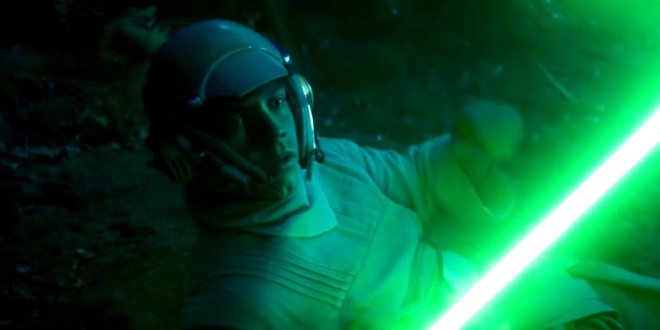
This brief duel, depicted via flashback and narrated by Force Ghost Luke Skywalker (Mark Hamill), is notable for being the only time we see Leia Organa (Carrie Fisher and Billie Lourd) wielding a lightsaber, and gets a point for explaining why Leia never became a Jedi. But ultimately, this is a duel best left forgotten since it features two CGI golems with awkwardly-deaged faces glued onto them.
Qui-Gon Jinn vs. Darth Maul – Star Wars: Episode I — The Phantom Menace

TW: 0 | NI: 1 | FT: 1 | CF: 0 | Total: 2
Largely a nothingburger of a fight, this brief encounter between Qui-Gon Jinn (Liam Neeson) and Darth Maul (Ray Park and Peter Serafinowicz) as Queen Amidala’s (Natalie Portman) entourage prepares to leave Tatooine still meets the criteria, so I’m including it. It gets a point in Narrative Impact for being the first laser swordfight we see in the Prequels, setting the stage for a battle later in the film which completely changes what we could expect from a lightsaber duel, and a point in Fighting Technique for the cool flip Maul does off his bike at the start of the fight.
Anakin Skywalker & Obi-Wan Kenobi vs. Count Dooku – Star Wars: Episode III — Revenge of the Sith
TW: 0 | NI: 2 | FT: 1 | CF: 1 | Total: 4
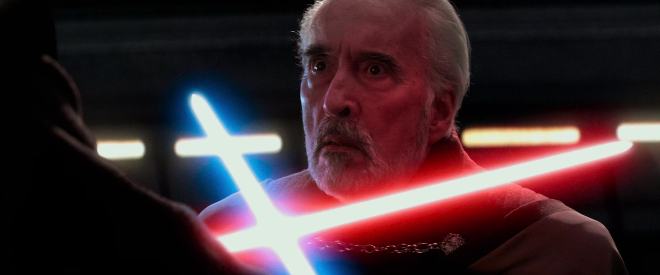
Revenge of the Sith is the film with the most lightsaber duels in it, but not all of them are bangers. This rematch between Obi-Wan Kenobi (Ewan MacGregor), Anakin Skywalker (Hayden Christiensen) and Count Dooku (Christopher Lee) gets some Narrative Impact points for concluding with the death of a notable Prequels sub-boss; a key step in Anakin’s turn towards the Dark Side. It also earns a point in Fighting Technique for continuing Anakin’s pre-Vader aggressive fighting style (characterized by his opening stance in which he cocks his saber above his head to deliver maximum force with his first strike) and the cool little twisty thing he does to (literally) disarm Dooku. Cinematically, it’s a fairly routine fight (aside from the sequence in which Obi-Wan gets a bridge dropped on his legs, which is fine yet super awkward), but I’m giving it a point for the way it is constructed to mimic the climax of Star Wars: Return of the Jedi — Ian McDiarmid in a throne (here as Chancellor Sheev Palpatine), against a space battle backdrop, urging a young Skywalker to strike someone down — because, after all, Star Wars is like poetry, it rhymes.
Obi-Wan Kenobi vs. General Grevious – Revenge of the Sith
TW: 1 | NI: 1 | FT: 2 | CF: 0 | Total: 4
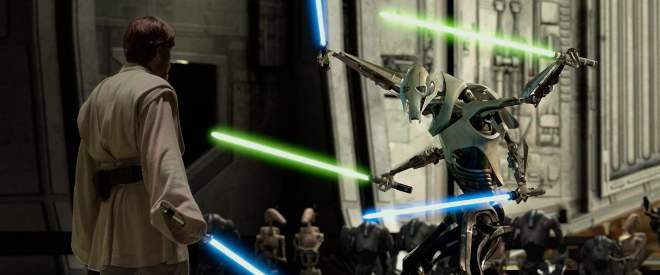
Another of Sith‘s lesser duels, this is also the only lightsaber duel to feature a non-Force user on one side of it (though as he’ll tell you, General Grevious (Matthew Wood) was trained in the “Jedi arts” by Dooku). This gets a Thematic Weight point for the way it speaks to the general “man vs. machine” conflict peppered throughout the saga, with Grevious existing as a character in the first place as a way to foreshadow Anakin’s fate. It also receives a Narrative Impact point since it concludes with Grevious’ death and plants the seeds of Obi-Wan’s eventual survival of Order 66. Technique-wise, it showcases both Obi-Wan’s more defensive fighting style, enabling him to hold his own against Grevious’ tentacular approach to dueling. Plus, the sight of Grevious wielding a crap-ton of stolen lightsabers is pretty cool.
Luke Skywalker vs. The Dark Side – The Empire Strikes Back
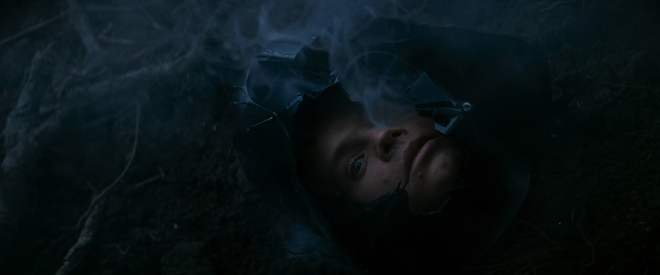
TW: 5 | NI: X | FT: X | CF: 1 | Total: 6
This brief duel, in which Luke enters a creepy cave on Dagobah and seemingly kills Darth Vader (David Prowse and James Earl Jones) only for Vader’s head to explode and reveal Luke’s face inside his helmet, is all theme — give in to the Dark Side and become what you fear! Your perception informs your reality; i.e. if you go looking for a fight, you’ll find one! The greatest enemy is yourself! But it also gets a point in Cinematic Flair for being the only instance in the entire Original Trilogy in which slow motion is used.
Mace Windu vs. Darth Sidious – Revenge of the Sith
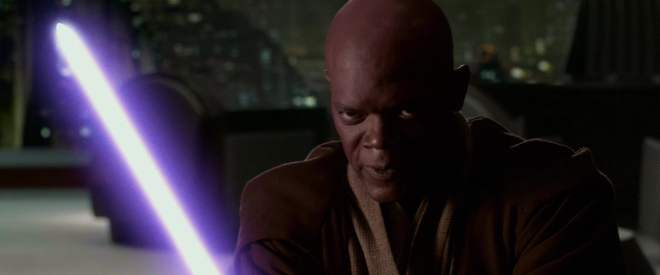
TW: 0 | NI: 4 | FT: 3 | CF: -1 | Total: 6
In terms of Narrative Impact, this is the second most important duel in Revenge of the Sith: it exposes Chancellor Palpatine as Darth Sidious, leads to his signature facial scarring, marks the end of Mace Windu (Samuel L. Jackson), and is the flashpoint pushing Anakin fully to the Dark Side, turning him into Darth Vader (in name if not yet in form). It’s also not without its share of Fighting Technique points, representing the only time we see Mace (an accomplished duelist according to various novels and whatnot) strut his stuff against another lightsaber, as well as the debut of Sidious’ unique, almost inhuman fighting style (underscored by the creepy howls on the soundtrack as he strikes).
The problem: many of the decisions that went into how the sequence is shot. From the choice to depict most of the duel in closeup (mimicking the close quarters of the setting), which obscures much of the technique, to the largely unnecessary cutaway of Anakin landing his ship and entering the building (George Lucas loves his take-offs and landings), to the unleashing of McDiarmid on the scenery at the end of the fight as he cackles with “unlimited power!” The Cinematic Flair fails here.
Rey vs. Kylo Ren – The Rise of Skywalker

TW: 0 | NI: 1 | FT: 2 | CF: 4 | Total: 7
The first true one-on-one, saber-to-saber duel between Rey (Daisy Ridley) and Kylo Ren has some minor narrative importance by teasing the idea that Rey is the Emperor’s granddaughter (however you feel about that narrative decision — I hate it — it’s still important to the development of the story, such as it is) and the choreography is typically solid. All else aside, the Sequel Trilogy does a nice job of fusing the dueling styles of the previous two trilogies — the original’s more lumbering, broadsword-inspired approach and the Prequels’ more kinetic, Eastern-influenced style — into one.
Where this one shines is the way it uses the whole “Force dyad” routine to create a duel that takes place in two places at once (Ren’s Star Destroyer bedroom and the surface of the planet Kijimi), and then gives each of those places a strikingly-different color palette, with the white-clad Rey in a starkly-white room and the dark-clothed Ren on the darkened city streets, such that one figure or another is always popping against the opposite background as the camera cuts from one location to the other. All else aside, it looks really cool.
Yoda vs. Darth Sidious – Revenge of the Sith
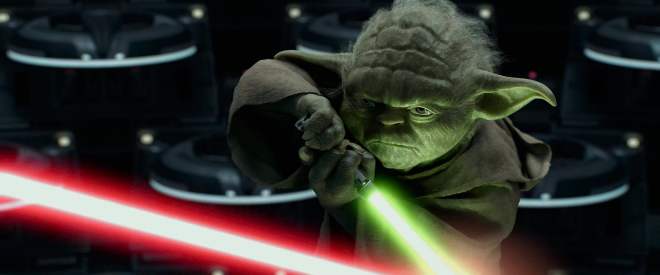
TW: 3 | NI: 1 | FT: 3 | CF: 1 | Total: 8
This is one of those duels which does a little bit of everything, but doesn’t do any one thing really well. It’s strong in Thematic Weight (having already turned the Republic into an Empire and declared the Jedi fugitives, Sidious goes further and literally weaponizes the government against Yoda by hurling a bunch of those Senatorial hover pods at him, and it has the whole “shoot electricity/redirect electricity thing, which is pretty much the Sith/Jedi distinction in a visual nutshell) and has minor narrative import (it drives Yoda into exile and doesn’t, you know, stop the rise of the Empire). Technique-wise, it’s consistent with both combatants established styles, and gains a little oomph from the way those styles are heavily acrobatic despite Yoda and Sidious being small and old, respectively.
Anakin Skywalker & Obi-Wan Kenobi vs. Count Dooku – Star Wars: Episode II — Attack of the Clones
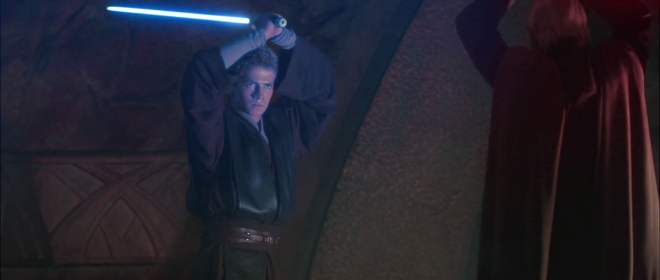
TW: 0 | NI: 1 | FT: 4 | CF: 4 | Total: 9
This relatively brief duel is one of those fights that, at its core, just looks cool and is fun to watch. Each of the combatants get to show off their styles — defensive (Obi-Wan), aggressive (Anakin) and precise (Dooku) — and then, after Obi-Wan is out, Anakin gets to use two sabers and then cuts the lights. The whole thing is illuminated by the glows of the sabers. Plus, it concludes with Anakin losing half an arm — dismemberment being the objectively-best way to conclude a lightsaber duel.
Obi-Wan Kenobi vs. Darth Vader – Star Wars: Episode IV — A New Hope
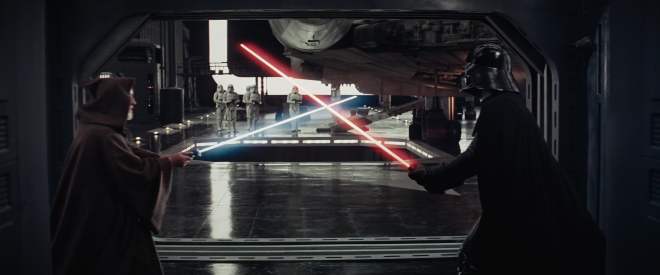
TW: 4 | NI: 5 | FT: 0 | CF: 1 | Total: 10
Despite being the very first lightsaber duel in Star Wars, this fight isn’t terribly exciting or fun to watch — the technology and techniques simply weren’t there yet to do much with it — but it is supremely important in terms of Thematic Weight and Narrative Impact. It introduces the idea of passivity and defense being more powerful than anger and aggression while concluding with the death of Obi-Wan (Alec Guinness), a character whose import to the saga would only grow after his death. Both tee up the idea of Force ghosts and allows Luke and company to escape the Death Star, pushing the young Skywalker closer to his ultimate destiny.
Yoda vs. Count Dooku – Attack of the Clones
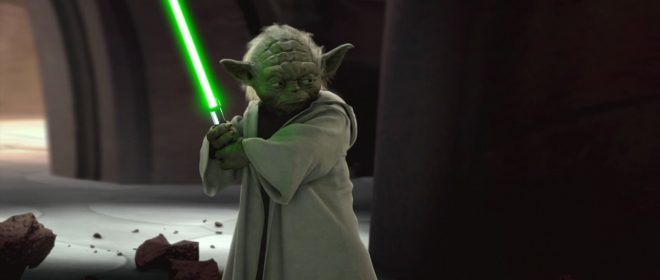
TW: 1 | NI: 2 | FT: 5 | CF: 3 | Total: 11
This is essentially the polar opposite of the Obi-Wan/Vader New Hope duel: all flash, no substance. There’s a little Thematic Weight and Narrative Import in the idea that Yoda (Frank Oz) chooses saving Obi-Wan and Anakin over finishing the fight with Dooku, thereby allowing the Clone Wars to fully blossom into being, But what makes this fight memorable is the novelty of seeing Yoda leap into action for the first time, a whirling dervish of martial energy, and the way Lucas and company succeed in making the ensuing duel visually clear despite the size disparity of the opponents. It’s not as significant as the New Hope duel, but it’s the one I’m more likely to cue up on YouTube for funsies.
Rey vs. Kylo Ren Round 2 – Rise of Skywalker

TW: 2 | NI: 4 | FT: 3 | CF: 3 | Total: 12
Less visually-engaging than their first duel (this is the one taking place amidst crashing waves atop the wreckage of the second Death Star), this one has a little more narrative and thematic oomph to it, given it also features the death of Leia and, ultimately, the return of Ben Solo. It also does a neat thing with the fighting styles, leaning into the weariness of the combatants by having them fight more in the style of the Original Trilogy. In those battles, the lightsabers seem heavier and required more oomph to wield. Even then, it still features some of Kylo Ren’s signature late-activate, reverse-grip moves (the opening moments of the fight, inside the Emperor’s throne room, where Ren dodges like a dozen strikes from Rey before he even ignites his blade are so much fun), while the water-soaked setting makes it visually-unique amongst these duels.
Rey & Finn vs. Kylo Ren – Star Wars: The Force Awakens

TW: 2 | NI: 3 | FT: 3 | CF: 5 | Total: 13
Like A New Hope — the film it is consciously aping — the opening of the Sequel Trilogy features only one proper lightsaber duel, but it’s a great one. Strong Narrative Impact for the way it establishes that Rey is the would-be Jedi hero of the trilogy, a watershed moment for the saga. It establishes the martial style of saber combat for the Sequel Trilogy (lighter than the Original Trilogy but heavier than the Prequels) along with Kylo Ren’s specific hack-and-slash, yet still somehow fluid style. The moment when Anakin and Luke’s old lightsaber whips past Kylo Ren’s head and into Rey’s hand as the Force theme swells is arguably the most fist-pumping, “eff yeah!” moment of the film. Also, the concluding image of Rey and Ren locked together, one blade pointing skyward, the other to the ground, creating a perfect “light/dark” diagonal, is still evocative.
Luke Skywalker vs Kylo Ren – Star Wars: The Last Jedi

TW: 5 | NI: 5 | FT: 0 | CF: 4 | Total: 14
This gets zero Fighting Technique points since there’s technically no actual lightsaber fighting in it. But it’s still one of the most thematically-weighted and narratively important duels in the entire saga. Luke’s approach — to act in defense of his friends, to never strike a blow or behave in an aggressive manner — is the perfect representation of what Yoda was trying to teach him in The Empire Strikes Back. Arguably, this is the only time we actually see a Jedi live up to those ideals on film. It’s also a duel that concludes with the death of Luke and the rise of Rey, making it hugely important to two trilogies. And the whole thing looks great, from the opening image of Luke striding out to face down the entire First Order (one of my favorite shots of the entire trilogy) to the evocative salt-crusted red battleground, to Luke passing away to the sight of a binary sunset, concluding his journey exactly where it began (because, again, it’s like poetry, it rhymes).
Luke Skywalker vs Darth Vader – The Empire Strikes Back

TW: 3 | NI: 5 | FT: 2 | CF: 5 | Total: 15
A little more kinetic than the stodginess of A New Hope, the first actual Luke/Vader duel is still a relic of its time in terms of Fighting Technique, with lots of “strike, parry, pause” routines. But in everything else, it’s top-notch. One of my favorite little details is the fact that Luke — the would-be Jedi — initiates the fight by lighting his saber first, the complete opposite of everything Yoda was trying to teach him and in complete ignorance of what he was meant to learn from his experience in the cave. The whole thing is well-shot and clear yet visually engaging. It is (suitably for a film that is all about the Empire striking back) the signature Darth Vader fight. He is always in command of the duel; an unstoppable force merely toying with Luke. And, of course, it concludes with both Luke losing his hand — establishing the tradition of lightsaber fights leading to a loss of limbs — and the signature plot twist of the saga and, arguably, modern cinema: that (spoiler?) Darth Vader is Luke’s father.
Obi-Wan Kenobi vs. Anakin Skywalker – Revenge of the Sith
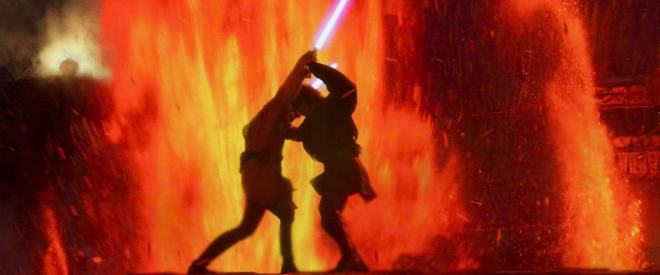
TW: 4 | NI: 5 | FT: 4 | CF: 3 | Total: 16
For Thematic Weight we get the self-contradictory discussions of Sith absolutism to the Narrative Impact of the (eventual) death of Padmé, the failure of Obi-Wan, and the immolation of Darth Vader by lava that we somehow always knew about in those dark inter-trilogy years. The fight is also the culmination of the Prequel Trilogy’s kinetic, fluid Fighting Technique via a battle which pits Obi-Wan’s defensive approach against Anakin’s aggressive, powerful strikes. This duel is the apex of the Revenge of the Sith duels, a sequence which lived in the imaginations of a generation of fans and still (mostly) lived up to the hype. And yet, it’s still not the best lightsaber duel of the Prequel Trilogy.
Qui-Gon Jinn & Obi-Wan Kenobi vs. Darth Maul – The Phantom Menace
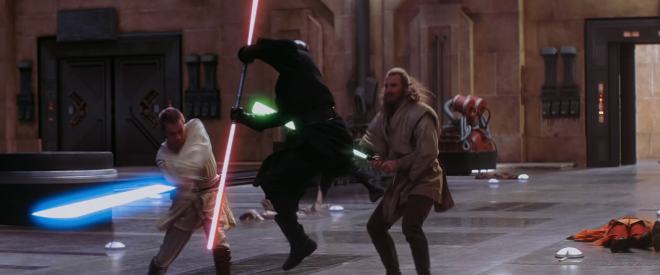
TW: 3 | NI: 5 | FT: 5 | CF: 4 | Total: 17
Does this duel — often referred to by the sobriquet “Duel of the Fates” thanks to the amazing orchestral composition of the same name from John Williams which underscores it — gain something from being the best part of an otherwise pretty bad movie? Absolutely! But it doesn’t change the fact that “Duel of the Fates” rewrote everything we knew about what a lightsaber fight could be: fast-paced, intricately-choreographed, heavily-stylized. It’s two-on-one! The bad guy has a double-bladed saber! Someone didn’t just lose a limb, they got cut in half!
Not only is it ground-breaking, foundational, and fun to watch, but it’s thematically and narratively-important, a battle of light vs. dark with the fate of the galaxy hanging in balance. The death of Qui-Gon (arguably the “purest” Jedi we meet in the Prequels) reverberates, not the least of which for the way it opens the door to the Obi-Wan/Anakin tutelage, probably the most destructive teacher/student relationship in the history of movies. The (apparent) death of Maul sets off a chain reaction of Prequel sub-bosses leading directly to Anakin’s ascendance as the right hand of the Emperor. Everything that happens in the ensuing eight films can be traced back to this duel. “Duel of the Fates” indeed.
Luke Skywalker vs Darth Vader – Return of the Jedi
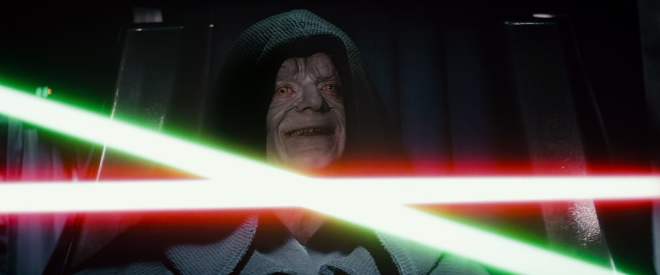
TW: 5 | NI: 5 | FT: 4 | CF: 4 | Total: 18
This duel represents the culmination of everything to which the Original Trilogy (and, retroactively, the Prequel Trilogy) is building: the ascendance of Luke as a Jedi, the defeat of the Empire, and the redemption of Anakin Skywalker (Sebastian Shaw for one brief scene). It is also the best duel of the OT in terms of Fighting Technique, featuring a natural evolution for Luke from the Empire fight, some cool backflips, and a thematically-resonant dismemberment (is Luke becoming more machine than man?!?). The sequence in which Vader taunts Luke beneath the Emperor’s throne, only for Luke to lash out in his fury as the chorus swells with a haunting melody, is memorable and evocative. And its Thematic Weight is off the charts, from the push-and-pull between aggression and pacifism that Luke undergoes, to the way he emerges from the (literal) darkness of the stairs filled with anger, to the singular moment of the entire trilogy (in terms of Force stuff), when Luke claims his status as a Jedi, like his father before him, by performing the most-Jedi act possible by throwing away his weapon and committing to non-violence (a moment later echoed in his Last Jedi duel).
Did I take a point off Fighting Technique and Cinematic Flair because this isn’t quite up to the snuff of the Prequels’ fighting styles and because the shot of Vader tumbling down the stairs is pretty goofy (his lightsaber really needed to have sliced into those stairs, an effect even the stellar ILM team couldn’t muster or didn’t have the budget to muster in 1983)? Yes. But those are minor demerits against what still stands as the single best lightsaber duel in all of Star Wars.

