
Review — ‘Star Wars: The Mandalorian And Grogu’ Is Movie-Long Reminder Of Its Lovable Leads
by Erik Amaya

Since Star Wars: The Mandalorian and Grogu was announced, people have been pondering the same question: is this just an extra-long episode of the TV show or a feature film. The nuanced answer is “yes.”
Taking its cues from the last bits of dialogue in the third season of The Mandalorian, the film finds the Clan of Two — Din Djarin (Pedro Pascal, Lateef Crowder, and Brendan Wayne) and Grogu — taking bounties from the New Republic to bring in Imperial Remnant warlords. For Republic Colonel Ward (Sigourney Weaver), the jobs are part of an overall intelligence plan to get further up the Remnant hierarchy and prevent it from becoming a resurgent Empire. For Djarin, it resembles something closer to revenge even as it reflects his old credo about bring in his marks warm or cold.
Into that state of play, Ward offers Djarin a new bounty: Imperial Commander Coyne (Jonny Coyne). Close watchers of The Mandalorian will recognize him as one of the men talking to Moff Gideon (Giancarlo Esposito) about the return of Grand Admiral Thrawn (Lars Mikkelssen). For those coming in without that knowledge, he’s just another Imp the Republic wants to question. Come to think of it, Djarin is also unaware of the Remnant’s larger plans regarding Thrawn and their other important project. Or he just doesn’t care. And if Mando doesn’t, neither does the film.
That disconnection from the ongoing story orchestrated by Lucasfilm co-president and chief creative officer Dave Filoni — who also shares a writing credit on this film with director Jon Favreau and co-screenwriter Noah Kloor — is one of the flick’s strengths. It hearkens back to those early Mandalorian episodes in which he was just a bounty hunter. Knowledge of the wider galaxy certainly makes the film’s plot richer, but is by no means a requirement to enjoy it. Instead, it treats the viewer to one of The Mandalorian‘s other strengths: Favreau and Filoni playing with their toys in an early 1980s basement or family room.
Indeed, from the opening battle scene to its final moments, The Mandalorian and Grogu leans hard into that feeling of kids at play with their Kenner Star Wars figures. What if Boba Fett and Yoda had to fight Jabba the Hutt or take on an AT-AT? This film proceeds from that sort of first-generation-Star–Wars-fan-thinking. And thanks to Favreau’s able direction, the results are a lot of fun. In fact, the film is almost exclusively dedicated to the feelings of fun the overall franchise offers.
Of course, if you are not into Favreau and Filoni’s action-figure-inspired playtime, the film may not work as well.
Additionally, a lot of the action on display appears to be storyboarded by members of Filoni’s animation team, and thus feels more like what you might see in an episode of Star Wars Rebels or the more recent Star Wars: Maul — Shadow Lord. If you’re on the wavelength, you will see satisfying fights and chases. If not, there’s always Andor and next years’ Star Wars: Starfighter.
In this, the film does indeed feel like several TV shows happening at once. But it is not the film’s only mode.

Under the dedication to a fun, easy-to-watch Mando adventure is an emotional arc worthy of a feature film. I don’t want to go too far into it, but sitting with the movie for a few days, I’ve really come appreciate that this particular character grows and that it feels appropriately scaled to the scope of the adventure. Think Lt. Commander Data (Brent Spiner) coming to grips with his emotion chip in Star Trek: Generations and Star Trek: First Contact. It is the sort of growth that would be far more incremental on television, but perfectly dramatic for a film.
Also, Favreau attempts a nearly-silent sequence that would absolutely not fit on television in general or The Mandalorian in the specific. To use Martin Scorcese‘s rubric for cinema, it qualifies. Although, despite that famed-filmmakers presence as an alien informant, the whole may not meet his definition of cinema. It is not the work of an individual mind, but it does bring some unique elements to the discussion and illuminates the human experience even when the “humans” in question are aliens. So, in that, the movie is, indeed, a film.
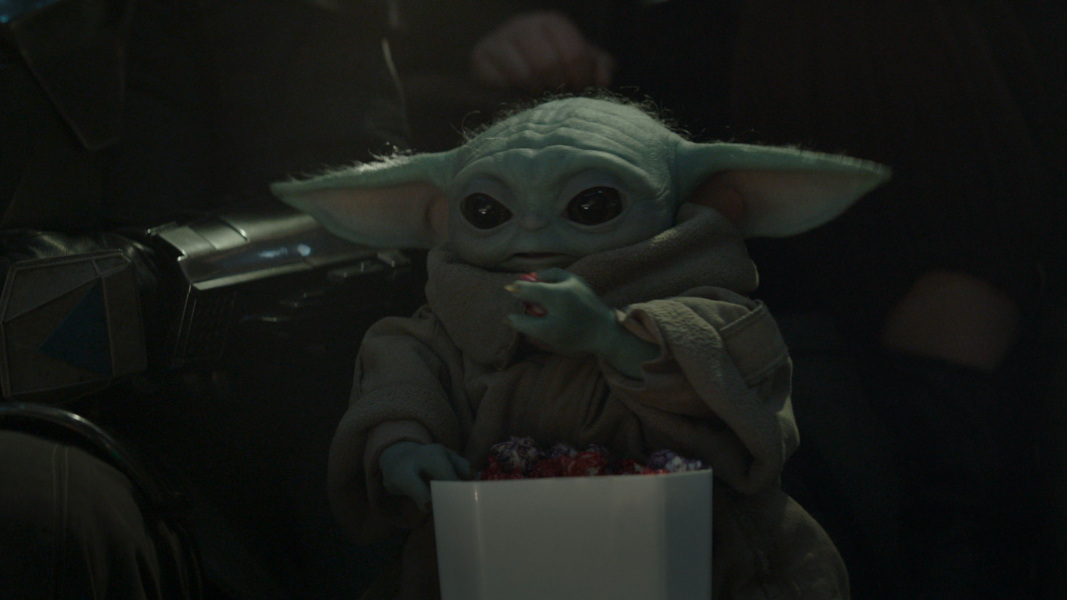
Which leads to its breakout stars: Grogu and Rotta the Hutt (Jeremy Allen White). The former is no surprise as he is The Mandalorian‘s best-known feature and a runaway marketing bullseye. People love the diminutive Force-wielder. Favreau plays into that adoration, giving Grogu a ton of moments to shine. It also offers the puppetry team behind the character a chance to show off everything they learned advancing the tech and art of the character across the run of the TV show. And to further the feeling of what only a feature film can accomplish: there are several Grogu scenes we suspect could not be accomplished on a television series budget or schedule.
Rotta, meanwhile, is a stunningly realized character light years from Star Wars: The Clone Wars‘ “Stinky” — although some nods are paid to his appearance in that first animated Star Wars feature film. The Hutt Djarin and Grogu meet some thirty years after his days as “Stinky” will surprise audiences and, I think, captivate them. He’s the Hutt you can like and a lot of the credit goes to White’s vocal performance, but also some top-tier character animation and Favreau’s forward thinking choices with the character. It’s also easy to imagine Filoni has plans for him in the future, but if this is Rotta’s one big outing, I’m happy to have it.
Other characters in the film, including Weaver’s Ward and Steve Blum‘s Zeb are solid, but lack enough screentime to really establish themselves the way Rotta and the title characters do. It’s not really a demerit, though, as the film is about those three characters and not the guest faces from the New Republic. That said, it is interesting to see Weaver representing the Republic and what she learns through the course of the film may have an impact on the impeding war between the Republic and the Remnant. Nevertheless, the thinner supporting characters can be seen as one of the film’s flaws.
No movie is perfect, after all, and like so many other tentpole releases, The Mandalorian and Grogu‘s biggest problem is its pace. I’ll ague that it is about ten minutes too long. No one sequence needs to be cut, but an overall tightening of each piece would help the overall whole. For as great as the silent scenes are, for example, they do tread close to losing the audience’s attention. And the AT-AT attack teased in previews since last year’s Star Wars Celebration Japan might be one AT-AT too many. I’ll freely admit the pace issue might be as subjective as my appreciation of Favreau and Filoni’s overall approach to Star Wars, so you may find the film gives you as much Star Wars as you want in one sitting.

And if you are going to sit for the picture, I highly recommend finding the biggest IMAX screen in your area to do so. The scenes shot for the format look amazing on a truly giant screen and make it clear that this aspect of Djarin and Grogu’s adventure could only be made for theaters. One particular drone shot of a sandy beach looks startling real at IMAX resolution and sells in a few short seconds the reality of the setting. It is another example of the film going somewhere The Mandalorian cannot. Conversely, I imagine the movie will feel more like the show when it inevitably debuts on Disney+. The theatrical environment is part of the filmic experience in this case.
At the same time, it is totally reasonable to feel like the overall story is something the show could have explored. Perhaps in a more contained way with the character growth happening at a slower pace, and certainly in a more contained scope. But it could have told a version of this plot. Then again, the original Star Wars took its cues from the cheaply-made movie serials of creator George Lucas‘s youth. The differences making both into larger scale A-movies are the details, time, and budget afforded to the tales. Lucas upgraded Flash Gordon serials with just $11 million (around $60 million in today’s money). Favreau aupscales The Mandalorian and gives it more of a cinematic heft in the process. Also like Lucas, how well that conversion works for you depends on how much you appreciate the filmmaker’s talents to begin with.
So is it a film or a long episode the TV show? Again, the answer is both. It can’t help but resemble The Mandalorian thanks to its leads, its director, and even the lightning of cinematographer Dave Klein, who lit several Season 3 episodes. But it has the scope, detail, and sense of fun seen in many Star Wars features. Perhaps more important than this seemingly primary question is the way it will remind you how much like Djarin and Grogu. They never stop being compelling characters in the Star Wars milieu, and like their Lone Wolf & Cub antecedents, you want to see them succeed against the odds. Perhaps that is the most important element of The Mandalorian Favreau needed to bring to IMAX, and there, he succeed.
The Mandalorian and Grogu opens on May 22nd.


