
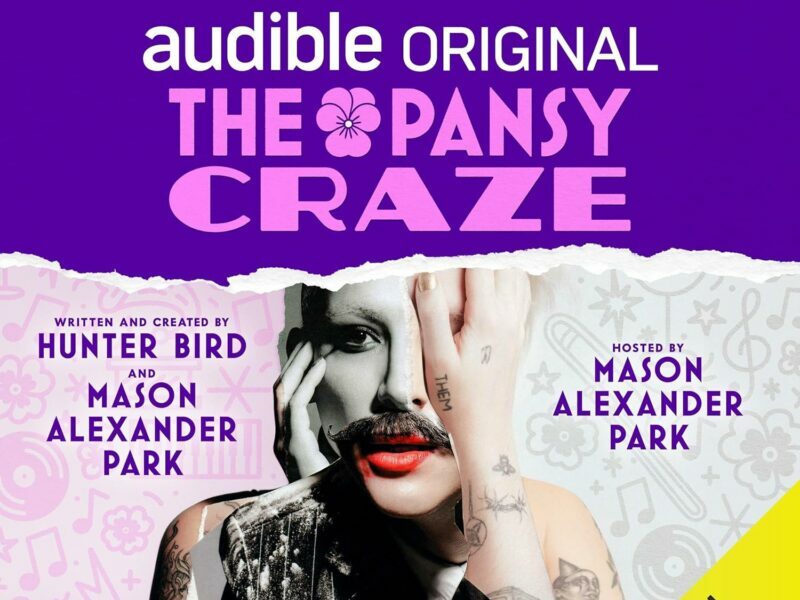
Pride Month 2026 — Let Us Speak Of ‘The Pansy Craze’: An Interview With Podcast Host Mason Alexander Park
by Rachel Bellwoar
While the term “pansy craze” is traditionally used to refer to a period during the late 1920s and early ’30s when gender bending and rebellion were going strong, that’s far from the only time there’s been a Pansy Craze. In their six episode podcast series, Mason Alexander Park mixes songs with history in the best cabaret act you’ve ever heard. From Annie Hindle to Jim Bailey, history is full of queer trailblazers making waves. In that tradition, here’s Park with more on this absolute treasure of a podcast:

Rachel Bellwoar: Before its current form as a podcast, The Pansy Craze started out as a concert series. Podcasts aren’t always known for being filmed in front of a live audience. Was that always something you wanted to retain for the podcast?
Mason Alexander Park: The Pansy Craze has gone through so many iterations over the years. My writing partner, Hunter Bird, and I always felt that we didn’t have enough time to dive into all of the history and stories we wanted in the original concert format, and began thinking of other ways to expand, which lent itself naturally to an episodic format. Audible went for the idea and gave us the chance to craft six episodes of material that we are super proud of. Episodes that allow us more time to sit with different moments of queer history and music.
Bellwoar: Given that you were performing these episodes in front of people, did that create any challenges in terms of ensuring nothing was lost for audio-only listeners?
Park: When creating this version of the show, we had to be really creative about how each episode was written, performed, designed, and put together. We wanted to create an experience that would never shortchange the live audience or the audience at home. Obviously, people listening won’t see some of the visual gags, choreography or lighting moments in the series, but that is only a small fraction of the experience. Our brilliant sound designers and band helped create a world that felt like an old radio play, something designed to translate purely in audio. It was a fun way of working, trying to tell the best story for people who would be listening nearly a year later.
Bellwoar: I’m obsessed with the theme song for this show and the different orchestrations (especially the medieval arrangement for episode four). What was it like putting those together?
Park: Thank you! I knew my friend Stephen Trask had worked on a musical that referenced The Pansy Craze, and I asked if we would be able to use his song from the show as our intro. Our glorious musical director, David Dabbon, did all of the arrangements and was constantly one-upping himself with each style he put the song into. I loved the challenge of learning a new arrangement with Lachlan every episode.
Bellwoar: How did you choose your subjects for each episode?
Park: We began with a list of maybe a dozen queer historical figures that would make for a good episode, and then just allowed the group to sit with that list and think of the best six that would flow together. These six feel close to home in terms of being stories I was aware of in high school that sort of sparked my love of queer history, especially the Mae West episode and the Shakespeare episode.
Bellwoar: On other shows guests show up and answer questions but you put your guests to work, like having Jesse Tyler Ferguson be the Barbara to your Judy in a rendition of their “Get Happy/Happy Days Are Here Again” duet. Did you have certain dream guests in mind from the beginning or did the episodes help inspire who you reached out to?
Park: I would say everyone involved in season one was a dream guest from the beginning. It’s a tall order finding people who are comfortable singing, acting, and being interviewed live. It is a skill that hearkens back to the incredible days of shows like The Carol Burnett Show or The Judy Garland Show. We began with the episode subjects, and then Hunter, our producers, and myself all brainstormed dreamy guests for the series. Some were people who could work in multiple episodes, others more specific, but we created a dream list per episode and started checking availability, and were absolutely blown away by who we ended up with.
Bellwoar: Towards the end of each episode, you ask your guests whether, before that night, they’d heard of some of the folks you’d been discussing and often the answer is no or only vaguely. How important is it to you to make sure these queer icons have their stories told and remembered?
Park: I think it’s so important for us to remain engaged in our past. I think there is so much to learn from the highs and lows of history. Queer history in particular has a habit of being hidden or revised, or even forgotten about … or outlawed … so it’s up to us to continue to make accessible records of our past in order to continue to prove that we have always been a part of the world we live in.
Bellwoar: I’d be remiss if I didn’t mention your co-conspirator on-stage, Lachlan Watson. How did they get involved with this project?
Park: I’ve known and admired Lachlan for years, and when it came time to doing the show I randomly thought I would reach out and ask if they could sing, to see if they had any interest in doing the show with me. They sent me a lovely video of them singing and loved the idea of the series, and that was that. I texted the team immediately and said we would be insane not to make this happen with them, and boy, was I right. What a special person and performer they are. I’m so lucky they said yes.
Bellwoar: Thanks for agreeing to this interview, Mason!
The Pansy Craze is now available on Audible.


