
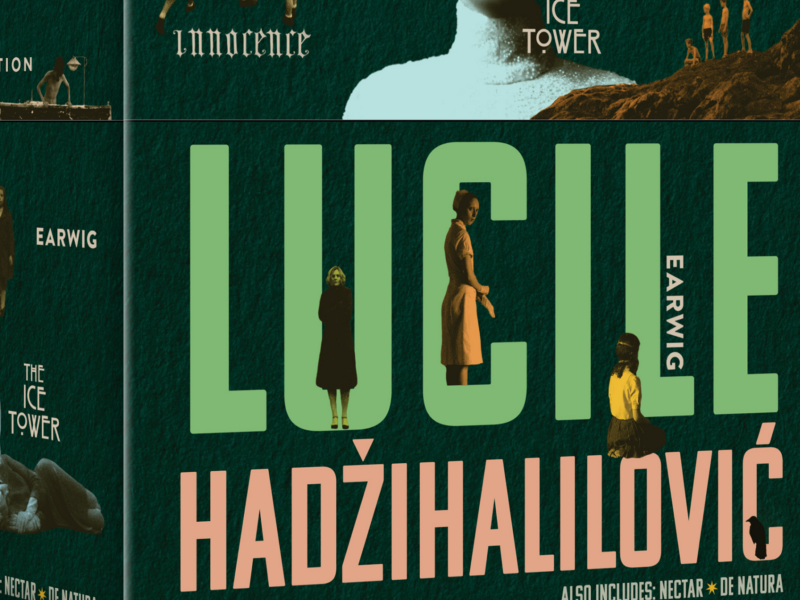
Reviewing Severin’s ‘The Worlds of Lucile Hadžihalilović’ Box Set: Part 1
by Rachel Bellwoar
Those unaccustomed to Lucile Hadžihalilović‘s nightmare worlds where image and sound take precedence over dialogue are in for a treat with this deep dive immersion into her surreal filmography.

Innocence (2004)
If it looks like a child sized coffin, it probably is a child sized coffin and not a coffee table with an unfortunate resemblance to a casket. When that coffin is opened, however, a very alive little girl is lying inside, which would be a relief if it weren’t so deeply concerning.

If viewers aren’t yet used to this approach to a first day orientation, it’s very clear the other girls in this scene are, as Hadžihalilović lets them show rather than tell how this all-girls school operates. All-girls is nearly accurate, too. While a handful of women are around, there are very few adults in general. Instead the older girls are expected to take care of the younger girls in a hierarchy that is clearly delineated by different colored hair ribbons. These ribbons are worn at all times and immediately swapped when a new girl arrives, changing the pecking order. Since there can only be seven girls to a house, though, what happens to the oldest girl when they get replaced? Nobody seems to know for sure. There’s just a constant awareness that everything is temporary and that getting close to people means they’re going to disappear someday (which is true, but also not like this).
Or maybe real life is meant to be unsettling. The question then becomes whether this is really a better way of dealing with the ever looming threat of death — cutting kids off from their peers in an orderly fashion. Writing it out like this there’s almost a cold logic to the school’s set-up but seeing it in action it all feels wrong. It’s just hard to explain why it’s wrong because so little is known about the school and how it functions. Hadžihalilović is a director that puts visuals first, which means there are a lot of narrative questions that never get answered and remain mysterious. It’s easy to suspect that the school might have some Handmaid’s Tale objective in mind (especially since it’s a school for girls) but nothing is ever confirmed. Another problem that Stephen Thrower puts into words in his extremely thoughtful booklet essay is that while the girls bring up rules all the time, it’s unclear why they obey them because what isn’t shown are punishments or consequences for breaking them. If there were punishments, these could be pointed to as evidence that the school is bad. Their absence makes it more difficult to condemn the school or understand why the girls go along with their rules since they outnumber the teachers.
Thrower also brings up the fact that it’s never explained where the school is supposed to be located but to me the bigger problem is “when:” is this a conservative period piece? A dystopian future? How did the girls wind up in the school and why does Iris (Zoé Auclair), the new girl in the coffin, ask about a little brother (proving these kids had lives before they showed up) but never a parent or guardian?
There’s no question that the strict uniformity of the school makes for a striking tableau, but whereas in some of the films in this box set it’s easier to accept the lack of answers, in this film (and maybe it’s because vulnerable kids are involved) those lack of answers add-up and become more frustrating than the powerful images can make up for. I also think (and this is a conclusion I’ve come to after watching all four films in this box set) that Hadžihalilović does her best work when she’s working with original material. Innocence and Earwig are both adapted from books and I ultimately had problems with both of them, namely in Innocence the lack of one point of view character to follow the entire time. Instead the film switches off, starting with Iris, then Alice (Lea Bridarolli), and finally the oldest girl, Bianca (Bérangère Haubruge). It makes all of their stories feel cut off and unsatisfying and by satisfying I don’t mean they have to be happy. Evolution’s ending certainly isn’t happy and leaves a lot unresolved, but I feel like sticking to one girl’s perspective would’ve helped give the film focus and more of a framework for how to think about the school, however accurate or inaccurate their understanding of its rituals.
One thing Innocence can boast is the best use of a grandfather clock since Jean Rollin‘s The Shiver of the Vampires (a film Alexandra Heller-Nicholas references in her visual essay). Severin’s disc also includes two short films by Hadžihalilović – “De Natura” and the longer “Nectar,” which reimagines bees as humans. It would’ve been cool if all of Hadžihalilović’s short films could’ve been included to make this a complete set of her work (so far) but “La Bouche de Jean-Pierre” (listed as “Mimi” on IMDB) is discussed in Alison Taylor‘s booklet essay and “Good Boys Use Condoms” is brought up In Hadžihalilović’s interview with Beatrice Loazya on the The Ice Tower disc. Hadžihalilović provides short introductions to all of the feature films. There’s also an IFC center Q&A between Hadžihalilović and fellow filmmaker Miles Emanuel on Innocence but like all of the IFC center Q&As that appear on this set the sound isn’t perfect and there’s no option to turn on subtitles.
The Worlds of Lucile Hadžihalilović goes on sale June 30th from Severin Films. For my thoughts on the other three films in this box set, be sure to keep an eye out for part 2.


