
Pride Month 2026: An Interview With ‘Queer And How We Got Here’ Author Hazel Newlevant
by Rachel Bellwoar
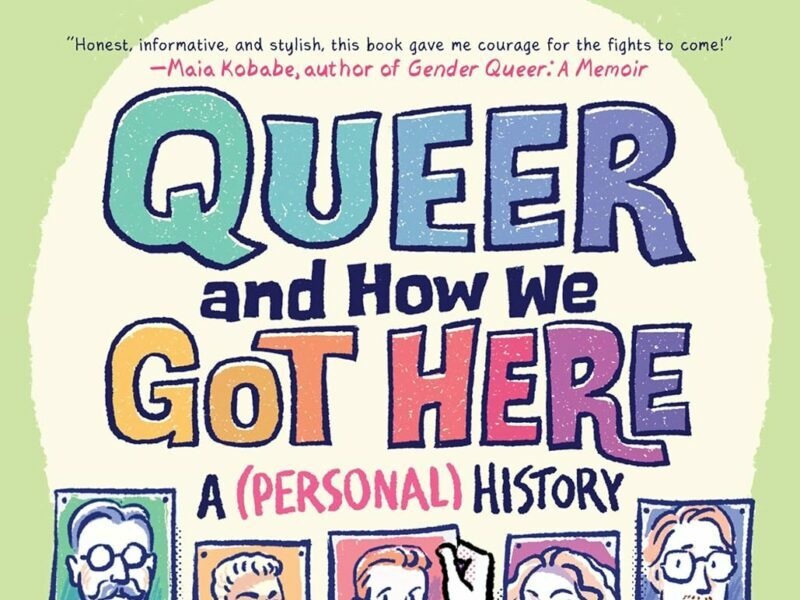
Untangling history can be daunting, which is why books like Hazel Newlevant‘s Queer and How We Got Here: A(Personal) History are a welcome asset. Using personal milestones as a jumping off point to discuss important moments and figures in queer history, here’s what Newlevant had to share about working on this project and how this graphic novel came to be:

Rachel Bellwoar: I think the first time I discovered your work and became a fan was through the brochures you made (and continue to update) with precautions people can take against Covid-19. What do you think it is about the comics medium that makes it such a useful tool for sharing information?
Hazel Newlevant: That’s great to hear. For both my COVID zine and my new book, I combined text, drawings, diagrams, and page layouts in whatever ways get my point across and look pleasing! Each element is efficient for certain things. In Queer and How We Got Here, I relied on text for broad strokes of history, illustrating the parts I could find visual documentation for. By drawing from historical references, I’m conveying a lot of information that I couldn’t even articulate!
Bellwoar: Queer and How We Got Here mixes personal memoir with queer history as a whole. What made you want to combine the two, rather than treat them as separate projects, and did you find one aspect more challenging than the other?
Newlevant: I like drawing personal comics, and that framework guided the research — trying to understand the historical currents that have shaped my own life. Without the history, the memoir would be too much navel-gazing. A lot of my queer experiences have been pretty chill, but they’re more interesting in the context of the struggle that made them possible! The memoir sections hopefully give a personal point of connection to why this history is important, at least in one person’s life.
The history aspect was more challenging, no question. I have to convey a bunch of stuff I didn’t experience, and anyone can fact-check me! Various scholars who read the draft version did fact-check me, so reworking was inherent.
Bellwoar: Over the course of the book you touch on topics ranging from coming out to pronouns to changing ideas around masculinity. How has the process of trying to organize and make sense of all that material been?
Newlevant: Well, I downloaded a lot of books from the Internet Archive, highlighting potentially-relevant stuff as I read. Following the citations lead to more books and academic papers. I watched a lot of documentaries on Kanopy and made PDFs of screenshots. All that got heaped into folders by topic, along with images from sources like the GLBT Historical Society and the Digital Transgender Archive. No great filing techniques. As I was thumbnailing, I made a spreadsheet with sources for every factual assertion, which came out to almost 1,000 lines long! It was crucial to re-check my sources as I was revising the text, to make sure I was still summarizing them accurately.

Bellwoar: In a country that can be binary-obsessed, the general public tends to talk about the transgender community only in terms of trans women and trans men. One of the things you bring up in the book is how much cultural context can affect a person’s perception of what’s possible. With censorship on the rise as well, what do wish more people understood about the larger transgender community, which includes trans masc and trans fem individuals as well?
Newlevant: Everybody should get to determine their own embodiment, and the direction of their physical development, to the best of available technology. Anything less is unthinkably oppressive to the human spirit. That’s the bottom line, connecting trans liberation, reproductive justice, and so much more. Gender roles are historically contingent and often arbitrary, so we should at least get to pick our own!
Bellwoar: I really appreciate how much you platform other books in this graphic novel. Most texts have a works cited but you really acknowledge your sources and give readers starting points for their own research. As someone aware of the impact books can have, how does it feel to know your graphic novel is going to be that beacon for others?
Newlevant: There’s a lot of places within my comic where I celebrate people writing and publishing various books, newspapers, magazines, and pamphlets as historically significant cultural interventions — like The Ladder newsletter creating the first network for lesbian communication, or Our Bodies, Ourselves de-stigmatizing masturbation and abortion. These publications create the very movement archives that I can look back on! As a book and zine maker, naturally I’m biased, but circulating ideas in print is really all that. My hope is that my book will help people be at peace with themselves, and share strategies for positive social change that have worked in the past, because there’s so much to fight for!
Bellwoar: In the acknowledgements you thank the people who helped you with the color palette for this book and it made me realize I had been taking that for granted, so I wanted to ask how you landed on the colors for this book?
Newlevant: The colors are inspired by risograph-printed comics, which use limited palettes of unusual ink colors, instead of traditional CMYK “full color” printing. Queer and How We Got Here is printed with different machines, but also uses distinctive (Pantone) ink colors: navy blue, hot pink, and bright orange. Everything is colored with those three inks at different concentrations. In a few places, I combined inks to make different colors like lavender or dark red — but I mostly forewent overlapping, because I wasn’t sure how it would look in print, and choosing from a small palette really speeds up the coloring process!
Pink and dark blue was the obvious combination, because my hair was bright pink at the time, and the dark blue makes for clear lettering while giving a nice spectrum of color options. It’s giving “gender,” which is apropos. My former housemate Robin Enrico, who’s also a cartoonist, suggested using a different secondary color for the historical sections. That was a great formalist trick to distinguish the historical from the personal, especially when my page layouts are so fluid. I used orange because it packs a similar visual punch to the pink, it looks kinda ’70s, and the lighter tones evoke sepia photographs and old paper.
Bellwoar: Queer and How We Got Here took multiple years to write and some of the obvious addendums that had to be made due to changing legislation, like Roe vs. Wade being overturned and the setbacks regarding gender markers on passports, are depressing as anything. Is there anything that gives you encouragement in 2026?
Newlevant: Since 2020, when I started working on my book, the scientific understanding of disease transmission has majorly advanced. After many decades of misunderstanding, it’s become unambiguous that most (possibly all) respiratory diseases are transmitted by respiratory aerosols, and transmission can be prevented with proper ventilation and air filtration. A respirator mask is an air filter for your face! I fuck with the people who are putting this knowledge into action. It’s like gay people creating new norms for condom use, once HIV transmission was understood. I’ve been organizing masks-required book events, and I like to say we’re “queering the intimacy” of sharing air by using protection.
Restrictions on gender-affirming and reproductive care mean we need to wrest these tools from the medical establishment. One of my favorite podcasts, Death Panel, has been releasing great interviews with mutual aid organizers recently, and that’s something I look to for contemporary inspiration.
Bellwoar: Thanks for agreeing to this interview, Hazel!
Queer and How We Got Here: A (Personal) History is on sale now from Little Brown Ink.

