
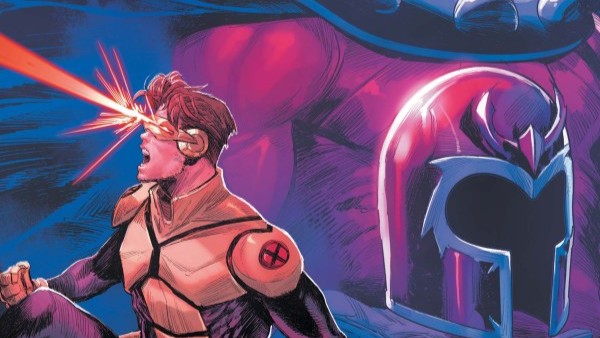
Previously On X-Men: Hurrah For Science In ‘X-Men’ #32
by Austin Gorton
It’s another aggressively fine week for the X-books, with nothing terrible but nothing terribly good, either, as the consistently better books (X-Men, Moonstar) are mostly just putting in the work in service of their current stories.
Generation X-23 #5

By Jody Houser, Marco Renna, Erick Arciniega, & Ariana Maher
X-80 returns to help Laura rescue the Generated from X-Infinite.
- With her red hair and quasi-poncho, X-80 gives off serious Hope Summers vibes.
- X-80 tells Laura that X-Infinite is the one she wanted her to save, saying, “he was the one I wanted you to save.” This is presumably a reference to their interaction in issue #1, except that hasn’t happened for X-80 yet, and in that instance, she said, “you can save them” not “he.”
- I like that in an effort to apparently seem more grown-up after he led the Generated uprising, X-Infinite gave himself a mohawk.
- There’s moments here where Renna’s art seems reminiscent of middle stage Jim Calafiore, especially in his figures.
A reasonable enough conclusion to the first arc, which answers some questions and confirms X-Infinite as a suitable and sympathetic antagonist for Laura. But with all the characters still generically named and largely lacking personality, it’s hard to see how this makes it past a second arc. I’m frankly stunned it’s getting one based on reports of its sales.
Moonstar #4

By Ashley Allen, Edoardo Audino, Arthur Hesli & Clayton Cowles.
Dani settles on a plan of attack to stop Kyron and save her parents.
- I’m still not sure I buy Dani’s dilemma given that if she doesn’t stop Kyron her parents will die anyway, but she thankfully moves past it pretty fast.
- There’s something weird about Dani referring to Brightwind as a “Pegasus” when Brightwind is a creature from the Norse pantheon and “Pegasus” is a distinctly Greek name, but I also have no better term for it.
- Audino does a nice job with the zombie animals.
Dani’s entire plan being undone by the fact that the MacGuffin tablet is now too big to carry and stuck in the ground is a fun twist on which to head into the finale.
Wolverine #22

By Saladin Ahmed, Julius Ohta, Jesus Aburtov & Cory Petit
Wolverine seeks medical help for his failing healing factor from the only doctor the X-Men know.
- Wolverine’s metal skeleton killing him without his healing factor to perpetually fight is a long-established thing, though other characters (like Bullseye and Cyber) with adamantium implants and no healing factor have always long seemed able to handle it fine.
- Cecilia Reyes was first introduced back in “Operation: Zero Tolerance” in 1997 and as mostly existed since as either the X-Men’s go-to medical expert and/or a reluctant member of the team. She last appeared in the abysmal Mark Russell X-Factor series as part of “From the Ashes,” where her throwing in with the corporate and government backed iteration of the team was never really addressed.
- Her reference to having previously treated a healing factor-less Wolverine is presumably a reference to the 2013-14 Paul Cornell run on Wolverine; she was shown to be treating him in Nightcrawler (vol. 4) #1 around that time.
- She is working out the Our Mother of Mercy Hospital, which is where she worked in her first appearances (of course, it’s since been tricked out with all kinds of gear for treating mutants by Sunspot, as revealed here).
- Puck fought against Wolverine as part of Alpha Flight earlier in this volume, but the pair have a long history together (dating back to the 1930s), so it makes sense Wolverine would reach out to him of all the various current Alpha Flight members.
- Taskmaster is a longstanding villain-for-hire, introduced as the person who trained the hired goons for other super-villains thanks to his memetic abilities. He had a stint as supporting character in Deadpool’s solo series, but otherwise doesn’t have a huge history with the X-Men.
- This issue does that thing where Wolverine very clearly meant to kill Taskmaster, because Taskmaster would have died if not for the healing factor Wolverine didn’t know he had, even though, in any other story, Wolverine tends to avoid killing his foes unless absolutely necessary.
Wolverine having his healing factor siphoned off rather than suppressed or eliminated is at least a minor riff on the whole “Wolverine is mortal” trope, but we’ll see where this goes. I’m really not loving the whole “Department H as the militant arm of a fascist anti-mutant Canadian government” status quo that is a recurring feature of this series (and elsewhere in the X-books), so I’m hoping the real culprit turns out to be something more than that again.
X-Men #32

By Jed MacKay, Tony Daniel, Mark Morales, Fer Sifuentes-Sujo & Clayton Cowles
Beast and his science team battle Department H while trying to save Schwartzchild.
- Beast similarly injected Magneto with Dextroamphetamine-X to restore his powers in issue #16.
- Kid Omega dismantled Ben’s psychic defenses in issue #5 and repurposed them to use against Professor X in #13, both which are rightly footnoted in this issue.
- Xorn’s ability to sense recent deaths nearby is an established bit of his power set.
- Per Tom Brevoort on the letters page, Jean Grey will be appearing in this series at some point in the near future.
Standard middle chapter stuff, with this issue suggesting MacKay may be subtly using this story as a vehicle to compare/contrast Beast and the Chairman (with Beast here taking command of his team effectively, echoing the Chairman’s ability to bend the rest of 3K to his will and goals). Still trying to wrap my head around Daniel’s art as well, which is much slicker and at times almost more cartoony than I remember. It’s not bad (and pairs well with Netho Diaz as the A/B artists of the book), but almost feels like a completely different artist than in the past.
X-Men: Outback #1

By Steve Orlando, Stephen Segovia, Alex Sinclair & Joe Sabino.
The X-Men are adjusting to their new status living in Australia and being dead to the world when Sabretooth attacks.
- Apparently the intent is to have at least one nostalgia series on the slate at all times; with Psylocke: Ninja wrapped, this steps into that slot.
- The narrator here is presumably Mojo, given the references to holes in his schedule caused by the apparent death of the X-Men.
- For a series set in a specific era of X-Men history, this issue is embarrassingly-short on footnotes. The Outback Era is fairly well-known and beloved, but just in case: the X-Men died fighting the Adversary, in a battle broadcast on national TV, and then were resurrected by Roma (daughter of Merlin, who is referenced but not named in this issue) in Uncanny X-Men #227, the climax to that series’ contribution to the linewide “Fall of the Mutants” event. With the world believing them dead, the X-Men decided to maintain the ruse so could strike at their enemies and protect their friends and family from reprisals with more freedom (an idea Storm first floated for the team back in Uncanny X-Men #219), aided by the fact that Roma had made them invisible to detection to all forms of electronic surveillance (basically anything other than the naked eye), which is why Dazzler is particularly cross in this issue (the “invisible to electronics” bit is one of those things that never actually got resolved; it just quietly got ignored after Chris Claremont left the X-Men the first time and no one has ever bothered to explain what happened to it).
- In Uncanny X-Men #229, Roma directed the X-Men to the Reavers, a group of cybernetically-enhanced bank robbers who operated out of an abandoned town in the Australian Outback. The X-Men rousted them, taking the town for their own base of operations, and adopting (or being adopted by) the Reavers’ Aboriginal teleporter, Gateway, enabling them to flit all over the world with ease. Thus, the Outback Era began (which is more or less the point at which this issue picks up).
- Sabretooth’s habit of stalking Wolverine on his birthday was first established in the backup story in Classic X-Men #3; the backstory referenced here involving Silver Fox was first revealed in Wolverine (vol. 2) #10.
- The idea that Sabretooth realized the X-Men (or at least Wolverine) were still alive because he found a fresh hair/scent at the cabin is simply wrong, however, as Wolverine had no memory of the cabin or his relationship with Silver Fox until after the Outback Era — this is the kind of continuity mistake that was all too common in Orlando’s X-Men Infinity comic.
- Dazzler and Rogue did indeed argue over Longshot’s affections a bit in this era, but never was it quite as historonic as Orlando presents it here.
- Similarly, Dazzler chaffing at the limitations on her career as a singer brought on by the X-Men being dead in the eyes of the world and invisible to all recording devices is a recurring thread during the Outback Era, but she handles it better in the original stories, with a hard-fought acceptance of the importance of being one of the X-Men, than what is presented here.
- Orlando’s Longshot voice is also off, lacking the childlike alien-ness that Claremont brought to it. Longshot also says that he’s lived rougher than in the Outback, but Longshot at this time had no memories of his life prior to when he dropped into the X-Men’s Danger Room in X-Men Annual #10 (he would eventually leave the team during the Outback Era specifically to try and restore his missing memories).
- At this point Colossus is unable to transform into his human form as a result of injuries he sustained in the “Mutant Massacre” crossover.
- Having Storm and Wolverine meet up in a nearby town kinda undermines the whole point of the X-Men living on their own away from the “regular” world.
- Storm mentions Jessan Hoan having suffered just from knowing the X-Men, which is another classic Orlando “almost right, but quite” continuity reference. Jessan was a banker kidnapped by the Reavers in Uncanny X-Men #229. They were in the process of turning her evil via cybernetics (comics!) when the X-Men arrived and interrupted the process. She would go on to become Tyger Tiger, one of the crime bosses in Madripoor, but regardless, her being targeted by the Reavers in the first place predates any interaction with the X-Men.
- On the one hand, I appreciate Orlando making the effort to establish Sabretooth needed outside help to track down Wolverine and the X-Men. On the other hand, Sinister’s weird Warg/dire wolf dog things are dumb.
- Similarly, Sabretooth tracking down the X-Men via any means is dumb, but at least Orlando did the mindwipe thing so it doesn’t break established narrative continuity.
- Storm’s new costume that she dons here originally debuted in Uncanny X-Men #230, and given that Orlando seems to be presenting the origin of that look here, we can safely assume this issue takes place between Uncanny #229 and #230 (which mostly works for it).
- I like Segovia’s art, but it feels a little less impactful here compared to Hellions (his last X-work), with a bit of Edoardo Audino-style manga eyes on display.
Putting aside the broader issues with Marvel’s obsession with nostalgia series, there’s nothing inherently wrong with revisiting the Outback Era, a unique time for the series with enough nooks and crannies between stories to explore and an interesting mix of characters. That said, having the first issue of the series involve the X-Men being discovered by one of their old enemies, when the whole point of the era is that they’re off the grid and unable to be found, doesn’t seem like a smart way to kick it off (even if Sabretooth’s discovery is mind-wiped away). Orlando also seems to already be struggling in terms of hitting the correct pitch and timber for certain character voices in this era (frankly, Russell Dauterman nails it better on the cover, via a single image, with no dialogue or narration) on top of his usual loose adherence to establishing continuity, which doesn’t bode well for the rest of a series set in a very specific time and with a very specific iteration of the X-Men.

