
Fire & Blood Files: On Matters Of Heirs & Manderlys
by Austin Gorton
**Spoilers follow for House of the Dragon Season 3 Episode 3 “Rhaenrya Triumphant,” and the series in general.**
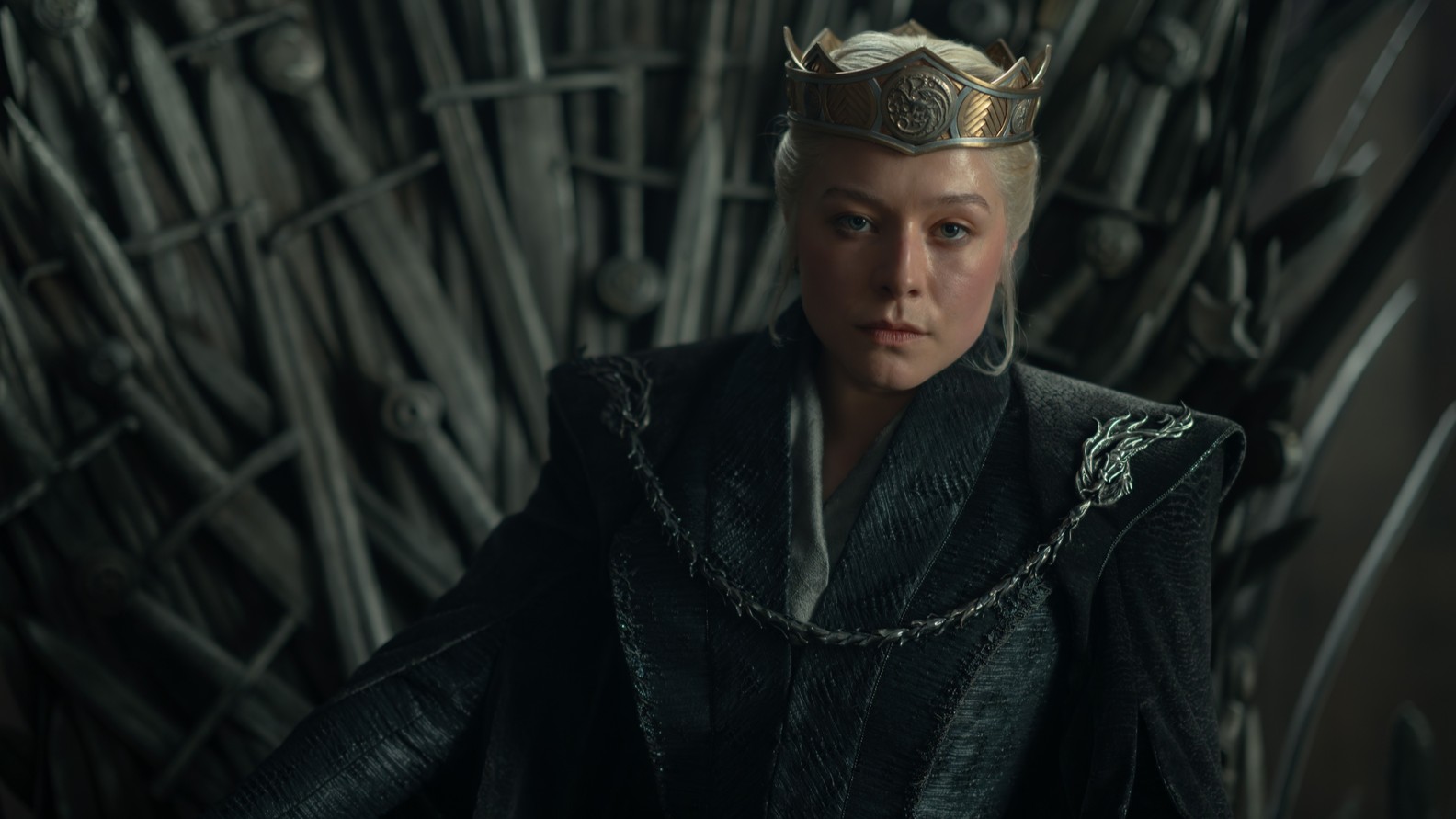
The third episode of House of the Dragon‘s third season, “Rhaenyra Triumphant,” is one of the series’ best. An atypical “slice of life” built around the idea of being careful what you wish for, in which the performances, script, score and sound design are all working in tandem with one another to capture the frustration of a woman who finally achieved her overarching dream in life only to find herself abidingly annoyed by the realities of that dream.
As such, it’s relatively light on plot developments and fun little nuggets of lore to explore, but along the way, two items of note are highlighted briefly which deserve a bit of closer examination: the question of Rhaenyra’s (Emma D’Arcy) current line of succession and the introduction of one of Westeros’ notable families that has heretofore been absent from television adaptations in the form Dan Fogler‘s Torrhen Manderly.

Though Rhaenrya succeeded in claiming the Iron Throne in the previous episode, that victory came in the wake of one of her worst losses, the death of her firstborn son and heir, Jacaerys (Harry Collett), Prince of Dragonstone, during the Battle of the Gullet. This after having lost her second-born son Lucerys (Elliot Grihault) at the end of season one, after Vhaegar went all chomp-chomp on Luke and his relatively tiny dragon.
As Rhaenyra mentions briefly in “Rhaenyra Triumphant,” that means her current heir and next in line for the Iron Throne is her thirdborn son, Joffrey (Oscar Eskinazi). The last of her children by Laenor Velaryon (John Macmillan) (or Harwin Strong (Ryan Corr), depending on who you ask/how much you value your tongue), Joffrrey has only appeared in three episodes by an actor capable of speaking (Season 1’s “The Princess and the Queen,” the first time-jump episodes, opens with his birth). He last appeared in the sixth episode of season two, “Smallfolk,” having been sent to the Vale for protection in the care of his half-sister Rhaena (Phoebe Campbell).
In Fire & Blood, Joffrey is a bit older (as with many of the younger kids, Joffrey suffers from the show’s decision to shave roughly a decade off the timeline relative to the events as chronicled in the book), and remains with his family on Dragonstone, eventually joining Rhaenrya in King’s Landing as her heir and playing an important – if tragic – role in the later storming of the Dragonpit and the general dying of the dragons. While the show is making some significant adaptive changes to the plotline involving Rhaena and the Vale, Joffrey’s presence in King’s Landing – both for narrative purposes and for the logic inherent in his elevation from “spare” to heir in the wake of Jace’s death – seems critical, suggesting we may soon see the follow-up to Rhaenyra’s command in “Rhaenyra Triumphant” to fetch him from the Vale.

Of course, Joffrey isn’t Rhaenyra’s last son. She also has two even younger boys by Daemon (Matt Smith), Aegon (not confusing at all George R. R. Martin, no notes) and Viserys. Like Joffrey, they were sent in the care of Rhaena to the Vale last season, and were last seen in “The Red Sowing” departing the Vale with a retinue of House Arryn guards (and Rhaena, but she peaced out pretty quick to try and rundown Sheepstealer) on their way to the merchant cog Gay Abandon, which was to take them across the Narrow Sea to Essos for the duration of the war. In Fire & Blood, the Gay Abandon gets caught up in the Battle of the Gullet, with significant things happening to both kids as a result. And like Joffrey, their ages as presented in the show (both are essentially toddlers, if that, at this point) limit what events they could realistically participate in, such that the entire plotline involving the Gay Abandon in the Battle of the Gullett was, well, abandoned by the creators.
In the book, in the aftermath of the Gullet, Aegon is still with Rhaenyra on Dragonstone and joins her, along with Joffrey (who, again in the book, never goes to the Vale in the first place) in King’s Landing shortly after she claims the throne. Like Joffrey, both Aegon and Viserys have notable roles to play in the history of Westeros down the road. While much of that comes in, essentially, the epilogue to the Dance of Dragons (and thus, is unlikely to be adapted in House of the Dragon), there’s some significant stuff involving Aegon in particular that absolutely has to happen to maintain even a modicum of adherence to the existing history as laid out in the source material, and that stuff requires him to be at Rhaenyra’s side. Which means however the showrunners are rejiggering Aegon and Viserys’ “Gay Abandon plot,” they’re going to need to show their hand soon.

As for Torrhen Manderly, the somewhat corpulent (George’s word, not mine) lord who speaks admiringly to Rhaenyra in the wake of her “feed the nobles rats while raiding their secret stashes at home” banquet (and also takes care to remind her that it was her earlier strategic blockage of the city that caused many of the food problems she’s now dealing with), he represents the introduction of a notable House that has yet to have any of its members appear in any of HBO’s Game of Thrones series. At the time of House of the Dragon, the Manderlys hail from the North. They are the masters of White Harbor, the largest city and port in the North (though the smallest of Westeros’ five major cities) and are a rare Northern house that worships the Faith of the Seven over the old gods.
That is because the Manderlys originated in the south, specifically the Reach, the southwestern chunk of Westeros once ruled by the Gardeners (before Aegon the Conqueror defeated them and raised up their stewards the Tyrells as the Wardens of the South and Lords Paramount of the Mander). During the Gardener’s time as the pre-Conquest rulers of the Kingdom of the Reach, House Manderly (whose name comes from the proximity of Dustonbury, their original seat of power, to the Mander river – or, according to some Manderlys, the river’s name comes from its proximity to their seat of power) was a ferocious rival of House Peake, and when House Manderly overreached after a protracted regional war with the Peakes, the Peakes convinced the Gardner king to exile the Manderlys. The exiled house was welcomed in the North, and using the wealth they took with them from the south, built and developed White Harbor, including their new seat at the New Castle, built to resemble Dustonbury.
Though Torrhen Manderly is the first Manderly to make it into a Game of Thrones TV series, in the novels, they play roles in several notable events. Torrhen himself will factor in later in the Dance (similar to Rhaenrya’s Aegon, that comes well after the point in time I would have expected the series to wrap, making the casting of Torrhen here something of a surprise). In the Game of Thrones era, as bannermen of the Starks, they fought in Robert’s Rebellion and later joined Robb Stark’s doomed army. They are part of a local inheritance dispute that inadvertently gives cover to the Boltons treachery, and after the Red Wedding (during which Wendel Manderly dies) they fake reconciliation with the Iron Throne and fealty to the Boltons as the new Wardens of the North as cover for their efforts to unite disaffected Northern lords against the Boltons and the Freys. In the books, it is the Manderlys who execute some measure of revenge for the Red Wedding by feeding a gathering of Freys pies made from…other Freys – a revenge plot the TV show instead has Arya (Maisie Williams) carry out.

Taken together, the recollection of Joffrey and the introduction of Torrhen Manderly in “Rhanerya Triumphant” are both, to keen viewers, seeds presumably being planted for future plotlines. And while Joffrey specifically and Rhaenrya’s line of succession more broadly will undoubtably have key roles in the story, the insertion of Torrhen into the story not only represents a “make good” of sorts for a house that’s been squeezed out of the TV adaptations until now, it also suggests the possibility of a longer narrative endgame for the series.