
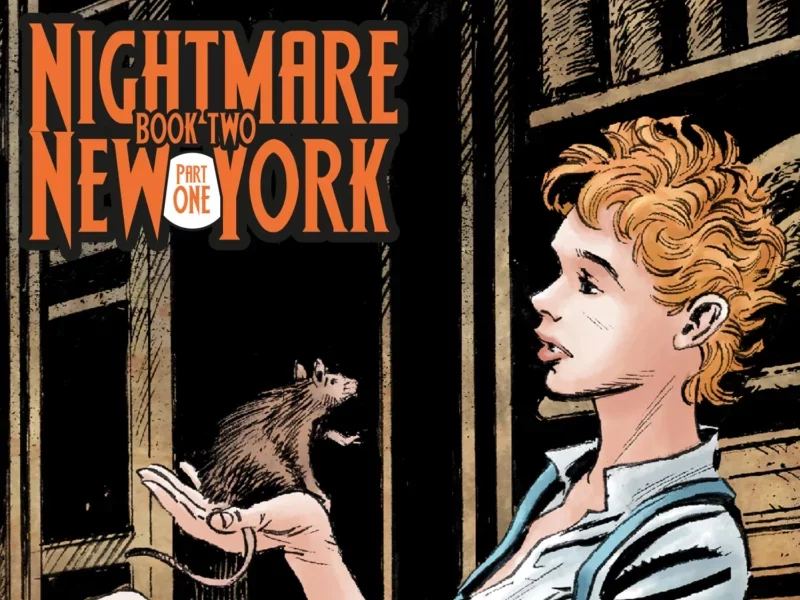
Walking The Crooked Lanes And Talking 2000 AD’s ‘Nightmare New York’ With Kek-W And Dave Roach
by Rachel Bellwoar
The last time we saw Lil (in Prog 2456), she was in Paris but that was 1899. Book 2 of writer Kek-W and artist DaveRoach‘s Nightmare New York begins in 1845 and Lil is still in New York, trying to get used to her new powers. With colors by Jim Boswell and letters by Annie Parkhouse, here’s what Kek-W and Roach could share about the new story arc and the real history behind it:

Rachel Bellwoar: For new readers, what’s the general concept of Nightmare New York?
Kek-W: Nightmare New York is set in the New York of 1845. The first series began with homeless street urchin Lil, who had just turned 18, trying to survive on the mean streets of The Five Points, one of the city’s most violent districts. Lil falls foul of Sammy McGloin, a vicious “bonebreaker” for the notorious Slaughterhouse Boys gang.
She is rescued by Jimmy Blind, the sightless, ageing King of the Ragpickers. British-born Jimmy is marked with a sigil, similar to one on the arm of sceptical Lil. He claims their sigils are magical in origin and offers to mentor her. Lil tries to flee The Points, but finds herself magically imprisoned within its streets, hunted by the Slaughterhouse Boys and by her estranged father, the corrupt Mayor of New York. It seems that Lil’s father had sold his own daughter’s soul to his demonic patron, Moloch, in return for wealth and power.
And now, on Lil’s 18th birthday, Moloch is stirring beneath The Five Points, eager to collect his debt…
David Roach: It started off as one thing — a sort of runaway in the big city in old New York — and then has sort of morphed into more of a coming of age sort of story as Lil begins to understand her powers more. But very, very weird!

Rachel Bellwoar: It makes sense for a series called Nightmare New York to take place in New York, but New York is a big city. Why did you choose to set Book 2 in the Bowery?
Roach: I direct you to Mister W … we always chat about the strip and where it might go, and then his mind just goes off in all sorts of unusual directions. I think he just can’t help himself!
Kek-W: As Lil was travelling on foot, it made sense to have the next location somewhere that was in walking distance of The Five Points. As I started delving into the history of The Bowery, all sorts of interesting material started emerging: background stuff about the Bowery Boys and the Bowery Theatre started feeding into the story, so that the locale started becoming a character in its own right.
As a journalist and critic, Edgar Allen Poe reviewed at least one dramatic play shown at the Bowery Theatre in the mid-1840s, possibly more, so his cameo in the one-off NNY tale “Hard Times” is loosely based in fact. As were the Bowery “b’hoys” and “g’hals”, who were the Irish street Dandy-Punks of the 1840s. The fire-boy, Mose Humphrey, is based on a popular folkloric Bowery b’hoy character played by actor, Frank Chanfrau.
The role was a huge New York theatre hit in the 1840s, attracting a massive working-class (and gang member!) following. Chanfrau later became director of the Bowery Theatre. All this ephemera helped form the spine of the one-off story and the second series.
There’s some interesting stuff here and here on it.
Bellwoar: What has the research process been like, in terms of capturing the mid-19th century when this series is set?
Kek-W: As is probably evident from above, research generally forms the core of a series, or at least provides me with some sort of map or ‘shape’ for it. Mostly I use it as an “ideas capture” process, which then often leads me directly into the creation or design of key characters, or even specific scenes within the story. The first series originated with an email from editor Matt Smith, asking if I could create a new strip suitable for artist John M. Burns. It was fairly vague, suggesting only that I avoided Science Fiction as he had enough SF strips at that time. From collaborating with John, I knew he loved illustrating historical material and had a great flair for it.
I’m not sure how my brain linked The Five Points district of 19th century New York with an occult pentagram, but that was literally my starting point. It would be an Historical Horror series, I decided. I then started reading up on the streets and landmarks of that area (many of which are now long-gone), its characters and lore. The fact that The Points had been shoddily built on the old Collect Pond, which had never been properly filled in so that buildings would sometimes just randomly collapse down into the mud and sewage, stuck with me and eventually became a scene. The Middle Classes soon fled the area, leaving it mired in filth and poverty, run by criminals and political bosses. Hundreds of people would often be crammed into a single building that might then fall into stinking sinkholes, burying many of them alive. Horror was a constant companion for inhabitants of The Points.
It quickly became obvious that the Horror of Poverty was one of the series’ themes — that death and grinding misery aren’t just caused by demons. Moloch was a bull-headed demon whose worshippers sacrificed their babies at his fiery altar in return for good fortune and wealth. Moloch struck me as the perfect symbolic patron for Lil’s father and his elitist 19th-century “one-percent” cronies. It started me thinking about The Bull of Wall Street, “Bull markets”, etc. From all that sprung Lil’s backstory — her horrible, demon-worshipping parents, the privileged background she was forced to flee, etc. Lil then becomes our guide to the mean, poverty-stricken streets of 1845 New York, a place where magic and horror can be found in every alleyway.
Roach: Really intensive on my part as well, researching buildings, clothes, settings, characters, mystical signs, Fetish statues, angels, devils… you name it. Luckily there are some photos and engravings from around the mid-19th century so that’s a great help. In one panel I drew a pig lurking in an alleyway after seeing several pigs in engravings from that time. Yes, there were farm animals in Manhattan, way back when!
Kek-W: Oh, one more thing: the magicians, James Murrell (“Jimmy Blind”) and The Black Constable, John Domingo, are both based on historical, larger-than-life occultists who have both become semi-folkloric, almost mythical characters. Murrell was an English hedge magician, a “cunning man” as they are known in the UK, who lived in rural 19th century Essex, England. Cunning men were said to walk “the Crooked Lanes” — magical pathways that are threaded through the physical world that only they could see or travel. Jimmy and now Lil both have that ability. Murrell allegedly wore iron goggles in real life, so I suggested to John that we leaned into that visually.
Ragpickers Court — where Jimmy and the outcast Ragpickers live — was a real location on Mulberry Street in the Five Points, and we used old illustrated references to create our fictional version. Same with the Old Brewery, etc. I use research, but I’m not a stickler for it. If characters or events in NNY are a year or two out from the real world, I’m not going to lose sleep over it. I use research primarily to create a flavour and a vibe for stories — a layer of verisimilitude — I’m not rigidly straitjacketed by it. Think of the process as creating a parallel timeline. Actual history is usually far stranger than anything I could write!

Bellwoar: Now that she’s inherited more abilities from the other Five Points guardians, what’s next for Lil?
Kek-W: New enemies, new allies, new demons, bizarre new occult threats and more glimpses of strange old New York. Oh, and possibly even a romantic interest? Lil may have gained new occult abilities, but she struggles to control them. Her biggest battles may turn out to be with herself.
Bellwoar: Each of the guardians has a different sigil on their skin. How did you come up with the designs for these sigils?
Roach: There are two different sets that we’ve used so far, all taken from existing folklore. In Book two, we’re using the Elements, which Kek suggested, which we then assigned to various characters in the series. Sometimes, as in that case, the strip almost has a life of its own, and as we thought about who might have these signs, and how they might suggest certain powers, histories or personalities, the episodes evolved in all sorts of unexpected ways. I really love the collaborative element of all that.
Kek-W: The sigil and character designs for the first series were mostly done by the legendary British illustrator John M. Burns, who I’d worked with for a decade or so. My initial research references were early Pythagorean pentagrams and The Seal of Solomon, so the glyphs were generally Greek or Hebrew in origin. But, as John pointed out, many looked quite similar to one another, so we started creating our own new, distinctive ones for the different characters.
John had to retire due to ill health after the initial episodes, but was emphatic that the series continued on without him. I suggested David Roach as a possible successor as he was a huge fan of John’s work, a comic-book scholar and a superb artist in his own right. David was the only artist I could think of who would truly honour John’s work and make the transition feel smooth and organic. John then worked with David, providing him with copies of the art for the early completed episodes, and his rough pencil breakdowns for some unfinished pages. The sigil and character designs for the second half of the first series, and from then on, are David’s, though there is regular email traffic between us both, discussing all sorts of different visual and character aspects of the strip, swapping of reference material, research, etc.
John coloured his own work, but we were very fortunate to be able to get the amazing Peter Doherty on board as colour artist. Peter’s colour palettes are subtle and beautifully evocative of old New York. He and David are a wonderful, synergistic pairing, a great team. John, of course, sadly passed a few months later after retiring. He was a huge talent, an artistic giant, and a lovely man. I still feel his loss very keenly. It was an honour and a delight to have known and worked with him.
Bellwoar: Lil might not have the best relationship with her parents but she’s starting to pick up some allies. Can you speak a little on the other characters readers will get to meet or know better in Book 2?
Kek-W: Lil now works at a bakery in the Bowery owned by a Hungarian immigrant couple, Stefania Fodor and her brother, Gyorg. She stumbled into the Fodors’ life, feverish and exhausted by the events in the first series, in the one-off interim episode, “Hard Times”. Madame Fodor seems kind and caring, almost maternal, but Gyorg the baker really doesn’t seem to like Lil.
Given that no one in Nightmare New York is quite what they seem to be — the good guys turn out to be unreliable or treacherous, while villains sometimes do the right thing for the wrong reasons — it begs the question: what are the Fodors hiding? Lil has been lied to and betrayed all her life; she has serious trust issues — and can you blame her? Her parents conceived her in an occult ritual and used their own daughter as collateral in a demonic transaction. Lil not only has to master her newfound abilities, but must also find a way to trust people and build new relationships. It’s not going to be easy.
Roach: We have some really interesting characters in book two- particularly a brother and sister who really aren’t what they first appear to be. A warning though, don’t get too attached to anybody because they might not survive to the end of the strip. Sometimes even I’ve been shocked!

Bellwoar: If you could tap into the powers of one of the Five Points guardians, whose powers would you choose?
Roach: Lil’s power to turn intangible and float through solid objects would be pretty mind-blowing, I’d say!
Kek-W: I would choose the ability to walk The Crooked Lanes — those strange tunnels, paths and roads that wind in and out of reality. But I think that many of us — writers, artists, the neurodivergent, etc — already have that talent.
We see the world from a slightly different angle to others — as did our ancestors. The everyday and the banal open up and reveal themselves to us differently to many people. The Surrealists and the Situationists called this the dérive — the practice of drifting through a city or landscape in a dream-like or delirious state of mind, exploring, seeing it with fresh, open eyes. 200 years ago, Charles Baudelaire spoke of the flâneur — someone who strolls through a city in a languid daze. Nowadays, we’d probably call it psychogeography. Walking The Crooked Lanes like Lil is able to (with Selene the rat as her guide) means that the world constantly renews and refreshes itself for you.
That you can escape horror and mundanity just through the power of your imagination — through ‘magic’. That seems like a pretty useful power to have.
Bellwoar: Thanks for agreeing to this interview, Kek-W and David!
Book 2 of Nightmare New York started in 2000 AD Prog 2488.


