
Fire & Blood Files: Why Are The Hightowers So High On Their Own Supply?
by Austin Gorton
By the end of “Tumbleton”, we’ve reached the halfway point of House of the Dragon‘s third season. Yet given the way the season is constructed, with the first two episodes playing like the final two episodes of the previous season, the show is still, to some extent, in setup mode.
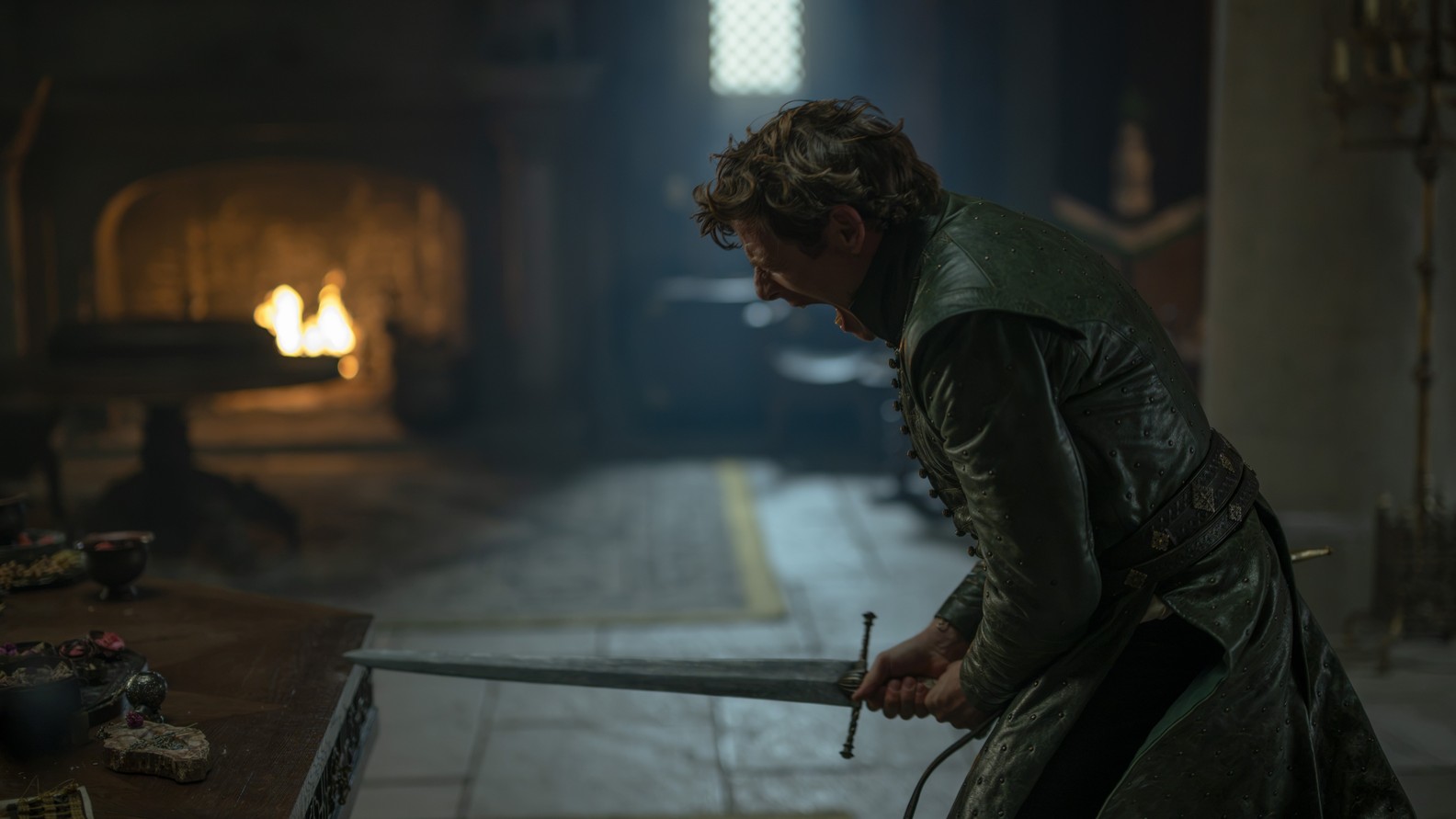
To wit, amongst all the business being accomplished in “Tumbleton,” its chief aim is to provide a proper introduction to Ormund Hightower (James Norton) and position him as the antagonist of the season. As the head of both the largest force opposing Rhaenyra (Emma D’Arcy) and the head of House Hightower, he also represents the show’s best window into the Hightowers – a window through which we see in “Tumbleton” the house’s defining characteristics of superiority, piety and anti-Targaryen fervor in a zealous new light.
All of which begs the question – especially because the Hightowers are largely absent from the later Game of Thrones narrative – why are they so full of themselves, what do they actually believe, and what happens to them?

At the time of House of the Dragon, the Hightowers are considered an “overreaching” or “upjumped” House – they are not not the Wardens of the South, the Lords of the Reach, or the Lords Paramount of the Mander, all titles belonging to House Tyrell, to whom the Hightowers are technically vassals.
Yet as masters of Oldtown, the largest and richest city in Westeros, they wield significant power in their own right. An ancient house, their origins are considered by some to predate the arrival even of the First Men, to say nothing of the later Andals and Targaryens. In the old days, they were often attacked by the Kings of the Reach, House Gardener of Highgarden, and were only brought into the Kingdom of the Reach via marriage (as opposed to being conquered).
They smartly allied with the Andals when they showed up, allowing the Hightowers to maintain their monetary and political capital. Similarly, when Aegon the Conqueror arrived, they held back while House Gardner opposed the Targaryen overlord. As result, though the Hightowers remained a vassal state to the new Lords of the Reach — the Gardners one-time stewards, the Tyrells — after Aegon and his sister-wives decimated the Gardner-Lannister alliance at the Field of Fire, they maintained their relative regional dominance in the new Targaryen Westeros.
A lineage stretching back to the earliest days of Westerosi civilization, massive wealth thanks to their command of the continent’s largest port, and a knack for political survival is enough to make the Hightowers pretty full of themselves. But as the Lord and Defenders of Oldtown, the Hightowers also oversee the seats of knowledge and faith in Westeros.
Both the Citadel, home of the Conclave and the location where maesters are trained, and the Starry Sept, seat of the High Septon and the center of the Faith of the Seven, both reside within Oldtown (it’s basically like if Oxford University and Vatican were both located in one city, though the seat of the Church of the Seven would later move to the Sept of Baelor – the building Cersei (Lena Headey) blew up – after its construction in King’s Landing under Baelor I).
As such, the Hightowers are generally learned and deeply religious, with a sense that their roles as defenders of the seat of religious power in Westeros gives them a mandate to defend that religion everywhere. While, at the time of House of the Dragon, the Targaryens are masters of political body of Westeros (backed by the power of their dragons), the Hightowers can effectively make the case that they are the masters of the realm’s two other most important institutions, the maesters and the Faith of the Seven.

All of which makes Ormund, as presented in “Tumbleton,” the perfect avatar of the Hightowers: a well-read, intelligent lord with a religious piety and desire to spread and protect that faith to a zealous degree, and someone not afraid to challenge the might of the Targaryens for both political and religious reasons. And yet, for all their power, in the grand scheme of the broader “A Song of Ice and Fire” narrative, the Hightowers largely disappear from Westeros history after the “Dance of Dragons.”
Even without getting into spoilers regarding the fates of specific Hightowers in House of the Dragon (which I won’t be doing here), it’s clear their power dwindles at some point after the events of the TV series. Otto Hightower (Rhys Ifans) was Hand to three kings (Jaehaerys I, Viserys I and Aegon II (Tom Glyn-Carney)); his daughter queen to Viserys and the Dowager Queen of Aegon II. When the Reach rallies to the side of Alicent Hightower’s (Olivia Cooke) son Aegon in the civil war, they are led not by their liege lords the Tyrells, but by the Hightowers (to be fair, this has as much to do with the fact that the head of House Tyrell at the time is a baby so the house chose to stay neutral, but still).
Yet by the events of Game of Thrones, the Hightowers are not one of the major players, either in Robert’s Rebellion which overthrows the Targaryen dynasty or in the War of the Five Kings and its aftermath that follows Robert Baratheon’s death a generation later.
There are certainly Hightowers around, laced throughout those stories: Ser Gerold Hightower is Lord Commander of Aerys the Mad King’s Kingsguard, and one of the knights present at the Tower of Joy, protecting Lyanna Stark as she secretly gives birth to a new Targaryen heir (aka the future Jon Snow (Kit Harrington)). Margaery Tyrell’s (Natalie Dormer) mother is a Hightower. Jorah Mormont’s (Iain Glen) second wife, the one whose lavish tastes led to his exile in Essos and to whom, in A Clash of Kings, Jorah compared in appearance Daenerys Targaryen (Emilia Clarke), was a Hightower. But these are all tertiary characters (at best), especially in terms of the TV adaptation (in A Knight of the Seven Kingdoms a Hightower is defeated by Prince Valarr (Oscar Morgan) at the Tournament of Ashford Meadow).

This is largely because the Hightowers, with their history of avoiding war, due both to political and financial calculations as well as their genuine faith, doubled-down on those tendencies in the wake of the Dance of the Dragons. With the impact on their house by the Dance coming in the wake of the zenith of Hightower power in Westeros – arguably wrought in part by the zealousness and sense of superiority displayed by Ormund in “Tumbleton” – it was easy for subsequent generations of Hightowers to make the case for sitting on the sidelines of significant conflicts.
Why risk their money, their clout and influence as stewards of both knowledge and faith in Westeros, and their moral souls by racing off to war – especially when they weren’t even the liege lords of the Reach? Better to sit back in Oldtown, count their money, say their prayers, and let other Houses play the game of thrones.
