
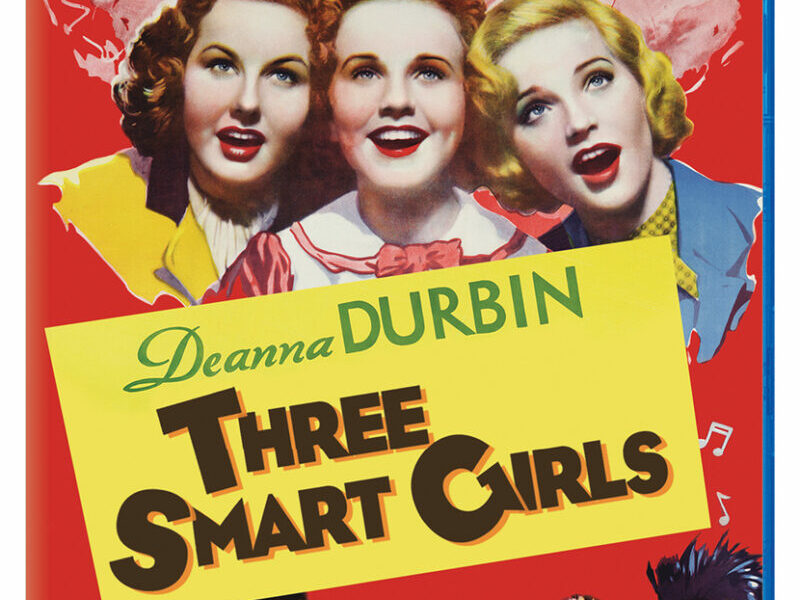
Introducing Deanna Durbin: Universal’s ‘Three Smart Girls’ Reviewed
by Rachel Bellwoar
Back when Kino Lorber was releasing some of Deanna Durbin‘s films on Blu-ray, the one bummer was that while Three Smarts Girls Grow Up (the sequel) was included in their boxset, Three Smart Girls was absent. It’s not as though there’s much continuity between the two films. New love interests were added and one of the three sisters (Kay) was even recast for the sequel, but it’s the principal of the thing, plus (as indicated by the opening titles which name Durbin as “Universal’s new discovery”), Three Smart Girls was her film debut, making this Blu-ray release a long time coming.

For those unfamiliar with Durbin, she was actually a contemporary of Judy Garland‘s and it was by mistake that Garland and not Durbin was given a contract at MGM. Durbin went on to work at Universal (the full scoop on that error can be found in Melanie Gall‘s book, Deanna Durbin, Judy Garland, and the Golden Age of Hollywood).
Whereas Garland was a belter, Durbin was a soprano and director Henry Coster wastes no time getting to that point by having the film start with Penny (Durbin) singing while out sailing with her older sisters, Joan (Nan Grey) and Kay (Barbara Read). Durbin’s talent is undeniable. It’s a voice that doesn’t compute with coming out of a fifteen year old’s mouth and the film doesn’t overdo it by having her sing too often.
The reason Three Smart Girls really succeeds, though, is because it doesn’t rely on Durbin alone to bring the entertainment. This admittedly is probably because Durbin wasn’t a proven entity yet but the point is instead of treating Joan and Kay as back-up singers, all three sisters are developed and given storylines (and neither of them attempts to match Durbin vocally — Penny’s the only singer).
None of the three sisters have seen their father (Charles Winninger) in ten years, but upon seeing the effect his impending engagement has on their mother (Nella Walker), they decide to hop on a steamer to New York and try and convince him he should’ve never divorced their mom in the first place.
Now, are there major flaws in this plan? Absolutely, starting with the film’s conception of divorce and insistence that this man who’s had no problem not being involved in his daughters’ lives for ten years is worth trying to reach or that their mother doesn’t deserve better. It’s also pretty wild that on more than one occasion the sisters ask their servants for money, not seeming to realize they shouldn’t be asking them to dip into their paychecks to give the sisters a loan.
When you’re watching the film, though, none of that logic gets in the way of being swept up by the charms of these three “smart” girls who come up with the craziest schemes, pre-Parent Trap, to reunite their family. It doesn’t hurt that every supporting player in this film is a comic genius. Of particular note are Binnie Barnes as their father’s golddigging would-be fiancée and Ray Milland, who’s never been more funny in perpetual catchup mode, “yes and”-ing every plot while not fully understanding what’s going on, only that he’s completely taken by Penny’s sister, Kay.
Universal’s Blu-ray comes with two 2011 featurettes on Universal’s legacy, with one focused on producer Carl Laemmle (and his son Carl Laemmle Jr.) and the other on talent agent Lew Wasserman.
Three Smart Girls is on sale now from Universal and can be purchased from Movie Zyng.
