
Characterization In The Buffyverse — ‘Angel’ Season 2, Episode 21
by Benjamin Hall
This is part of a bi-weekly series concerning the characterization of Buffyverse characters. Arguably the best place to begin reading this series is at the beginning, but that is up to each reader. As a reminder this column will cover major and some minor characters from the shows Buffy The Vampire Slayer (1997-2003) and Angel (1999-2004). Other Buffyverse media, such as the graphic novel Spike: Into The Light (2014) are not pertinent to this series. Also there will be no referencing real world events that have direct relation to either show in this bi-weekly series. Although this series does reference things that have no direct relation to the show in order to examine things such as metaphors and literary analogues.

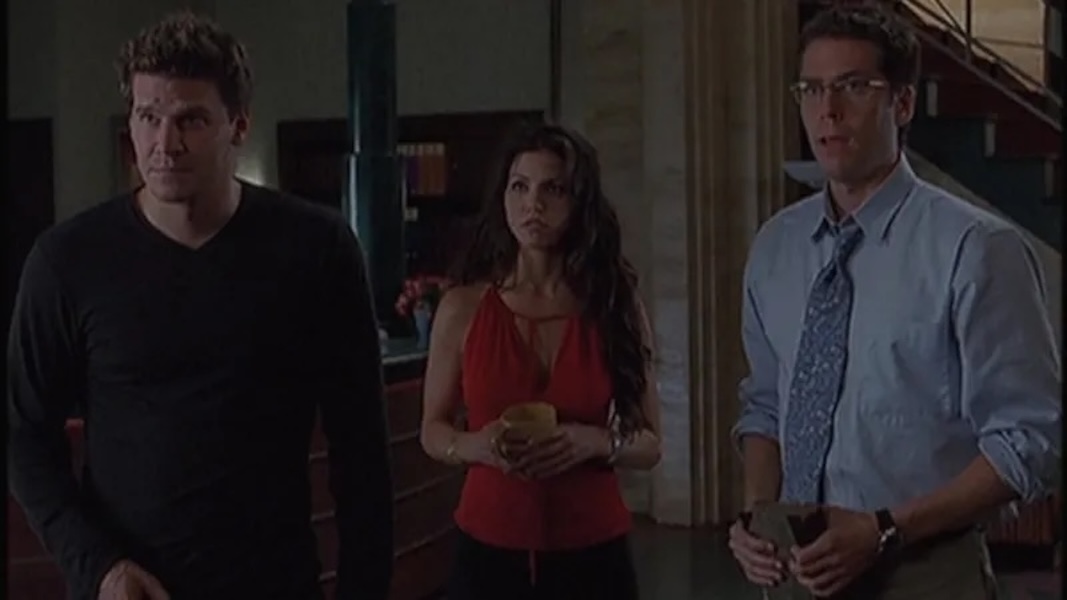
This week: Cordelia Chase (Charisma Carpenter) faces royal court politics in a different dimension. Meanwhile, Winifred “Fred” Burkle (Amy Acker) meets Angel (David Boreanaz).
(Warning of spoilers from this point on!)
(Trigger warning for mentions of torture, abuse, and slavery)
Angel displays a lot of narcissistic traits after seeing himself in a mirror for the first time in centuries. His regaling a crowd — albeit one of demons — of his experience cutting off Lindsey MacDonald’s (Christian Kane) appendage also displays how the soul curse does not really change Angel. Additionally, his desire for hero worship delays the search for the magical hotspot he and Lorne (Andy Hallett) are looking for. Luckily, Angel’s selfish actions engender some goodwill with select members of Pylea’s demonic populace. This goodwill quickly sees use when he and Lorne rescue Fred from death.
Cordelia’s ego runs rampant while she is under the misconception that she is a true princess and messiah of Pylea. Since she faces torture from both the migraine of a vision (Season 2, Episode 20, “Over The Rainbow”) and by the demon priests’ actions before gaining the titles, she should obviously be more wary and less enthusiastic. Since she bears no physical scars from the torture (and is not dealing with any emotional or mental ones), one can assume spellwork is at play. Her giddiness is the result of magic healing her various injuries from the secondary tormenting. Still, she retains enough clarity to have some understand of the danger she is now in.
Wesley Wyndham-Pryce (Alexis Denisof) has more of a take-charge attitude in this episode, suggesting the kind of person he will become in the next two seasons. Sadly, this adventurous demeanor will not be as upbeat in those seasons.
Charles Gunn (J. August Richards) unknowingly points out secrets via random comments he makes while helping with the research. One could argue that he is, in a sense, a one-man Greek chorus for this scene.
Lorne displays bravery by using his love of music to assist Angel and Fred’s escape. His ability to survive as a head in a basket is as much a surprise as the fact that he possibly ate humans as a child.
Fred is out of her mind because of the trauma from her years in Pylea. But she retains enough sense to still be searching for a way back to Earth while also helping Angel, Wesley, and Gunn.
Silas (Michael Phenicie) and Barshon (Andrew Parks) are two of the numerous demon priests, with the former being the leader and the latter another higher-up. Of the two, Silas is more patient since Barshon wants to rush their plan.
Constable Narwek (Brian Tahash) displays some loyalty and deference to Cordelia now that she is the head of the royal court. These aspects suggest he is what his dimension considers a good law enforcement officer.
Lorne’s nameless mother (Tom McCleister) and his brother, Numfar (Joss Whedon), are mostly gag characters who hate Lorne and their relationship to him. Numfar has the flimsiest reason to exist since he only provides brief and simplistic levity.
Groosalugg (Mark Lutz) is kind of a rip-off of the Marvel comics character Ransack the Reject since both are outcasts of their societies and possess a mixture of genetic heritage (The Eternals #8 [1976]). At the same time, Groosalugg is unlike Ransack since he exhibits behavior analogous to the concept of a chivalrous knight.
Landok (Brody Hutzler) being friendly and hyping up Angel to the Pylean town indicates he and Lorne are not dissimilar. Yet, the similarity of Landok and Lorne both acting as hosts for events of entertainment will not see discussion in Angel.
The rebel leader (Adoni Maropis) and rebel #1 (Danan Pere) exemplify their forces as being overly paranoid. While this is justifiable as the humans suffer greatly under the demons, the rebels should at least think of getting more information from potential spies.
A lot of the characterization in this episode is a continuation from the last two (Season 2, Episode 19, “Belonging”). For example, Angel’s wanting a simplistic way of being a hero. Although there is a lot of development, a fair amount of it is plot-centric. The parts that involve growing the characters will not be entirely relevant in the future. Unfortunately, the main characters will forget lessons they learn, or they will apparently heal practically overnight from trauma. Thus, they will be much like Cordelia after she gains her titles.
