
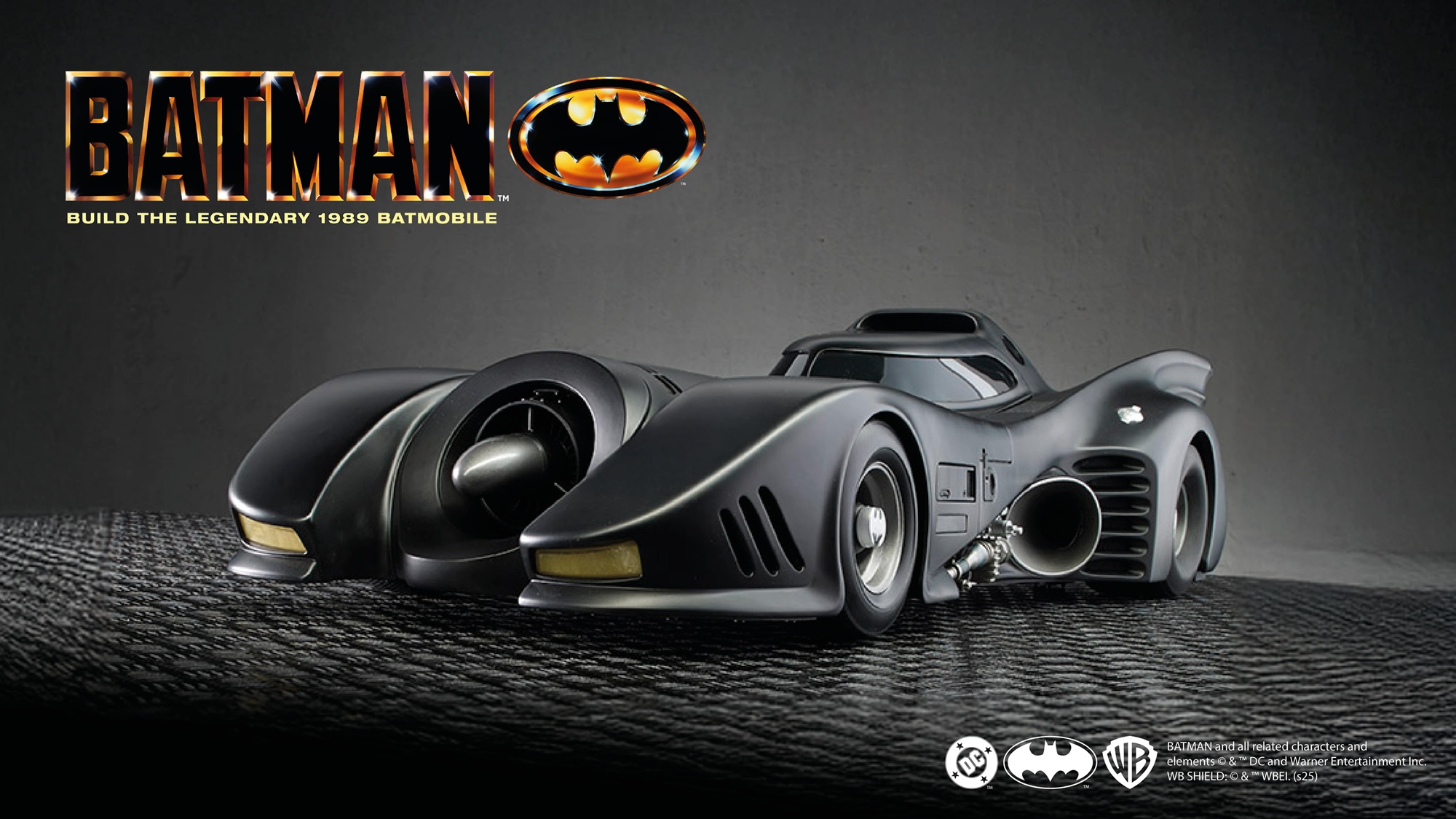
Reviewing Fanhome’s 1989 Batmobile 1:8 Scale Build-Up Subscription Stages 9-13
by Brendan M. Allen

The latest box in my Fanhome 1989 Batmobile 1:8 Scale Build-Up Subscription* has arrived. Stages 9-13 in this part work sub address the turbine that lives under the hood of this massive 30” diecast monster. There are a lot of those witchy little bits that are definitely not intended for these gorilla hands of mine and one stage I’m almost certain I screwed up. I won’t know for sure until way down the line when the rest of that front end goes together.
Let’s get into it.
Build Stage 9
Stage 9’s magazine** kicks off with a character study on one of Batman’s classic rogues, Penguin. The main focus is on Danny Devito’s performance in 1992’s Batman Returns. While Devito is a fantastic actor, brilliant in a range of roles from Frank Reynolds to the Lorax, the definitive Penguin is, and always will be, Meredith Burgess. I said what I said.
The second piece is on the 1940s Super Sedan, with its oversized bat-shaped front grill ram, high-powered engine upgrades, and sweeping aerodynamic lines. This is the most gangster Batmobile, which is fitting for the period.

The build stage involves stacking combustion and exhaust fans on the engine shaft. These are more intricate details that will be hidden inside the engine compartment when the model is complete.

Build Stage 10
The first piece in this stage’s literature takes on another re-imagined classic rogue, Michelle Pfeiffer as Catwoman in Batman Returns. Bob Kane had Hedy Lamarr in mind when conceptualizing the character in 1940. That fact gets one line. The original television role was brought to life by Julie Newmar, who is not mentioned here. Neither is the ultimate embodiment of Catwoman, Eartha Kitt.
The car feature is the ’80s roadster that debuted in Batman #311. This car was a throwback to ’70s automotive styling. It featured a metallic blue and black body, with yellow detailing around the lights and the classic Batman logo on the doors, hubcaps, and trunk. It also was equipped with twin bubble windscreens, rear bat wings, and built-in crime-fighting gadgets. I never really liked this design, but I also hated the Corvette C4, if that tells you anything.

The build requires mounting an electric motor to the housing that will encapsulate the shaft and fans assembled in previous stages and attaching some cosmetic exhaust pipes to the exterior. Looking at the included “finished” diagram for this stage, my inkling that all these fans and bits will be completely hidden from view on the completed model is confirmed.

Build Stage 11
This stage’s digital accompaniment has a feature on Christopher Walken’s character Max Schreck. He is the first to play this role, as it was invented for Batman Returns. The character gets his name from the actor who played Count Orlock in Nosferatu (1922).
The vehicle feature is the Speed Machine from The Dark Knight trilogy. This motorcycle pops out of the side of The Tumbler, which … come on. There is just no way this thing works mechanically using real world physics. I know we’re supposed to suspend disbelief in cinema, but … come on! How does the drive shaft connect to the rear wheel when in Tumbler mode? How could a segmented axle maintain structural integrity on those jumps and flips at bonkers speeds?
Cool idea, but no.

The build stage completes the exhaust front chamber, complete with more of those external exhaust pipes.

Build Stage 12
Batman Forever (1995) was … I mean … it’s definitely a film. I know Val Kilmer gets some heat for this one, but I say the man did his best with what he was given. There’s only so much any actor can do with a bad script, horrible effects, and super campy villains. This design is the infamous “nipple suit,” and to be fair, it has to be freezing in that Batcave. More baffling is the choice to make the nipples bigger and more pronounced on George Clooney’s suit in 1997’s Batman & Robin.
The featured Batmobile is the heavily modified coupe from Detective Comics #39. While not explicitly stated, this vehicle shares lines and paint with both Chevy and Ford models of the same era. The gadgets are all hidden, and there is no outward indication that this is anything but a really fancy, fast car. As cool as some of the later designs are, this actually makes the most sense for a masked detective’s primary mode of transportation.

And now we get to the build stage that I’m 97% sure I screwed up. This stage finishes the combustion chamber. The pieces in this stage are supposed to snap into the completed tube from the previous stages and lock in. Except for the life of me, I can’t get this damned thing to lock in. It kind of jams on there and gets stuck hard enough not to come off, but … those shafts inside the thing are supposed to connect so that the electric motor we installed will spin all those fan blades hidden within. They do not connect. I tried over and over again to just snap the thing in, but it just will not seat.

I even checked in on Wayne from World of Wayne to see how he completed this step, and Wayne’s looks just like mine. I know by manually spinning the shaft that it is not connected to the motor, but I cannot fathom how to correct this issue. Future build steps will determine how big of an issue this actually is for me. I also noted that Wayne applied a generous helping of grease to these internal parts, which makes a lot of sense to mitigate plastic on plastic noise down the line. If I have to dissemble to reassemble later, I will goop it up with grease as well.

Build Stage 13
The magazine for Stage 13 kicks off with a piece on Robin, highlighting Chris O’Donnell’s performance in the burgundy nipple suit. The backup is four pages on my least favorite Batmobile, the wedge-shaped monstrosity that debuted in Detective Comics #601. I have no good things to say about this car.

The lucky thirteenth build stage begins the complex suspension system. This is a fun stage because the parts are actually functional. I have one massive wheel from the first box for this build. It’s heavy, constructed of thick black rubber. This tilt frame with dual shock absorbers is cool. The springs are real. The suspension will have to actually function under the weight of 30” of heavy diecast. This looks and feels like a real, functional, miniaturized suspension system.

This thing is starting to look really cool. The structure of these Fanhome builds gives me the same little lift every time the mailman shows up on my porch with a new box. There’s a thrill breaking the seal to see which subscription I’ll be working on that day. Taking out the little sealed baggies and boxes, feeling the weight and heft of these diecast parts, laying them all out in a row on my work table … those things all contribute to the experience. It isn’t the same as buying a scale replica off the shelf. When the build is complete, there’s a piece of you in it. After a ton of sweat equity and swearing, that sucker is yours.

While that one issue with the disconnected drive shaft niggles the back of my head, I am hopeful the solution will become evident in future build stages.
*Fanhome provides this subscription to me free of charge for the purposes of review.
**I hesitate to call it a magazine, because while it is obviously intended for print, Fanhome has decided to only offer a digital version to subscribers. The double spread layouts make it difficult to read the smaller print on a device, and it’s super awkward to navigate on a reader. Not a fan of this obvious production cost saving measure. For the price of these subs, subscribers should be able to actually read the accompanying literature.
