
SDCC 2026: ‘Magic: The Gathering’ Designer On New Sets And ‘Mood Swings’
by Erik Amaya

Mark Rosewater: One of the things about Magic in game design terms, we call a “barrier to entry” — which is [whether a gamer thinks] “I know nothing,” or “I know enough to play the game.” And Magic, because it’s a little more complex game, there’s a little bit more to learn. So what we found is the more passionate you are about the subject matter, the more eager you are to learn. A lot of people love fantasy. The core Magic is fantasy, but some people like other things like Marvel superheroes. And I think if you learn the game with something you’re passionate about, it A.) makes it easier to learn because you have an intuitive sense of what the cards do. And B.) it just makes it more fun because you’re playing with a property you love.
I would say that if you’ve never played Magic and we make a property that you’re really excited about, that’s the best time to learn with something that you’re very excited about.
Amaya: I’ll admit Doctor Who brought me back. I played in the ’90s, wandered, and those Doctor Who sets had to happen.
Rosewater: What we’re hearing about Universes Beyond is we’re just doing classic, famous properties and people are like, “Oh, I love Lord of the Rings. I love Star Trek. I love Marvel. I love Avatar. I love Teenage New Ninja Turtle.” So it’s been really, really great for getting either new players into the game or old players that have lapsed back into the game.

Amaya: Were there any particular creative challenges when crafting the cards for the Marvel or Hobbit sets? And how does that influence the way you think about doing future Universes sets?
Rosewater: Each set has their own challenges. With The Hobbit and The Lord of the Rings, it’s based on specific books. The source material is those books, that’s what it is. So sometimes the game needs something and it doesn’t quite exist [in the source lore]. The example for Lord of the Rings — Magic needs a lot of flyers. That’s important. And in Lord of the Rings, there’s just not a lot of things that fly. Not nothing, but not a lot of things. So we’re digging deep to find things … “Oh, there’s some birds!”
On the flip side, Marvel has so many things that fly. We’re like, “Okay, I know he can fly, but do we have to put flying on him?” There’s too many flyers. So each property’s a little bit different.
And the thing about Lord of the Rings that’s really cool is the people that know Lord of the Rings know Lord of the Rings. They know the book backwards and forward. So anything we reference, they know. Where something like Marvel — Marvel has eighty years of storytelling that you might love, and we talk about a corner that you just don’t know, not because you’re not a Marvel fan, but there is a depth to Marvel. There’s a lot of stuff in Marvel. And so even as a Marvel fan, I know people have certain, “Oh, these are that subsection that I love the most.”
Amaya: Our Tabletop Gaming writer, Anton, is very excited about Mood Swings coming to the table and wanted to say congratulations! He also wants to know what it feels like to finally softly playing this game you’ve been working on for almost thirty years?
Rosewater: So a quick background. I’ve been working on Magic since 1995. In 1998, three years into working on Magic, I designed a trading card game of my own called Mood Swings. Magic is an amazing game — I personally think the best game ever made, but it is complex. And I love trading card games. So I’m like, “Could I make a game that’s just a simpler, more accessible version of a trading card game?” Something that is just not quite as complex. So the idea of Mood Swings: you buy 45 cards, that’s all you need. You have everything you need to play out of the box. Although it’s a randomized card set, so if you and I both buy a deck, we’re not getting the same cards. Each person gets served their own.
There’s 45 cards [in each pack] of 133 [total cards in the game]. A two-person game takes five minutes. On my turn, I play a card, you play a card, we check our score. Someone wins the round, win three rounds, you win.
It’s very fast, it’s very easy, very simple to learn, but it has a lot of things I love about a trading card game. There’s collecting, there’s trading. The cards have a lot of interesting depth. There’s a combination of cards that make neat things happen. And so it’s me showing off all the coolness of a trading card game, but just really scaled down to make it more accessible. And what I would say to any Magic fans out there is “if you have friends, loved ones, kids, people who might not be ready for Magic yet, but you want to share your love of trading card games, it’s a way to start.”
It’s a simpler trading card game. And all of the cards use emotions, so it’s very universal. You can play happiness and sadness and fear. It’s a really fun game. I’ve been working on it for 28 years. It just came out. So I hardly recommend it.
Amaya: Does it feel great to finally have people out in the wild playing it?
Rosewater: Oh, it feels amazing! Proving that yes, this actually does work. I was just last weekend at MagicCon in Amsterdam. And many, many people were playing and I got to play with a lot of people. So many came up to me and said how much they were enjoying it. And they got other people to play that they couldn’t get to play Magic — they were getting their significant other or their kids or somebody else into training card games. And so yeah, it’s been amazing.

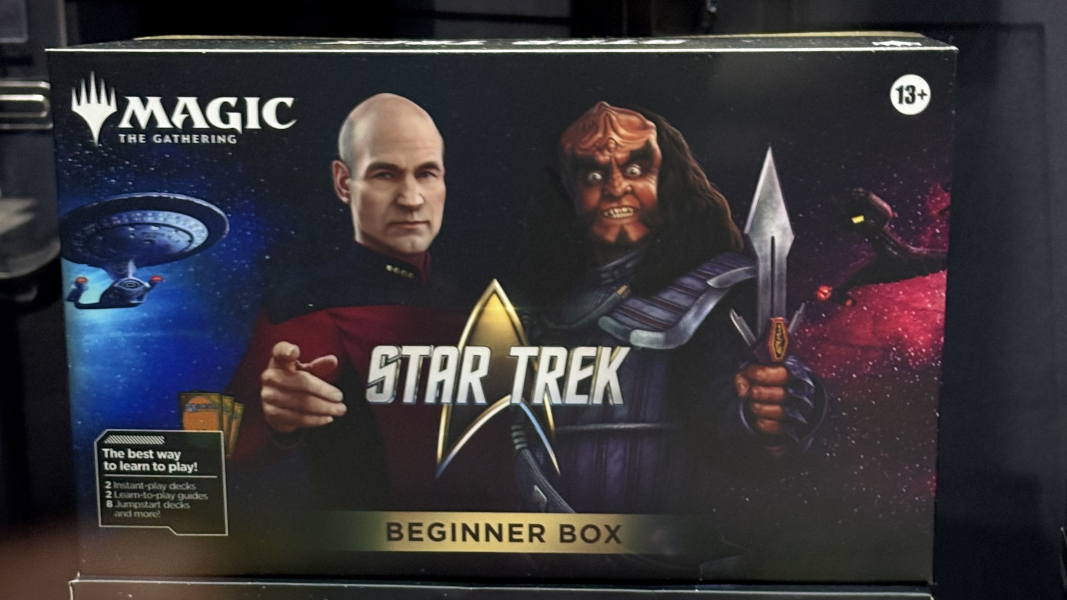
Amaya: That’s awesome. So adapting Star Trek into Magic — what does that entail? How do you bring that lore into the mechanics and be like, “Okay, A is B.” Does anti-matter become a usable card?
Rosewater: The idea for any Universes Beyond set is you want to figure out what’s the essence of the property and then figure out how do we have gameplay lean into what that is?
Now, one of the things that helped a lot is last year we made a set called Edge of Eternities, which was Magic did space. And so before we got to Star Trek, we tackled space and tried to bring out what made space work in Magic. That set did very, very well. So we tread a lot of ground that helped us lay the framework for what space means in Magic. And a lot of it really is, I think, Star Trek has a ethos that’s very positive. We wanted to make sure that the gameplay was very much about that — there’s lots of different things out there and experience with different things. There’s a lot of cool pockets of it. There’s lots of characters to play, there’s the Borg and different aliens. There’s a lot of really cool things to do. And the set really tries to hit all those different aspects. You can lean into whatever you most enjoy.
Amaya: What is the first question the team asks to make sure that those cards captured the spirit of Star Trek?
Rosewater: Well, normally what happens is the first day of the Universes Beyond design, we do what we call the whiteboard, where we have a whiteboard and we say, “Okay, what do you think fans of the property want?” And we make sure that every design team has people who are fans, what we call subject matter experts or SMEs. So we say, “You’re a fan of Star Trek. What does Star Trek have to have?” Okay, you got to have Captain Kirk, you got to have the Enterprise, you got to have the Borg, you got to have phasers, you got to have the Prime Directive. You write everything on the board you think it needs and then you start thinking about how they come together? Are there things that Magic already does that lines up perfectly. And you start building it together.
But it first comes out with just figuring out, “Okay, what do we have to do? What is essential?” And then the needs of the property will start guiding how the design happens.
We thank Mark for his time. Magic: The Gathering and Mood Swings are available wherever games are sold.
