
Reviewing Fanhome’s 1989 Batmobile 1:8 Scale Build-Up Subscription Stages 24-28
by Brendan M. Allen

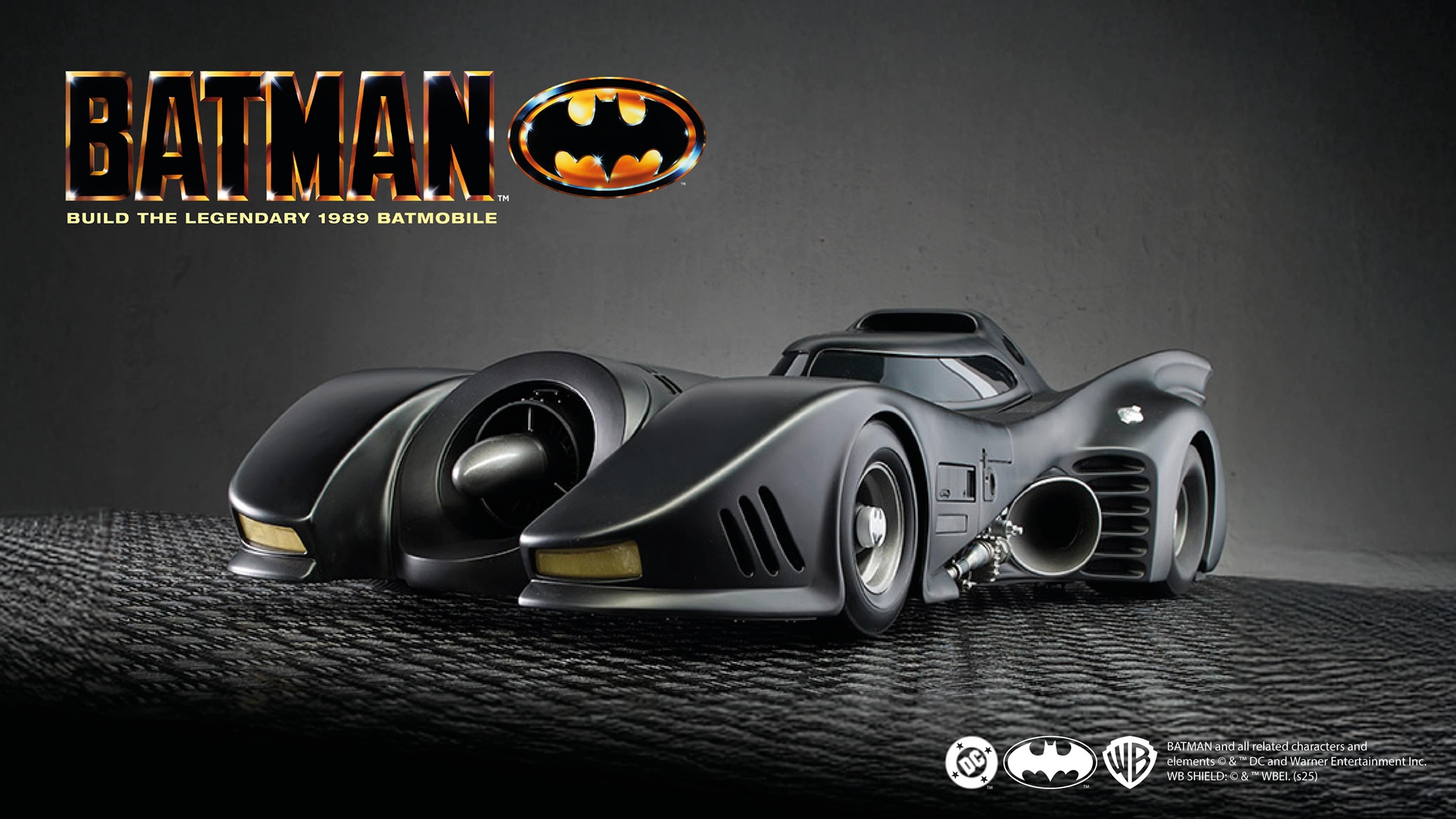
The seventh package in my Fanhome 1989 Batmobile Build-Up subscription has arrived.* This 1:8 scale model meticulously recreates the iconic vehicle from Tim Burton’s 1989 Batman film with all the sleek styling and high tech gadgets that make it Batman’s ultimate crime fighting tool.

The finished model will clock in at an incredible 29.5” long, consisting of diecast metal and ABS components. Just like in the film, it will have retractable side wings and roof canopy, a functioning front turbine, a realistic dashboard, rotating wheels, and an opening trunk. There will also be retractable machine guns, a disc launcher, and a grapnel. A remote control will trigger LED lighting and sound effects.
Let’s get into build stages 24-28.
Stage 24

This stage’s featured vehicle is the Batboat from the 1966 Batman film. The boat itself was a modified Glastron V174. Mel Whitley and Robert Hammond designed the boat, adding a red flashing beacon, glowing eyes, bazooka hatches, seats for Batman and Robin in the front of the boat, twin wind screens, a center console, an outdrive jet cover, and an aft to deck cover with a glowing Bat-Signal on the tail fin.
Although the boat was powered by a Merc Cruiser L6 stern drive, a water squirter and a jet nozzle were added to make the Batboat look like it was nuclear-powered, because in the 1960’s, nuclear meant science-y.

The parts for this build stage include the left “wing,” and the left machine gun cover. Assembly requires attaching the previously included machine gun well and the machine gun cover to the left wing.
Stage 25

The twenty-fifth digital issue in this sub features the Batmobile from the Legends of the Dark Knight story arc Prey. In the story, readers saw Batman building his first Batmobile. Early versions of the car suggested a two-passenger design. The finished vehicle looked more like a jet-powered racing boat than an automobile. As I’ve mentioned before with other vehicles in this series, because it’s in a comic book, the details were fluid. The split mandible nose changed to a smooth, solid curve and back, all in one issue. No special features or abilities were shown in the series beyond the heavily-armored body.

The build involves installing the left disc compartment under the left machine gun well and snapping together a couple more of those discs that will live inside it.
Stage 26

In Detective Comics #219, Batman and Robin see several known criminals driving around in old cars. They deduce that something is about to happen and decide to investigate a classic car convention in the town of Millville. To keep with the spirit of the festivities — where all modern cars are forbidden — Batman temporarily replaced the Batmobile with this car. Based on the 1905 Marmon, it featured a Bat Mask on the front, a pair of door insignias, and a large fin on the rear.

The build stage involves installing the left headlight, left headlight lens, LED, and wiring harness.

Stage 27

This stage’s Batmobile is from Legends of the Dark Knight #156. First appearing in 2002’s “Blink” story arc, it was brought back out for the follow-up story in 2003. Some of the more overt features on the car include oversized sweeping front fenders, a small aircraft-style cockpit, and ridiculously enormous rear fins.

The build stage is for the right side machine gun. It is exactly the same as the left side machine gun, but mirrored for the opposite side.
Stage 28

Stage 28’s digital magazine features the second-most talked about Batmobile. Built by movie car engineers Chris Corbould and Andy Smith, The Tumbler from 2005’s Batman Begins is one of the most polarizing Batmobile designs. The goal was to make the vehicle actually look like it could do all the impressive maneuvers that previous ‘mobiles were shown doing, but obviously were not really equipped to do. This stripped away a lot of the sexy “bat” aesthetics, but left a very capable-looking militaristic beast of an urban tank.
It clocked in at 9 feet wide and 15 feet long, weighing in at 2.5 tons. It was still capable of 0-60 miles per hour in under six seconds with a top speed of 110 miles per hour. Thanks to its unique design, it was also capable of making unassisted jumps up to 30 feet.
It was a rough, dirty take on the Batmobile that solved real-world physics issues with previous Batmobiles, but lacked the sleek, sexy lines of previous incarnations.
The build stage completes that right side machine gun and includes the right machine gun cover.

I’m going to have to get a bigger box pretty soon. The left wing and hood are enormous, and if the build stages for the right side mirror the left, I’m going to have more really large parts coming soon. The 1:8 scale is really starting to sink in as I look at the sheer size of these parts. I am now all caught up for the stages I actually have, so it’ll be another three weeks or so before the next installment arrives. Hopefully, stage 19 will be in that box with stages 29-33.
*Fanhome provides this subscription to me free of charge for the purposes of review.

