
Talking ‘Undercover Monster’ With A.C. Medina, Mina Elwell, And Kit Wallis
by Rachel Bellwoar
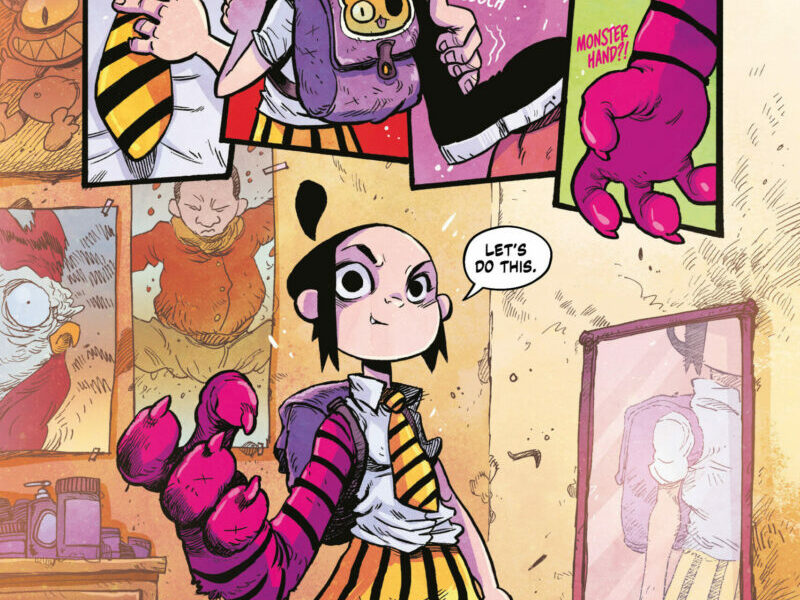
Mia has been kicked out of a lot of monster schools, but she’s never been enrolled at a human school before. Co-written by A.C. Medina and Mina Elwell, with art by Kit Wallis and letters by Dave Lentz, Undercover Monster is the story of Mia’s attempt to stay out of juvie by agreeing to help find the dream eater who’s been attacking members of the school. The last thing monsters need is the bad PR and to have their existence exposed like that, but will Mia be able to solve the case? Here’s what Medina, Elwell, and Wallis could share about the new middle grade graphic novel:

Rachel Bellwoar: As a fan of your previous series Hellicious, how did you decide on Undercover Monster to be your next collaboration?
Mina Elwell: AC, Kit, and I have stayed friends; this is just the first project that made it out of the group chat! We’d been wanting to make a middle-grade graphic novel together, and we kicked around a few ideas, but when Kit showed us some old designs for the character that would become Mia Avery, we knew this was the one.
Kit Wallis: It was based on an old concept I had way back in 1999. The original was aimed more towards the 17-25 age range. It was basically developed by A.C, Mina and myself for a YA audience.
Elwell: What makes it especially meaningful for me is that when I was first looking for the right artist for Hellicious, the art I saw on Kit’s website that made me reach out was one of his early designs for the character! So in a way, I knew Mia Avery before I knew Kit.
A.C. Medina: Part of why our team works so well is that we genuinely believe there’s no genre, theme, anything really we can’t approach creatively. Kit can tell us “pickles?” and Mina and I would whip up a treatment for it. With Undercover Monster, it really did start the same way, with one of us saying “Monsters” and the rest came to life.
Bellwoar: While Romero is a zombie, Mia doesn’t fall into a monster category per se but is considered a monster because of her arm. Was that something you wanted to explore with this graphic novel — who or what gets classified as a monster?
Elwell: Absolutely. AC and I really wanted to explore what labels others assign to us and which ones we assign to ourselves. This age is when so many of us start to form our own identities, and which labels we embrace and reject is a huge part of that process. Am I a human or a monster? Am I smart, even though I’m a zombie and people assume I’m a mindless ghoul? Am I a bad kid who is going to get in trouble no matter what?
Medina: For a lot of people, you are not given a choice in what the world sees you as and have to work against that belief in everything you do, no matter how young we are. Romero very much represents that; the world has told Romero what he is and will do before he even learns how to say anything back.
When we meet him, he’s learned a lot, a lot more than most kids his age, and that comes through his investigation. That belief in himself to tell the world who he is and what he’s about is what drives him during this investigation. 
Bellwoar: As the “undercover monster” of the title, Mia has been sent into a human school to uncover which of the students is a dream eater. What was it like coming up with a look for the nightmares of the dream eater’s victims?
Elwell: Dream eaters are kind of like vampires, but instead of draining their victims of blood, they drain out their dreams (which leaves their unfortunate victims anywhere from sleepy and confused to in a coma!) We had the idea that when a dream eater eats, it leaves some “crumbs” behind, and those crumbs are pieces of stolen nightmares drifting around the real world. Our heroes have to search these nightmares for clues before they fade away.
I thought of these scenes as looking completely different from the rest of the book, inspired by the witch battles in the Puella Magi Madoka Magica anime, but I had no idea what that was going to look like for us. Luckily, Kit knew just what to do and made them all stunning.
Wallis: We basically wanted the ‘dream eater’ scenes to have a slightly different claustrophobic feel, so we came up with the weird “boarders” to denote those scenes.
Medina: The dream sequences, to me, were as much about the Dream Eater and their current state as well as their victims. There’s a collision of themes and shared connection in these signs that I think makes them the most special.
Having Kit, who each time I write a description for, I am positive he will make it bigger, better, and louder, and that’s just one of the many reasons we’re so lucky to work together. This method really shines in these scenes, and we’re excited to hear about readers’ favorites.
Bellwoar: Mia comes to realize a lot more monsters attend human school than she was expecting. Was there a ratio you kept to, in terms of how many monster students to show roaming the halls and classrooms compared to humans and was it helpful having a school uniform to dress all the characters in?
Wallis: There was no real thought into how many monsters to humans there should be; I was more down to making it look fun and interesting. So the more silly characters, the better. I probably should’ve drawn more! The school uniform helped with making colour schemes more consistent.
Elwell: The huge monster population in human school serves the practical plot function of making it really hard for our heroes to narrow down their list of suspects, but on a deeper thematic level it was important to us that Mia and the Dream Eater aren’t the only undercover monsters in the story. We’re all different, and most of us probably feel like there are aspects of ourselves that we have to hide at some point in our lives. You might be hiding a monster arm under your coat, but the kid sitting behind you might be wearing that yellow beanie to keep his brains from falling out, so we’re all more alike than we know.
Medina: While we couldn’t tell you the exact number of monsters in the school, we don’t know on purpose. The feeling of uncertainty in just how many monsters have to hide in human schools really amplifies the mystery we wanted to share. Mia is a new kid in a new school, and that’s in itself always a scary place to be.
The fact that there are monsters amongst her, hunting the humans who are much scarier than monsters in her experience, I think, is a place we wanted to be in as writers so our audience could be in a similar place as well.

Bellwoar: With a lot of investigations, the same team is shown looking for clues the whole time, but one of the fun things about Undercover Monsters is the Monster Club keeps expanding. Did you enjoy getting to shake up the dynamic of the group regularly by adding new members?
Elwell: Mia comes into this story as a lone wolf who moves around all the time and doesn’t bother to make friends anymore, and somehow finds herself a part of an ever-expanding team of misfit monsters.
We have AC to thank for this! He is great at coming up with tons of kooky characters who could be one-off gimmicks and then making me deeply invested in their complex inner worlds and how they come together.
Medina: Working with Kit, I’ve been lucky enough to see some of the best designs in comics I’ve ever seen. The more monsters we made, the more of a chance I had to see that, so I really wanted to go for it with our crew.
I think people of all ages share a desire for community now more than ever, so we really put thought into how each member of Monster Club operates. We were very fortunate to have as many pages as we did to live with these characters, and yet by the end we feel we have so much more left to tell for each of them.
Bellwoar: In terms of making sure the investigation was easy to follow, did you find that a challenge or was that one of the more exciting aspects of this project?
Elwell: This was my favorite thing about working on Undercover Monster! As soon as we decided it was a mystery, I knew it had to be a puzzle that middle grade readers could actually have the chance to solve if they wanted to. There are floor plans of the school, photos of the suspects, and notes by the characters between chapters to help readers follow along. Whether they guess right on the first read or not, I hope people will have fun spotting all the clues to the Dream Eater’s real identity woven into almost every page when they reread!
Medina: We’re very proud of how our investigation came to life. It truly is a puzzle we had to solve first before we wrote it. That in itself made Undercover Monster so memorable to work on, and it’s something we really hope readers connect with as we have.
Bellwoar: Thanks for agreeing to this interview, A.C., Mina, and Kit!
Undercover Monster is on sale now from Papercutz.
