Echoes Of ‘The Wolves Of Saint August’ — Reviewing ‘Hellboy & The B.P.R.D.: The Monster Of Nivola’
by Anton Kromoff
Review
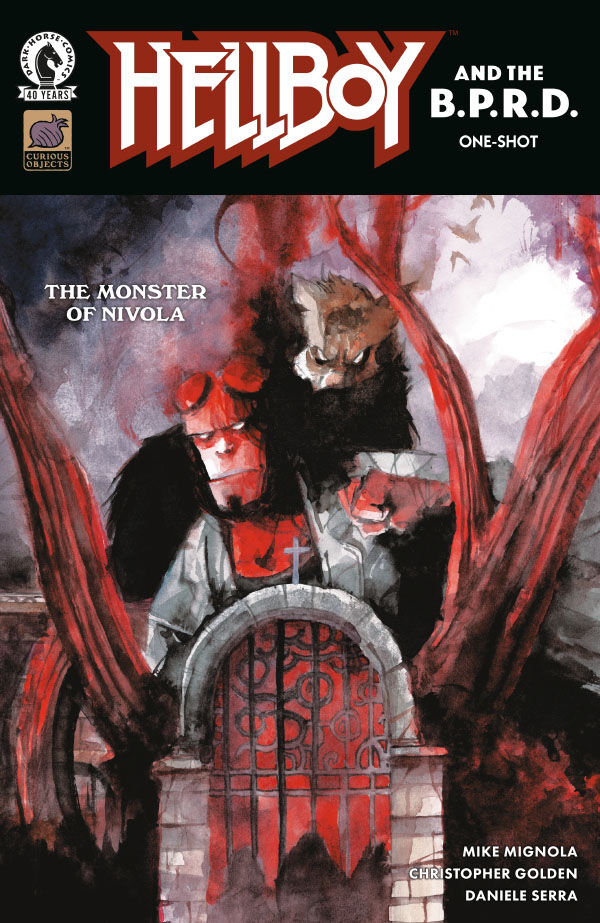
Hellboy and the B.P.R.D. The Monster of Nivola strikes a really solid balance between moody art and brilliant storytelling that captures the spirit of the well-storied world of Hellboy and the B.P.R.D.
Overall
10/10Welcome to the table,
The Wolves of Saint August, the collected color version from 1995, was one of the most influential comics this reviewer has ever read. While the earlier Seeds of Destruction story is a great Hellboy offering, it feels in many ways dream-like and still slightly unsure of itself and what it wants to be. Not a criticism of the work, as it is still wonderful, just an observation from someone who travels the pages of the assorted Hellboy stories regularly.
The reason to bring this up? In many ways, The Wolves of Saint August as the best jumping-on point for those trying to find a good entry point into the world of Hellboy and the B.P.R.D. It’s a solid werewolf story that has some brilliant visuals. It also features Hellboy using a cross as a weapon and some really solid Mignola art. It remains some of the most iconic of the series to date. It exposes exactly who Hellboy is, what his motivations are, and the kind of stuff he is going to encounter in the stories that follow it. It’s just quintessential Hellboy.
Meanwhile, Hellboy and the B.P.R.D.: The Monster of Nivola has landed on my desk. I think it may also serve as a good jumping-on point for those new to the well-storied world, but does it hold up to The Wolves of Saint August?
Let’s get into it.

Comparison is the thief of joy. Comparing a prestigious collection of four chapters in a single edition against a single issue is a bit unfair to the single issue. Please don’t expect this to be a “this is better than that” kind of review. The reason I want to bring them both into the same room, though, is that they are both werewolf stories. Both feature Hellboy fighting monsters. Both have small villages and religious themes. And … both are really solid jumping-on points for Hellboy, in a matter of speaking. More on that towards the end.

Written by Mike Mignola and Christopher Golden, with art and colors by Daniele Serra, and letters by who I firmly believe must be the hardest-working letterer in comics, Clem Robins, The Monster of Nivola takes place in Nivola, Sardinia, in 1963. That’s some 500 miles (in a straight line anyway) away from the Balkan Village of Saint August.
-Spoilers Follow-

This story kicks off as a woman drives along a rural highway. She passes construction workers who are modernizing the town on her way to a local church, where she finds nuns who know she is coming and seem distraught and immediately apologetic towards her.

The nuns take the woman to a dead werewolf. They explain in a moody flashback, deliciously perfect in Serra’s watercolor style, that the werewolf had been at the church for years. It had been fairly calm, but the gentrification of the town, the encroaching of the new world, had disturbed the old world and that had caused the werewolf to prowl out and about.

Much like The Wolves of Saint August, the curse of lycanthropy was not really something that could be controlled. Unlike the Saint Augusts’ story, the werewolf in Monster of Nivola seems generally innocent. I say that, and it does seem like he killed someone, or a few someones, but it was not a “let me unzip my flesh and be a giant wolf thing to eat you, Hellboy” in nature.
 This, of course, leads to a misunderstanding of sorts in the aforementioned flashback where Hellboy kills the werewolf and then the lady collects his body. There are some words exchanged between her and Hellboy that seem to allude to the fact that Hellboy needs to keep his head down because the world judges you without knowing your story.
Hellboy and the B.P.R.D.: The Monster of Nivola strikes a really solid balance between moody art and brilliant storytelling that captures the spirit of the well-storied world of Hellboy and the B.P.R.D.
Until next time, the only thing that feels slightly out of place is that if you are being introduced to Hellboy, it may be rad to venture out for your first time with Mignola on pencils. That in no way diminishes this story or makes it a bad point of entry. I just started with Mignola art, and that makes Hellboy very Mignola by design in my mind.