
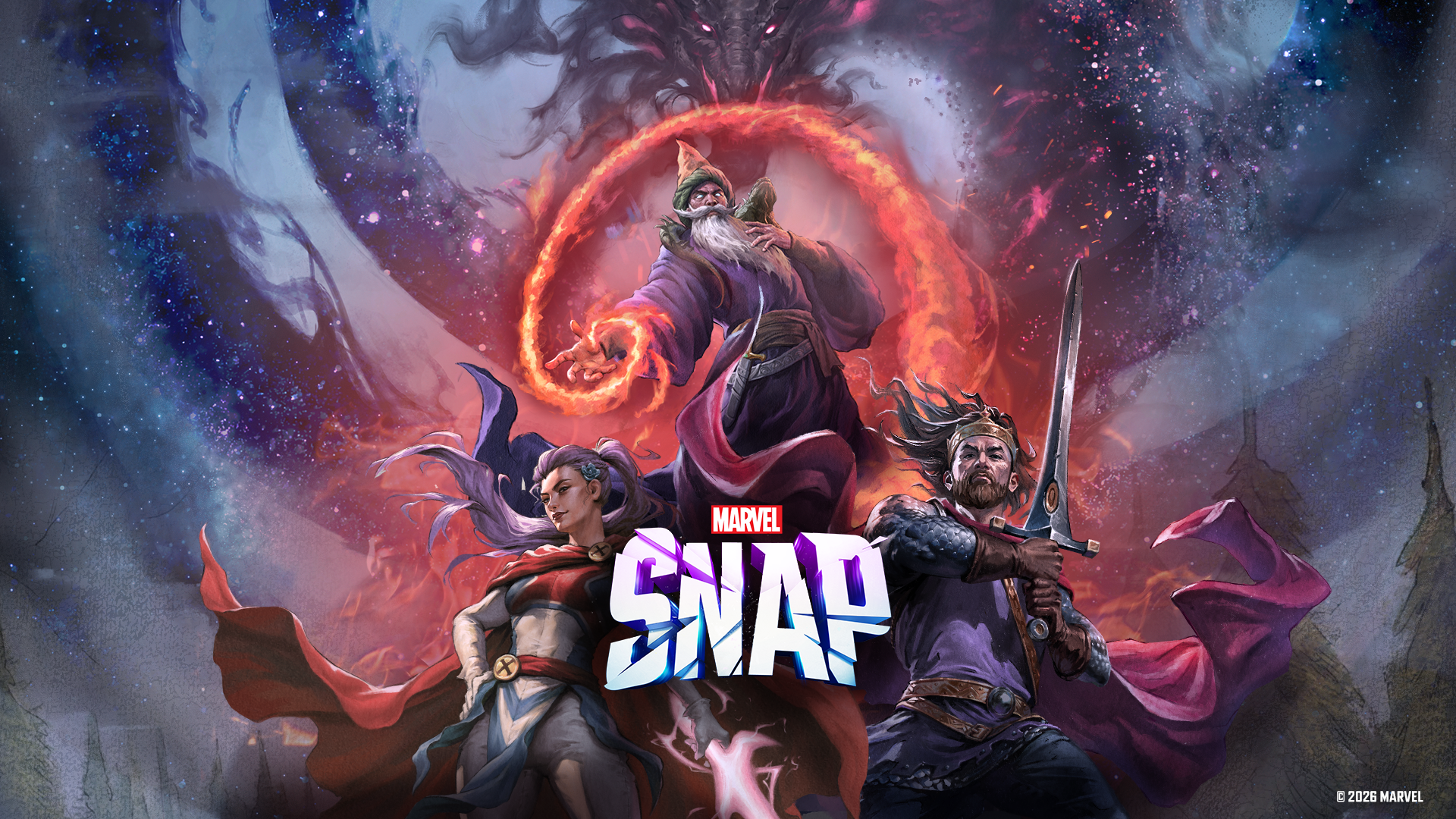
Snap Into Marvel: ‘Knights Of Avalon’ Finally Adds Some New Characters To The Game
by Austin Gorton
After three seasons in which the bulk of the new Marvel Snap cards featured new versions of characters who already have cards to their name, “Knights of Avalon” finally gives us a season with more new-to-the-game characters than not. Of course, there are still two “new card, existing character” offerings, and many of the new characters are not exactly heavy hitters within the Marvel Comics universe, but beggars can’t be choosy. Especially with two consecutive seasons of “Avengers: Doomsday counterpart” cards looming.

Obviously, this season is built around Marvel Universe versions of Arthurian legends, and while there are specific Marvel versions of characters like Mordred and Lancelot (as well as Morgan Le Fay, another figure from Arthurian lore who debuted in an earlier Snap season), they aren’t exactly well-known mainstays of the comic book world with numerous appearances under their belt like, say, Thor and Hercules (two other characters from folklore/legends/mythology with specific Marvel Universe counterparts).
Of this batch, Captain Britain is probably the biggest “name” character, and that’s largely on the strength of the deep X-Men history associated with Betsy Braddock, the character depicted on that card. Nevertheless, it’s good to see Betsy finally make an explicit appearance in the game (it’s never been clear if the game’s previous Psylocke cards are intended to be the Betsy Braddock version of the character or the current “all Kwannon” version, whereas this card unquestionably features Betsy) and to have a season with more new characters than reskinned old ones — even if they are, on the whole, being plucked from some more obscure corners of the Marvel Universe.

Arthur Pendragon & Excalibur: King Arthur’s (Marvel) comic book debut occurred in 1943’s Krazy Komics #11, a “funny animal” book published by Marvel’s predecessor, Timely Comics. After more serious/traditional appearances in the Atlas-era Black Knight comic (more on that below), Arthur made his modern (i.e., after the publication of Fantastic Four #1) debut in Strange Tales #108 (February 1963). For the most part, Marvel King Arthur has broadly the same backstory and schtick as the “traditional” King Arthur of folklore, at least as chronicled by Thomas Malory.
But in addition to making various appearances, largely in time-travel stories involving superheroes ending up in Arthurian times, King Arthur is also looped in, somewhat, with the X-Men. This is thanks to the role Merlin and the realms of Avalon and Otherworld play in the origin and storytelling engine of Captain Britain, who in turn gets pulled into the X-books via his sister Betsy and the fact that X-Men writer Chris Claremont created him and then later made him part of the cast of an X-Men spinoff book, Excalibur.
Speaking of which, the font used for the name of King Arthur’s sword (which, in the Marvel Universe, is the one he pulled from the stone) on its card matches the logo of the X-Men spinoff Excalibur, specifically the one used towards the end of the book’s run, from 1995-1997. And since this season is all about boosting cards (particularly 4-cost or higher ones), Excalibur boosts 4-cost or higher cards, while the King Arthur card draws the sword itself. Nothing terribly comics-specific about it, but it seems a fitting gimmick for King Arthur with broad appeal appropriate for the Season Pass card.
Merlin of Avalon & Grand Design: The season’s most notable repeat character, Merlin is, like King Arthur, a character drawn from myth and legend whose Marvel comics debut took place before the Silver Age superhero boom (specifically Young Allies #11 (November 1943), a Golden Age title from Timely featuring the sidekicks of Captain America and the Human Torch in World War II) before popping up in Marvel’s nascent superhero universe in Strange Tales #108, alongside King Arthur. Unlike King Arthur, Merlin has played a far more significant role in the wider Marvel Universe, particularly in Captain Britain’s original Marvel UK stories (in which Merlin is responsible for granting Captain Britain’s powers and oversees the multidimensional Captain Britain Corp, with the help of his daughter Roma).

Curiously, despite the fact that there are a few different characters in the Marvel Universe who have claimed to be Merlin, and that the “official” Marvel version of the character is typically spelled “Merlyn”, Second Dinner didn’t take any of these approaches to differentiate this second Merlin card (“Merlin of Avalon” is a title they made up). Nor is the card’s ability all that different from the original’s, costing a little less and only adding one specific spell (albeit a powerful one, and one which speaks to Merlin’s tendency to work indirectly, behind the scenes, hence Grand Design empowers cards at other locations) to your hand.
Captain Britain: Betsy Braddock first appeared in Captain Britain #8 (December 1976), with her U.S. debut coming in New Mutants Annual #2 (July 1986). For the first ten years of her existence, she was a supporting character to her brother Brian (though she did serve a brief stint as Captain Britain in that time); after her creator, Chris Claremont, brought her to the states, so to speak, she became a fixture within the X-Men, first simply as a telepath who struggled with the limitations of her physical prowess, then as a race-swapped Asian ninja wielding a psychic knife.
By the late 2010s, “Ninja Psylocke” (whose body was actually that of an assassin named Kwannon; it’s a long story) and “British Psylocke” were split into two separate bodies. Kwannon continues to serve as one of the X-Men, while Betsy once again took up the mantle of Captain Britain, holding it, more or less, ever since.
Mordred: Another character lifted from Arthurian lore, Mordred made his debut in the Marvel Universe in the pre-Silver Age Black Knight series (specifically issue #1) in 1955 (his “official” Marvel Universe first appearance is Marvel Super-Heroes #17 (August 1968)). The illegitimate son of King Arthur and his half-sister Morgause, the comic book Mordred usually ends up operating as a sidekick/stooge of his aunt Morgan Le Fay, notably in the Avengers’ 1997 return following “Heroes Reborn,” in which they are recast as fantasy characters due to a spell cast by Morgan.
More recently, Mordred popped up in the Krakoa Era Knights of X, where it was revealed that he is a mutant; that series ended, however, before much was done with that idea. Appropriately for a character who rarely operates far from his father’s sphere of influence, Mordred’s Snap card is all about synergizing with Arthur Pendragon and the season’s “power boost” archetype.

Lancelot: The last of the “imported from legend” characters of the season, Lancelot is also the Arthurian figure of the four with the smallest comic book resume, making all of eight appearances to date. Like Mordred, he made his Marvel Comics debut in Black Knight #1 (May 1955), but didn’t show up in Marvel’s superhero era until March 1974, as a supporting character in a Doctor Strange story in Marvel Premiere #14. Also like Mordred, his card ability is entirely (and appropriately) built around synergizing with the power boost archetype and the Season Pass card.
Elder Dragon of the Moon: The season’s other repeat character card, this is a new version of the Dragon of the Moon, which was introduced during the earlier dragon-focused season. As far as I can tell, dropping the title “Elder” in front of the name is entirely a convention of Marvel Snap and not based on anything from the comics, making it one of the more egregious examples (along with Scarlet Witch: Queen of Chaos and Merlin of Avalon) of the “let’s give a character an additional card and just make up a name for it” cards. To Second Dinner’s credit, the Dragon of the Moon does have some connection to King Arthur’s story, meriting its inclusion in this season — it is credited as the evil influence which led Mordred to rebel against Arthur.
That said, the Dragon of the Moon is far more consequential to the story of Moondragon (it’s where her name comes from) and the demise of the Defenders (making its first appearance in 1984’s Defenders #138), serving as the villain whose defeat requires the majority of the team to sacrifice themselves. Now there’s an idea for a season: the Defenders, featuring new-to-the-game characters like Hellcat, Nighthawk, Cloud, Gargoyle, and Elf with a Gun. Heck, Second Dinner could even sneak in new versions of Valkyrie or Moondragon if they felt the need.

Sir Percy Black Knight: This may seem like another case of “reskinning an existing card” but the Sir Percy version of Black Knight is a distinct from Dane Whitman, the “main” Black Knight (who is presumably the Black Night featured on the card of the same name). Unlike the other Arthurian characters this season, Sir Percy is a Marvel Comics original, debuting in the self-titled Black Knight #1 (March 1955) and, like Mordred, moved into the Marvel Universe proper in Marvel Super-Heroes #17.
Summoned to Camelot by Merlin, Sir Percy of Scandia adopted a status quo familiar to pulp and superheroes: as Sir Percy, he was a cowardly fop, looked down upon by the woman for whom he secretly pined; as the mysterious Black Knight, he bravely defended Arthur and his kingdom from the likes of Mordred and Morgan Le Fay, earning a spot at the Round Table. Rarely a regular fixture in the Marvel Universe, Sir Percy lived on mostly via various ghostly appearances and in the form of his ancestor, Dane Whitman, who adopted his moniker and wielded his (cursed) sword, the Ebony Blade, as one of the Avengers.
