
Talking ‘Vengeance Unchained: The Legend Of Black Caesar’ With Stephanie Williams And Ray-Anthony Height
by Rachel Bellwoar
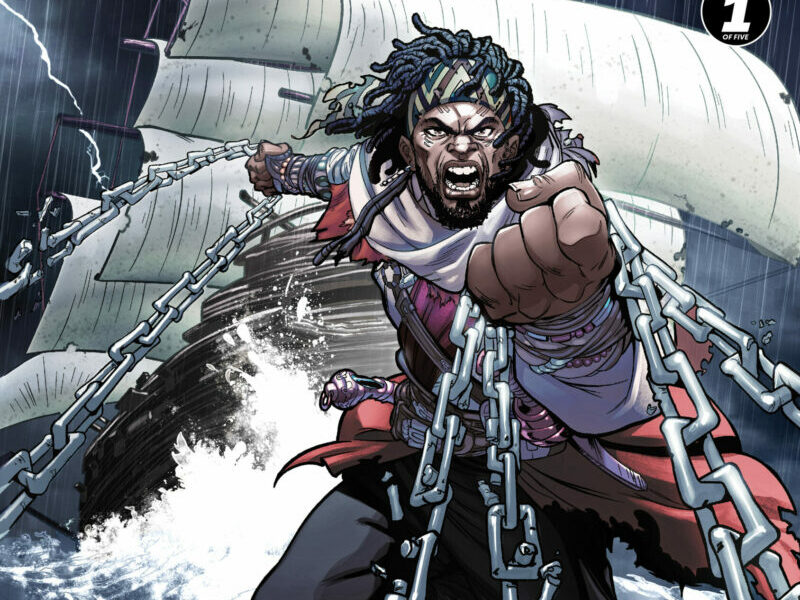
Musa’s father had warned him there would be people who would be threatened by his size and leadership skills. In Vengeance Unchained: The Legend of Black Caesar, writers Stephanie Williams and Matthew Gross — alongside artist Ray-Anthony Height and Studio Skye-Tiger — are tracking Musa’s journey from king to pirate. For more on the series, which was brought to Archie Comics by basketball star Shaquille O’Neal, check out this interview with Williams and Height below:

Rachel Bellwoar: Growing up I used to love to read about pirates. Were you similarly drawn to stories about life on the high seas?
Stephanie Williams: Yes, but mainly movies. I enjoyed movies like Sinbad: Legend of the Seven Seas, Treasure Planet, and the Muppets’ interpretation of Treasure Island. It wasn’t until my adult years that I developed another appreciation for those stories after discovering historical Black romance stories by Beverly Jenkins that featured people who look like me on the high seas.
Ray-Anthony Height: The animated series Pirates of Dark Water and the Ray Harryhausen Sinbad films pretty much encapsulate my early appreciation for pirates.
Bellwoar: For readers who only know Archie Comics for Archie Andrews, a historical fiction series might seem outside the publisher’s wheelhouse. Why do you feel Archie Comics is the right home for Black Caesar?
Williams: Archie has a longer history of taking big swings than people give it credit for. This is the publisher that put out some of the hardest-hitting horror comics of the last decade or so, and it has always been willing to stretch what an “Archie comic” can be. What mattered to me was that they wanted this story told at full strength. No one asked us to sand down the history or soften what happens to Musa. And there’s something special about a publisher with that kind of reach putting its name behind a story about a West African king.
Height: Now more than ever, Archie is reminding comic book readers why the company has been around for 87 years and remains a household name. Archie stays diverse with projects from every genre — experimental and innovative. From Batman and the Punisher to Jay & Silent Bob, comics, animation, film, and even video games, Archie has proven that there is actually nothing outside their wheelhouse.

Bellwoar: After finishing the first issue, I immediately started looking up the real Black Caesar. How was it doing research for this series and is there a general consensus about his life or are there a lot of conflicting narratives or blind spots?
Williams: There is very little consensus, which is both the frustration and the gift. The legend says he was an African chieftain who was tricked onto a slave ship, survived a wreck off the Florida coast, raided from the Keys, and eventually sailed with Blackbeard. But the paper trail is much thinner. There’s a documented Caesar on Blackbeard’s crew who was captured in 1718, and historians disagree about whether he’s the same man as the one in the Florida stories, or whether those stories describe one person at all. The people who kept records in that period weren’t interested in preserving the inner life of an African man. So the blind spots are the story, and the research I did to fill in those gaps is my way of highlighting history that inspired the imagination behind this story. For instance, while putting together Black Caesar’s supporting cast, I found myself researching glassmaking along the West African coast. Pirates need spyglasses, and I wanted someone in his crew to do so authentically. I discovered that primary glassmaking in West Africa is best documented at Igbo Olokun in Ile-Ife (southwestern Nigeria), which operated from the 11th to 15th centuries CE, well before European arrival. Archaeological excavations there uncovered thousands of glass beads alongside crucibles, vitrified clay, ceramic cylinders, and glassworking waste, proving artisans made glass from scratch using local raw materials. In issue two of the series, you’ll see how that research informed the story.
Height: Although this is more of a question for Stephanie (the research I did was purely visual), you can’t help but notice the lack of concrete details on a legendary figure like Black Caesar. So, building the beautiful and lived-in narrative like Stephanie has built into this story was probably both daunting yet fertile with possibility.
Bellwoar: Before he became Black Caesar, Musa was a king in West Africa. Why was it important to you to start this series there, rather than share that information later in flashback, and how was it trying to envision what life looked like in 18th century Oyo?
Williams: Because a flashback would have made his life a footnote to his capture; too many stories about this period begin on the ship, as if history started there. I wanted readers to meet Musa as a whole person first, a king with responsibilities, a home, people he loves, and political problems of his own. So hopefully, by the time his life and kingdom are disrupted in the most vicious way possible, you feel what was lost because you had the chance to experience it in the story. Oyo in that century was a major power with a sophisticated court and a formidable military, and it deserved to be on the page in the present tense. Envisioning it meant a lot of reading and a lot of trust in Ray and the studio, who made it feel lived-in rather than like a museum exhibit.
Height: Stephanie, in all her work, has a way of creating this connective tissue to the characters she writes. Starting out in Oyo right there alongside Musa, his kingdom, his people, and his partner, getting a sense of the beauty, majesty, and love of our MC makes the moment it is ripped away from him more potent. It’s what true storytelling is all about.

Bellwoar: We only get a few pages of Musa and Princess Adanna together in issue one, yet their relationship is cemented so clearly. Was that a real challenge to pull off?
Williams: Yes, and I’m glad it landed. With so few pages, you can’t tell readers that two people love each other; you have to show how they talk when no one else is in the room. I focused on the small stuff, something I learned from the masters themselves, Black romance authors. So leaning into the shorthand, the teasing, the way she can say what his advisors can’t. If you believe they have a history, you’ll carry her with you for the rest of the series the way he does. And once again, a lot of the credit goes to the art as well. So much of that relationship is in how they look at each other, and a glance can do the work of a page of dialogue.
Height: Steph is being modest, but it was simply a very potently written few pages. Musa and Adanna’s love for each other was palpable. I’m also a lover of romance comics and film, especially the black & white classics. In those, and in all love stories really, it was all about facial expression and body language, and with just a couple of pages, we needed to say a lot.
Bellwoar: We also get to see Musa in action a few times in issue one. Is it more difficult to stage fight scenes on land or at sea?
Williams: Ray can speak to the drawing, which is where the real difficulty lies. From the script side, sea fights are harder. On land, the ground stays put. On a ship, everything is moving, the space is cramped and vertical, and the setting itself can kill you. But that’s also why they’re more fun to write. Rigging, rails, a pitching deck, and the water waiting below all make the environment a third combatant. Musa also fights differently in each place, and that was a storytelling tool for me. On land, he fights like a king. At sea, he has to learn to fight like something else. My job was mostly to set up clear stakes and then get out of Ray’s way.
Height: Ha! It wasn’t just the sea; it was a raging sea during a storm, chaotic and visceral to the core. A stark contrast when Musa was fighting on land. Solid and powerful. The Studio Skye-Tiger team even inked my breakdowns and pencils with that in mind. I want to say they had fun with both.
Bellwoar: I didn’t immediately realize Studio Skye-Tiger was the name of your studio, Ray-Anthony. What was the collaboration process like with the other artists on this series and, for that matter, Shaquille O’Neal, who brought this series to Archie Comics?
Williams: Ray will have the best answer on the studio side, but from where I sit, Studio Skye-Tiger is why this book looks the way it does. It’s a real team effort across the line art, colors, and letters, and pages kept coming back better than what I’d pictured.
Height: We have a crew, I believe, of eight now. I act mainly as a mentor, art director, and post-production/clean up. On Black Caesar, I was also the penciler. Elisa Del Castillo and Lukas Koelbel were our main finishers, with DJ Chavis jumping on colors and Jess Havok on letters, but almost the entire crew was brought on the project. I guess you can say we operate like an anime or manga studio. As far as Shaq goes, the fact that he reached out to Archie was a brilliant move. It brought me, Stephanie, and the SST team together to bring you a new classic!
Bellwoar: Thanks for agreeing to this interview, Stephanie and Ray-Anthony!
Vengeance Unchained: The Legend of Black Caesar #1 goes on sale December 2nd from Archie Comics.
