
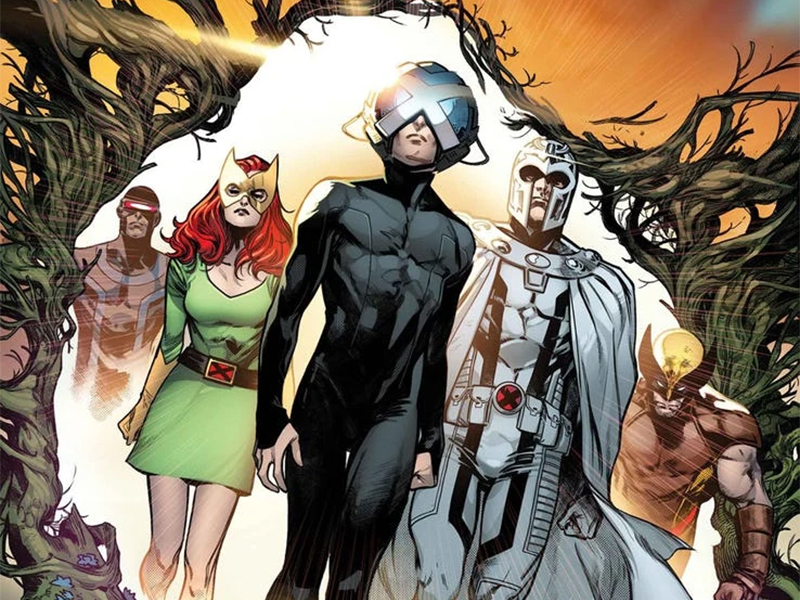
Comics We’re Thankful For: The First Krakoan Era Began With ‘House Of X’ And ‘Powers Of X’
by Scott Redmond

Time to take a break with a stomach full of ham — the superior holiday meat — cranberry sauce, and mashed potatoes. Pies are still over on the table, calling our name, alongside a bevy of other desserts.
Before diving into those well deserved holiday treats, let us continue to take a moment to truly be thankful for what we have in life. For those of us at Comicon.com, one of those things, naturally, are comic books. Not just the ones we read and review currently, but the ones we’ve read through the years that have touched our lives. Molded us and shaped us into the beings that stand before you (metaphorically) now.
My offering at this table of thanks is a massive meal onto itself — a modern event story that is already a classic, as it offered a whole new way to view and play with Marvel’s Merry Mutants. Yes, today, we give thanks and dive into the absolute bounty that is House of X and Powers of X.

“Humans of the planet Earth. While you slept, the world changed.”
With those words, the best five years ever began for the X-Men section of the Marvel Universe. With mutations on the table, the X-Men have always been a space where evolution and change is at the forefront, from their original formation, to the All-New All-Different era, to their time in the Australian Outback, to the game-changer years of Grant Morrison. Under the leadership of writer Jonathan Hickman and editor Jordan D. White, what is now known as the First Age of Krakoa joined that list and shot to the top in many hearts.
Mine definitely being one of them.
For context, the 2000s were beyond rough for X-Men. After the shot-in-the-arm that came with the Morrison New X-Men years, the titles became kind of listless. They had no reason to be; replicated titles and nostalgia were king. That’s not to mention the whole Wanda Maximoff “No More Mutants” decimation, which wiped out a ton of mutants, leading to years-upon-years of new “mutants are facing true extinction” styles of storytelling with diminishing returns.

So what made this time different?
Extinction was off the table, and mutants were allowed to thrive. Within the pages of this two-alternating-miniseries story, all of mutantkind are able to come live upon the living island nation of Krakoa. It’s a space where death no longer means anything as the usage of Cerebro and the power combination of five mutants allows for resurrection. Gone, too, are the ideas that mutants can just find a way to survive living amongst humans who hate and fear them.
Here we began a whole five years of mutants thriving, but also dealing with their own issues along with attacks still being levied against them from humans and machines. Nothing about Krakoa was a utopia. It was made clear that while this era of mutants on an island away from humans was more ideal and better created, it had massive holes and flaws. How could it not when two of the architects — Magneto and Professor Xavier — are flawed individuals who spent their formative years under the oppressive systems of humanity.

Key to it all was Moira MacTaggert, the seemingly-human ally who died many years before. Her part came via a massive retcon which this whole era hinged upon: she actually was a mutant. Not just any mutant though. Hers was a power that allowed her to die and then return, living out a whole new lifecycle each time.
The reality of X-Men we know was her tenth and (foretold) final life in a span of lives where she lived, learned, and kept knowledge every time. Imagine being a baby knowing a whole lifetime of events and that the choices you made this time still led to a bad outcome. Sounds like the kind of thing that would either drive you to madness or cause you to push even harder to make it work next time.
There is so much more that I can’t even fully dive into because this story is massive and deserves to be experienced.

The initial run makes my list is a number of reasons. First of all, as stated above, the ways it changed and actually did something new with the X-Men made me extremely happy. The X-Men have been my comic book love, alongside Spider-Man, since I was a small child. Seeing them get to actually thrive with new, different types of stories grown from this one caused my little fandom- and storyteller-heart to do backflips.
Another reason: R.B. Silva, Pepe Larraz, Marte Garcia, and David Curiel. Take one look at the artwork in these books and tell me that it isn’t one of the grandest things you’ve ever seen. Every part is gorgeous, epic, and dense as all get out.
Finally I’m thankful for this book because of what it led to.

Five years where creators of every stripe and potential voice were allowed to tell different and diverse sorts of stories. Not just diverse in genre, but in what characters and types of people were important. From the villains-stacked Hellions, to the politics-laden Immortal X-Men, to the terraformed-Mars-set X-Men Red, or the pirate-themed Marauders, the high fantasy Excalibur, or the team of resurrection investigators who were X-Factor.
There was a flavor for everyone if they really wanted to dive into something.
Within these books, we witness strides in storytelling and world building, a willingness to shed light on and boost up lesser-known or underused characters, and take great departures from what had been done before. It was not beholden to stories of the past, but instead used them to help guide things into a new present and future.

Unfortunately, Krakoa came to an end and the books doubled-back into very loosely connected nostalgia-heavy stories that took a lot of swipes at the Krakoa era. Some of it is better now, but something grand was lost when Marvel decided to just abandon all things which came from HOXPOX — as House of X and Powers Of X affectionately came to be known.
Hickman always had plans to bring the story to a conclusion, one he didn’t get to see played out, but that doesn’t mean that some of the changes and concepts couldn’t have stuck around.
It might have been too short-lived, but I’ll forever be thankful for the time that was the Krakoa era and what HOXPOX began. For the stories, the connections, friendships, and opportunities that came with it.


