
Comics We’re Thankful For: Paul Jenkins’ ‘Spider-Man’ Legacy
by Tony Thornley
Welcome to Comicon.com’s annual Thanksgiving event, Comics We’re Thankful For, in which we take a look at the comic books that made us who we are.

I got into Spider-Man at possibly the worst possible time. In the late 1990s, Marvel’s long-time set-up of four Spider-Man titles at once was losing steam. Frankly, they weren’t the only ones — Superman and Batman had been running four titles at a time for years, and those were also losing sales. So Marvel opted to trim the fat, reduce the line to two titles, and try to streamline continuity.
It was a change that landed with a thud. Writer Howard Mackie’s dual runs on Amazing Spider-Man and Peter Parker: Spider-Man (with John Byrne and John Romita Jr. on art, respectively) were extremely poorly received.
And naturally that’s when I started reading Spider-Man.
I didn’t hate it, but it was one of my earliest experiences with “this isn’t great, is it?” that I can remember.

Then, at around 18 months in, Marvel announced a change. Romita would be moving to Amazing Spider-Man and Mackie would be pulling back to only one title. They’d be replaced by Mark Buckingham and Paul Jenkins, respectively.
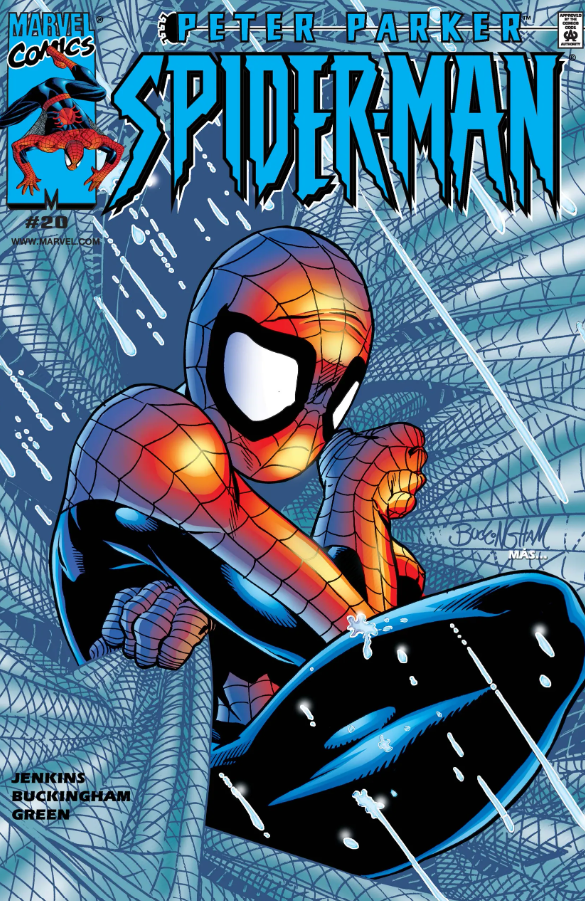
Though most readers remember April 2001’s Amazing Spider-Man #30 (by J. Michael Straczynski and Romita) as the line’s turnaround after the disastrous relaunch, it really started with Peter Parker: Spider-Man #20 by Jenkins and Buckingham.


The two Brits started their run with a simple, emotional story about newly widowed (supposedly) Peter and his Uncle Ben. As Peter struggles with his usual inadequacies, his memories of building his relationship with Ben reassure him. This is the man who became his father; he could never stop loving him, and would never be disappointed in him.

Naturally, the entire thing couldn’t be about sentimentality, but Jenkins launched into a run from here that balanced superhero action with humor and character-rooted plots. For every issue about punching bad guys (both a mix of old and new, like the Green Goblin and Typeface), he took the time to explore Peter’s life as a young widower, what makes him better than the Green Goblin, and even the impact he had on his neighborhood.

After about two years, the run shifted into a relaunched Spectacular Spider-Man with Humberto Ramos replacing Buckingham (who became the main artist on Fables). The heart stayed, though, and Jenkins’ story remained centered on Peter Parker, not the costume.


It’s an era that has, unfortunately, become largely forgotten. It’s a shame, because it’s one of the best modern Spider-Man runs out there. It’s a comfort comic that’s more than just comfort food. It’s what Spider-Man can be, and remains one of my favorites.

