
Alan Moore Book Club: ‘Illuminations’: “Illuminations”
by Koom Kankesan
Summary
This column of posts will deal with the stories in Alan Moore’s new collection Illuminations. Some of these stories are old and some are new.

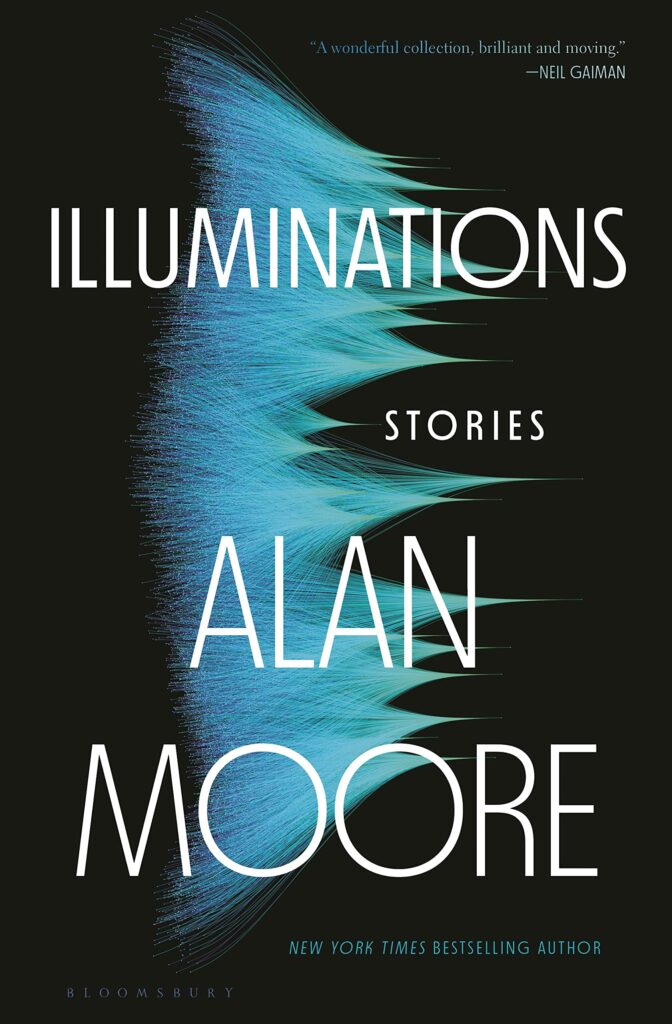
The sixth entry in the book, ‘Illuminations’, at eighteen pages long, is the short story which also bears the same title as the book. This might be a moment to stop and ponder the book’s title. The term ‘illumination’ suggests insight, shedding light on a matter, the kind of epiphanistic short stories written by James Joyce. Moore has previously been compared to Joyce for Moore’s mammoth novel Jerusalem is ambitious in scope and addresses the neighbourhood of the Boroughs (where Moore grew up, in Northampton) in time in a way that could be compared to how Joyce intended to put Dublin on the literary map with Ulysses. So far, the stories have not centred on epiphanies so much as twists, and the twist in this case comes in the guise of progress.
This story centres on a man who, having gone through a painful and messy divorce in which he’s lost custody of his children, decides to visit the seaside town of Welmouth where he holidayed with his parents as a kid. As far as I can tell, Welmouth is not a real place although there is a Weymouth in Britain that is a seaside town. Moore, in conversation with Stewart Lee about this collection of stories, did mention that this story comes from the experience of visiting the grounds where he holidayed with his parents and brother Mike when they were children. This is where, amongst the other strange delights and experiences, Moore encountered a plethora of American comics and sci-fi publications that weren’t readily available in his hometown. Recently, Moore (who is famous for keeping a demanding writing schedule and rarely taking vacations) journeyed to this place with his wife Melinda Gebbie, only to become extremely depressed and disappointed at what had happened to the place over time.

Something very similar happens to the protagonist of the short story, except that he travels alone and in the wake of his life being upended. It proves a recipe for sadness. The story is very much about nostalgia and the dangers inherent when seeking its comforts. Details of the seaside place with its amusements, pubs, trailers, etc. are rendered in sad, haunting, excruciating detail. For much of the story, the paragraphs alternate between the protagonist’s childhood memories of some aspect of the place, a thrilling ride for example or the waxworks displays, and the protagonist’s modern day encounter with the same aspect. While some things have disappeared or changed, other elements are still there like the pub which seems to have lost something, sliding into slow death. As the protagonist attempts to enjoy the aspects as if he were a kid again, he is repeatedly disappointed and finds himself further and further lost as a soul grappling with the passage of time, observing his childhood from afar.
Nostalgia should be very familiar to fans of comics. Often, we collect and read comics out of nostalgia, partially because the comics are nostalgic artifacts themselves, and partly because we try to recapture those feelings and times in our childhood when we discovered those artifacts. There is something darker here though, the idea of aging and not being able to let go of the emotions and delights we experienced as children, the futility of longing for that time. Adulthood and middle age, with all its strife and messiness, can rarely compare with or echo the pure, carefree times of childhood. By using the device of photographs from childhood and the impressions of lights and colours (illuminations), Moore takes us through the very sad and despairing understanding that things change, rarely for the better.

I do really like the catalogue of details and impressions, a very quintessentially British set of impressions, which Moore revels in when mining this period and vein of nostalgia. Some of the details, like the Vimto drink or Anglia car, instantly made me think of A Small Killing, Moore’s excellent graphic novel with artist Oscar Zarate, which also deals with a protagonist returning to memories of his childhood with his family. In many ways, this is the saddest of the stories thus far and I wonder if we are supposed to draw defeatist connections between the nostalgia in this story and the nostalgia which fuels much of adult comics collecting/reading. Moore has criticized this nostalgia and the way it props up the comics industry, the way it allows the comics industry to perpetrate cynical malpractices.
The next item in the short story collection, “What We Can Know About Thunderman”, is Moore’s 242 page critique of the comics industry – the central piece to this collection that will probably get the most discussion from readers. It will take me a while to read and digest, so I will report back on it after a lengthier time. I expect it to be powerful.

