
Christmas Book Club: ‘Daredevil: Born Again’ – Chapter 7
by Koom Kankesan
Summary
This series of posts has explored the chapters within Frank Miller and David Mazzucchelli’s Daredevil: Born Again, one of my most favourite Christmas stories. Chapter seven is the last one in the run and examines what happens when the Kingpin co-opts a deranged unpredictable war machine called Nuke in order to pull Daredevil out of hiding. Things certainly don’t go the Kingpin’s way and this must serve as somewhat of an impromptu end to the run as Frank Miller’s subsequent two parter never got produced. Regardless, this episode provides a fascinating commentary and reflection upon the U.S. military industrial complex and the perversion of the American ideals espoused by Captain America.

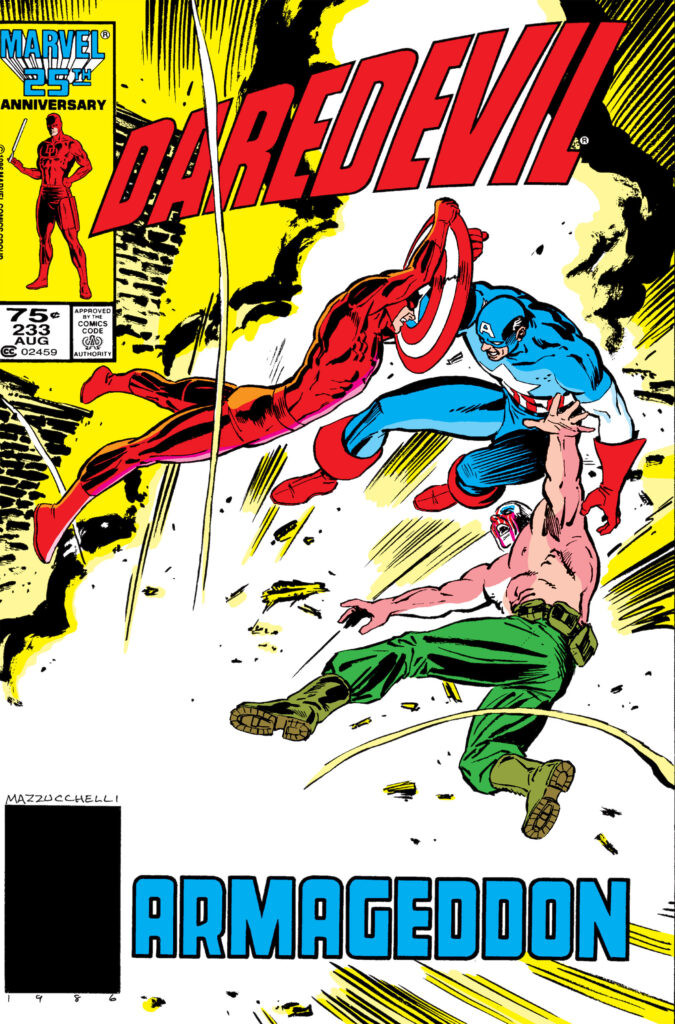
Daredevil #233. As soon as the character Nuke gets mentioned, someone will inevitably say “give me a red.” It seems to be the go-to cliche because no one really knows what to say about Nuke. He is a surprising, puzzling, bomb (pardon the pun) in terms of the style of the run or even during this whole period in Marvel history. In re-reading this chapter, I’ve come to really appreciate the writing that’s gone into it. In a previous post, I said that I’ve always liked the first five chapters the most but after re-reading, I’d have to say the writing and storytelling in the latter two chapters are excellent – I just wish there was more to it and the Nuke episode wasn’t so rushed.
We can’t really talk about Nuke without discussing Frank Miller’s immense affection for Captain America, a character who couldn’t be more different from Daredevil if he tried. In Marvel Fanfare #18 which is only a couple of years older than Born Again, we get a very traditional, patriotic version of Cap. We know that if we zip forwards to the future, especially after 9/11, Miller will once again seize on a very propaganda-oriented version of Cap. However, Born Again‘s Cap is filled with doubts of what has happened to patriotism, the golden age of values associated with America’s fight during WW II, and what has happened in the wake of Watergate, Vietnam, and the counterculture movement. Perhaps this is Miller reacting to what was already a tension in Cap’s own monthly title or perhaps it is reflective of the divide between Miller’s throwback/idealistic values and his edgy explorations as an artist responding to current events. Much like Miller’s new template for his heroes at this time, this Cap does not talk much, moves stealthily, and acts independently. Miller is able to have it both ways because while Cap retains his ideological purity, it is the military industrial complex that is corrupt and that element works very well with the weave of Born Again in general. Albeit brief, the soul searching we get in Cap’s interior monologue points to a fairly rich characterization of him in this issue.

Nuke might be over the top, more worthy of a gonzo character in Elektra: Assassin or Hard Boiled but he also points to Miller trying to reckon with the identity of the U.S. at this time and the power of shadowy agendas in the military, the CIA, and its covert operations abroad. In the same way that the atmosphere and grit of Daredevil and Urich’s struggle with the Kingpin captured the economic reality of living in New York at this time, Nuke is an attempt to reckon with the contemporary state of America’s militaristic might. Coming before the Ollie North hearings which pointed to the U.S. Iran-Contra scandal or the film Lethal Weapon which (in a sort of pulp/neo-noir way) looks at how America’s loss of political innocence in Vietnam intersects with increased corruption and crime within U.S. shores, Miller attempted to tackle the subject through Nuke. It’s not a bad attempt, is quite prescient, and deserves more accolades than it gets. Once again, if he’d strung out the character and developed his ideas more solidly, this probably would have resulted in something that simply evokes more than the catchphrase “give me a red.” The Soviets apparently used amphetamines to keep their soldiers fighting and to create super soldiers of their own during WW II, but I have no idea if Miller knew that at the time.

When I was younger, I thought that Nuke was Miller’s reaction to the type of 80s action roles we saw from Sylvester Stallone, Arnold Schwarzenegger, and others, especially in a film like Commando which would have been contemporary to Born Again, but now I see Nuke as also anticipating the Image era in comics. Whereas Nuke has a layer of irony and political commentary, the Image guys missed that, going for gonzo, violent, insanely muscled protagonists that revelled in two dimensional excess and psychopathy. Miller also anticipates his own future direction which embraces the ridiculous nature of Nuke wholesale, losing the kitchen sink realism and texture that make his 80s works so great. When you look at the buzzed blonde haircut, limited psychopathic characterization, boots with combat soles, and physical power, it’s impossible not to think of Sin City‘s Marv. Nuke also seems to anticipate video games like Duke Nukem or movies like Universal Soldier.
In re-reading this issue, I noticed lots of wonderful moments of irony employed: Matt telling Cap he hadn’t noticed the flag on Nuke’s face, the Ottos talking to Matt about there being no point in suing their insurance company and denigrating lawyers, Cap ironically responding: “I respect that, lieutenant” while he disobeys orders and creams regular soldiers foolishly trying to stop him, Foggy not noticing Matt as he brushes past and then Matt saying the same words to Foggy as he brushes past him before meeting Cap, Daredevil hijacking a checker cab (one of the acts the Kingpin frames him for in issue #228) and a bystander sarcastically asking whether he’s blind, and so on.


Everybody mentions the fire and rain soaked page introducing the Avengers and how mythological the prose is (this is one of my favourite pages too, especially because Matt is a resurrected Jesus of sorts in this story and now he’s confronted with Marvel characters who are framed like classical/ancient Gods) but look at the storytelling on the page right after it. It doesn’t leave the same fortissimo impression the previous page does but the way David Mazzucchelli uses silence to counterbalance the words, faces and expressions, and differing framing and angles during that top four panel tier is a master class in storytelling and mood. He then uses two panels in the middle tier to slow down the rhythm and shift location, just using silhouettes and rain before finally giving us a one panel tier with the Kingpin in the centre, continuing to slow down the rhythm but building tension by the use of composition and posing vis a vis the Kingpin and the syndicate member grilling him. Truly understated yet dazzling work.

The careful observer will notice that Mazzucchelli has really whittled down the detail in his figures by this chapter. We are getting an economy of brush strokes to render faces and bodies and details. However, his composition, storytelling, use of shadow and gestural brush work is so good that the images still seem very natural and realistic. If you take a look at the fantastic half splash with Daredevil rolling across the rooftop while dodging Nuke’s bullets, it looks like a very rendered image. However, if you start examining it, you can see how basically the figure of Nuke is rendered and that the helicopter which Nuke is hanging off is more blunt brush strokes than anything else. It’s worth looking at the opening splash to Daredevil # 184 where Miller has DD doing a similar somersault (into the Punisher – another gun-happy character that comes out of the Vietnam war) to look at how Mazzucchelli has incorporated the figurative brush work of someone like Klaus Janson on the one hand, and the anatomical precision of someone like John Buscema or Neal Adams on the other.

The reason why I love Mazzucchelli’s art so much is not simply because he has a command of anatomy and beauty like the best of the best do. I love Adams and Buscema’s work and others too, but you can always sort of predict what you might see from them. Mazzucchelli, because of the sheer range of influences he’s synthesized, always surprises me. Each picture is staged and thought about in very careful storytelling terms when it comes to Born Again. Each of these panels, every single one of them, seems distinctive and imprinted upon my mind from a young age. I’ve tried during these discussions to attempt a description of the things I love about Mazzucchelli’s artwork but it really goes much deeper than that. There is a very primal level on which this stuff is imprinted upon me, fused with my mind. It bypasses the intellect and my ability to render through words. It’s got an almost fetishistic quality: something about the way Mazzucchelli draws Daredevil’s belt on his costume for example or render the belt buckle, or the way he draws the naturalistic boots of the costume. The feeling that gloves are real gloves with real fingers that have weight and joints, bend in the way fingers bend. It’s something about the stance a character will have in a panel that communicates so much visually. It isn’t just that the anatomy is well studied and pleasantly constructed, it’s the way the thigh fits into the hip socket or the way the character’s torso pivots through the figure’s movement. The way shadows drop and seem to slide in a given panel, or the way musculature is gestured and defined within shadows, the way Daredevil’s mask seems to become a face all unto its own, both realistic and figurative at the same time.
It’s time for me to finally wrap up and stop trying to analyze this book. I think this tale will be one of the most impactful I’ve ever read, right to the end of my very life. I know this is also true for other people. I wouldn’t mind if they throw a copy into my casket with me when I am buried. Like an ancient Egyptian totem filled with spiritual hieroglyphics that will accompany me into the underworld. For me, if there’s one thing I have to pinpoint about why this is the case, I’d say it’s got to do with the incredible representation of spirit, the urge to never give up, that impressed me so much when I first read it at the age of twelve or thirteen. However, with each reading, there are other elements that speak to me just as much and there’s so much more I just don’t have the time to tackle, or simply haven’t noticed, or have felt but can’t quite tie into words. For example, I didn’t even get a chance to discuss the line that’s been crossed by having Ben Urich kill someone in the last chapter or Daredevil killing someone in this one.

If you’ve had a chance to re-read the book yourself, I hope it’s provided a reading that is also rewarding and affirming for yourself. At the very least, I hope you found or find something of depth in it as it is a fascinating story with all sorts of openings and strands and rough edges that define a particular place and time, and a significant stage in the history of comics. It points to what really good comics can be when they take on artistic concerns and intent that don’t condescend towards mainstream comics but somehow transcend them at the same time. Miller’s note at the end of the original printing of the trade paperback emphasized the special promise of Mazzucchelli’s work and that Mazzucchelli was thinking of writing and producing his own comics. The note is reprinted as an afterword in modern collections. It’s a bit understated in hindsight, given the very unusual and unpredictable trajectory of Mazzucchelli’s artistic practice and career after Born Again. I really don’t think there are many others, if any, quite like him. Born Again didn’t so much see the deconstruction of Daredevil as it saw the breaking down and future rebirth of Mazzucchelli’s sensibility, intent, and style. It’s quite remarkable and you can really see his style mould and transform as the story progresses.
I wish you all a Merry Christmas and happy holidays – thanks for reading along!
