
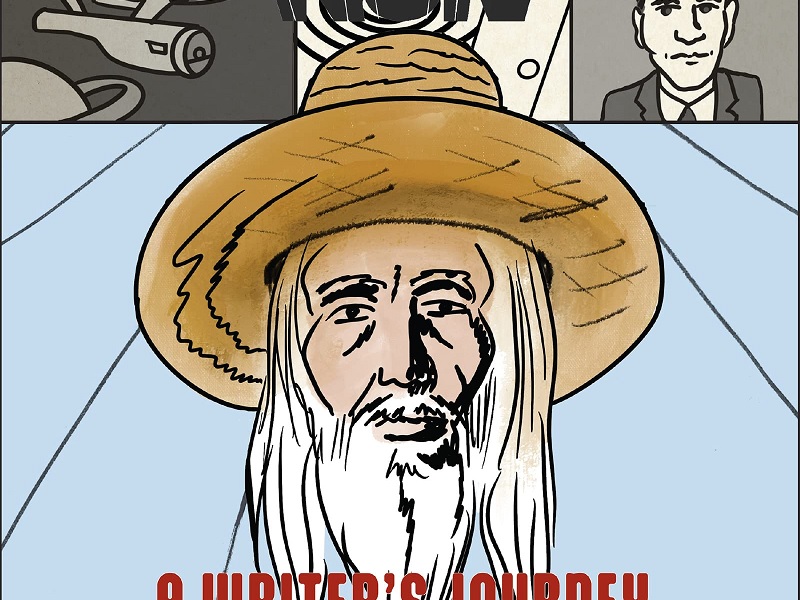
An Interview With ‘George’s Run’ Creator, Henry Chamberlain
by Rachel Bellwoar
He almost didn’t get credit for his work on 1960’s Ocean’s 11 and is responsible for writing some of the most revered episodes of The Twilight Zone, but who was George Clayton Johnson? After encountering George at a memorial in 2012, comics journalist, Henry Chamberlain, knew he had to find out. His upcoming graphic novel, George’s Run, is the result and for some recommended reading and insight into George’s life, check out this interview with Henry:

Rachel Bellwoar: The films and TV shows George worked on are far from small fry – he wrote the first episode of Star Trek to be broadcast on TV! – yet his name doesn’t necessarily have the recognition of a Rod Serling or Gene Roddenberry. When working on this graphic novel, did you have a particular audience in mind, for example sci-fi fans who might already be familiar with George’s credits, or readers for whom sci-fi might be completely new to them?
Henry Chamberlain: I first heard George speak in public when, in 2012, I attended a memorial tribute for Richard Alf, one of the founders of San Diego Comic-Con. I was blown away by the introduction before George had even spoken a word. Apparently, George had managed to write for many of the leading TV shows from the golden age, including Route 66, Alfred Hitchcock Presents, Honey West and most notably, The Twilight Zone and Star Trek. His stage presence was self-assured and accessible. From that moment, I knew this was someone that a graphic novel could be built around. Shortly after that event, I got in contact with George, and we began a series of interviews and informal chats. The idea, for me, had always been to have George’s life and times lead the way to an even bigger story. He was there at the beginning, and being an important part of, so much, including San Diego Comic-Con.

Bellwoar: Having written about comics for years on your website, Comics Grinder, what about George’s story did you feel was especially suited to being told as a graphic novel?
Chamberlain: George’s story is one of those stranger-than-fiction narratives that, as a writer, you embrace when the opportunity presents itself. Here was someone from the most humble of beginnings who, by sheer determination and just the right factor of luck, carved himself a place at the table. Yes, he had to carve it out since, on the face of it, someone might be justified in thinking he didn’t belong at the table—and yet he did belong. That alone is quite compelling stuff for a story! And then you add all the larger-than-life pop culture that George made a significant contribution to.
Bellwoar: Traveling from Seattle to LA to interview someone is no small move. Having already built-up a relationship with George through your podcast, what made you want to arrange to meet in-person?
Chamberlain: All along, from talking with George, I had been piecing together bits and pieces of what could make for a graphic novel. In order to get me deeper into the weeds, I needed to also chat with him in person. Off and on, I had been doing a lot of research, and one interesting factoid that impressed me was how Forey Ackerman had opened up his home to total strangers. Forey, as you may know, was the founder of Famous Monsters magazine and the guy who coined the term “sci-fi.” Well, he collected everything he could get his hands on and ended up turning his home into a museum. Back then, it wasn’t totally uncommon for some more adventurous celebrities to open up their home to strangers. I figured that George was a kindred spirit and he was. He invited me into his home and that was very helpful. I also got a chance to show him some samples of what I had in mind for a graphic novel. He gave me his blessing and said to follow my own artistic license.

Bellwoar: Do you remember which of George’s scripts you encountered first or when you first became conscious of who George was, as the creator of these amazing stories?
Chamberlain: If there’s a story I really like, I’ll always look up the author. So, I was aware of George going back decades. And I think I can see how that was the case for many other fans. You can argue that all of George’s scripts for The Twilight Zone were among the most memorable from the series. And, surely, you would have a hard time denying that “Kick the Can,” wasn’t among the most iconic. It represented the best the show had to offer when it was included in 1983’s Twilight Zone: The Movie. So, I’d made a mental note way back then. Over time, I was very familiar with the top four scripts that George wrote. But it had to have been many years later before I connected all the dots! That brings us back to my epiphany in 2012 during the Richard Alf tribute.
Bellwoar: George’s Run includes many scenes of George meeting with members of “The Group,” a group of genre writers that included Charles Beaumont (The Intruder) and Bill Nolan (George’s co-writer on Logan’s Run). Often you have them meeting in specific locations. Was it easy to find photo references for these places?
Chamberlain: Well, the locations came to me in fits and starts. I had been doing research on another project when I became aware of the significance of Musso & Frank Grill, dating back to 1919. I couldn’t help but imagine the guys hanging out there. This was later confirmed to me by William F. Nolan. Yes, Musso was a favorite hangout. I’ve been to Musso a number of times so I know the place and love it. The same can be said for Canter’s. Another place I have firsthand experience with is Johnie’s, which no longer operates as an eatery but you’ll see it used in many TV shows and movies. I filled in the gaps for the other locations by doing research. Pink’s, in fact, still exists and I want to go there soon.

Bellwoar: In what ways did the 60’s and George’s strong support of cannabis use help influence the art style and structure of this book, and is there a trippy image you’re especially proud of?
Chamberlain: I did as much research as possible in order to get a better sense of the Sixties. I interviewed folks who are older than me to get their firsthand accounts. Overall, it was a combination of earnest sentiment and corporate-sponsored mass-produced hype, much as it is in any modern era. Youth culture was predominant, no surprise there, with an emphasis on rebellion, permissiveness, drug and hedonistic experimentation. All that said, I was thrilled to incorporate as much of a psychedelic vibe as possible. It was honoring George’s vision and it made sense for the book’s look and feel. I think the page where George is announcing I’m about to go on a quest is pretty cool.
Bellwoar: As you mention in the graphic novel, one of George’s favorite themes was defying death and he himself would. Did he really tell Chuck Beaumont that, on his deathbed, he would make sure to live until Christmas (George passed away on Christmas Day 2015)?
Chamberlain: George predicting his death on Christmas Day was my own artistic license! I think it really works. Something else on that subject that I did not include in the book has to do with another connection between Rod Serling and George. Now, I did emphasize that Serling was tickled by the fact he was born on Christmas Day. But I also want to add here that there was a famous radio broadcast that both Rod and George would most likely have heard as children. The Plot to Overthrow Christmas is a radio play written by Norman Corwin and first performed on December 25, 1938. Rod would have been 14. George would have been 9. Norman Corwin would have been one of the influences on both writers. In fact, Serling would go on to write 1964’s Another Christmas Carol, which you might argue has a hint of a connection going back to Corwin.

Bellwoar: Had you been able to meet George again in December 2015 as planned, were there any subjects you were especially looking forward to asking him about?
Chamberlain: Well, I would have been looking for more clues about the writers that George got to know, especially Charles Beaumont. I’m always looking for more of a sense of “being in the room when it happened.” As I say in the book, I had reached a point where I was alone with what I had gathered from George and had to move forward. That said, George had already provided me with a treasure trove of clues, which either involved researching further or reading the books that he recommended. I did both and that filled in the gaps quite nicely.
I think one of the great takeaways from working on this book is gaining such a finer appreciation for all the writers involved and their collective vision. What were they aiming for? Was it strictly “dark fantasy” or writing a “psychological thriller”? Sometimes it was science fiction and sometimes it was not. Some fell a bit short; and some rose to great heights and, even today, are not necessarily well-known. For example, I highly recommend that you check out The Case Against Satan, by Ray Russell. That novel was published in 1962 and it is not dated at all and quite chilling.
Bellwoar: Overall, how has the experience of working on this graphic novel been different from your experience on your first graphic novel, Alice in New York?
Chamberlain: Alice in New York was, and still is, my great coming-of-age graphic novel. Back when I was working on it, I had envisioned it as a short story that could be developed into a prose novel. Only later did I conceive of it as a graphic novel. All in all, I know I got the story right. But, with the advantage of many years of hindsight, I see where I could come up with an improved version. This is a process that auteur-cartoonists go through over the span of time. One great example is Glenn Head‘s early short comics and how that evolved into more refined work, finally achieving his vision. For now, the only version of Alice in New York resides within the collection, Night at the Sorrento and Other Stories.
Fast forward to my experience with George’s Run, the big difference is that this is not a focused auto-bio work and yet I do bring in elements from my previous work which includes me in the story. I’m very grateful to Rutgers University Press for appreciating what this graphic novel is about, believing in it and deciding to publish it. The book will be part of its media studies and I’m quite honored and thrilled about that.
Bellwoar: Thanks for agreeing to this interview, Henry!
George’s Run: A Writer’s Journey Through the Twilight Zone goes on sale May 12th from Rutgers University Press.

