
Anime Boston 2023: The Osamu Tezuka Story
by Tito W. James

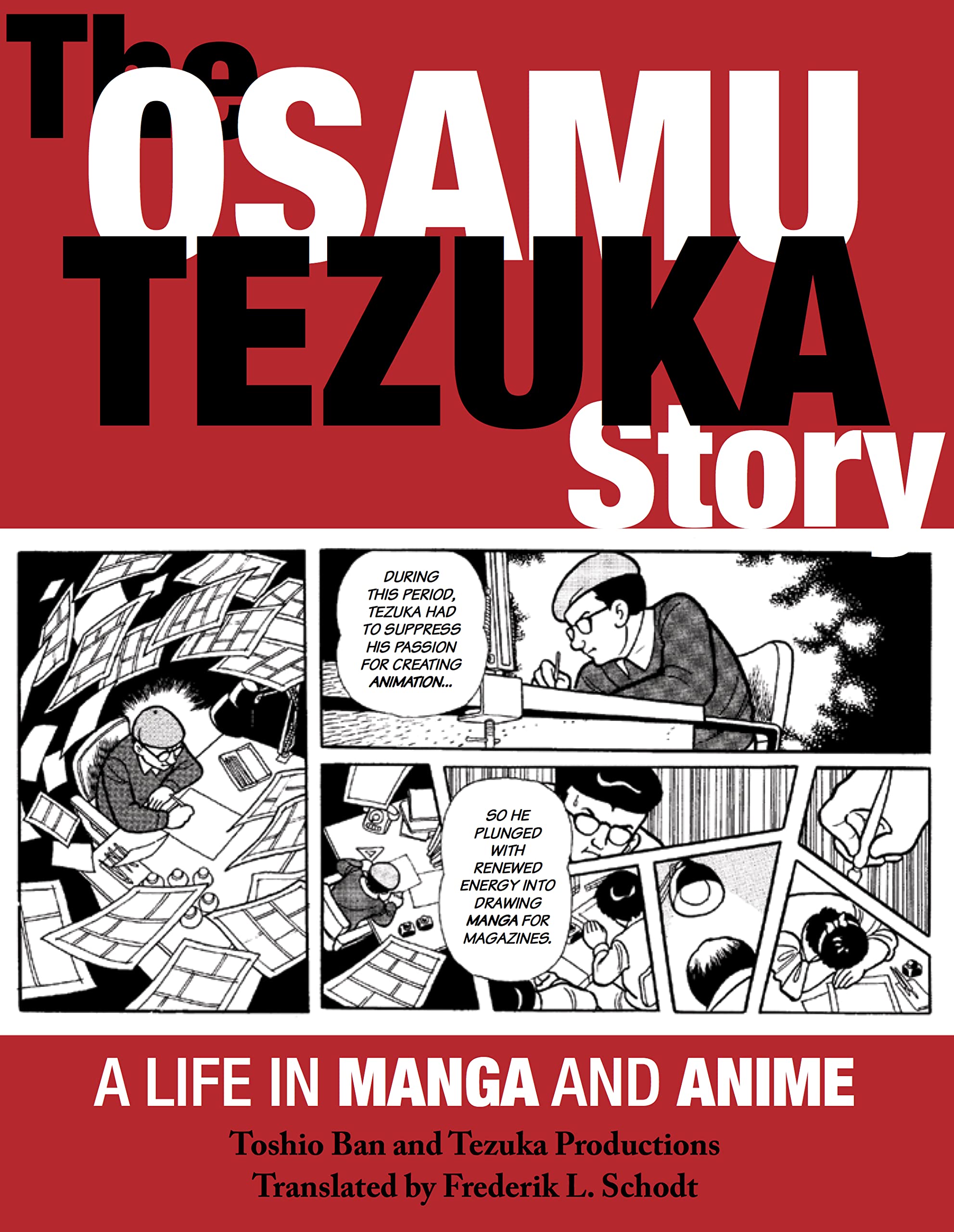
During Anime Boston 2023, I picked up a copy of The Osamu Tezuka Story: A Life in Manga and Anime by Toshio Ban. I’ve enjoyed manga biographies like Shigeru Mizuki’s Nonnonba and I’m a big fan of Tezuka’s adult manga so I decided to pick up the phone-book sized manga.
The Osamu Tezuka Story details Tezuka’s life from an early age and chronicles his struggles when Japan was at war and the post-war manga revolution he helped pioneer. I can’t say that I’d recommend this book to anyone who’s not familiar with Tezuka’s work. Ban covers the nitty gritty of Tezuka’s grueling work schedule and the many ups and downs of his anime production. I wish there had been more time spent on how Tezuka came up with his manga projects like Black Jack and Dororo. Tezuka’s creative process remains a mystery possibly even to himself.
As an American reading the manga, several things stood out to me. I didn’t know that until 1946 the Emperor of Japan had been considered a “living god.” The concept of the divine right to rule was more pervasive than I thought. The inhumane actions during WWII and specifically how Tezuka was thought of as useless for not being tough enough strikes an emotional chord. I see parallels in what transpired during this period in every country.
However, in addition to humanity’s fallacy in falling prey to militarism and violence, there were voices that encouraged Tezuka to pursue his creative dreams. Tezuka was encouraged to keep drawing manga by teachers who understood what he was capable of. There were many orphans created during the war whose physical wounds would heal, but they needed their soul to heal as well– and that was the medicine that manga provided.
Today’s children continue to face problems ordinary medicine cannot solve– violence, bullying, and even suicides. But can’t we offer them a safe space to heal, both psychologically and spiritually?
–Osamu Tezuka
The god of manga laid the groundwork for a multitude of artists that would come after him. Many of the challenges that face manga readers and manga creators still persist. The public scrutiny of manga as a storytelling medium during Tezuka’s era is identical to the struggles for artistic validity that animation and video games have faced in America.
Anime and Manga are more popular now than they have ever been. And as the popularity grows so does this discourse around what’s authentically anime. Contrary to popular belief, anime’s original meaning was not “Japanese animation” but “limited animation.” Tezuka and his company were copying limited animation techniques used by Hanna Barbera. Coincidentally, the Hanna Barbera characters were designed by Iwao Takamoto, who was Japanese.
I hope that a greater understanding of anime’s true origins will dispel any unproductive online arguments about who anime can be created by or appeal to. Osamu Tezuka was philosophically cosmopolitan and had great optimism for the future. While the 21rst century is far from the utopian space age Tezuka envisioned in Astro Boy, we can still learn much from the old master.
These future children or [next generation] will be capable of a new global way of thinking– one that transcends nation, race, ethnicity, and religion– and they may well try to forewarn those of us still on earth.
-Osamu Tesuka
Anime and Manga are now a global phenomenon and where is goes from here is up to us.