
Empowering Positive Change: Discussing ‘La Borinqueña’ Omnibus With Creator Edgardo Miranda-Rodriguez
by Tom Smithyman
Zoop is launching a new crowdfunding campaign today to create an omnibus of La Borinqueña. The 300-page book will include the complete first story arc the first four graphics novels as well as supplemental material. In a Comicon exclusive, creator Edgardo Miranda-Rodriguez discusses his humble beginnings, his philanthropic mission and how characters like Spider-Man spoke to him.
Tom Smithyman: What does it mean to you to have your La Borinqueña stories assembled together into an omnibus?
Edgardo Miranda-Rodriguez: I started writing La Borinqueña in 2016 with a short story that grew into a graphic novel series. I announced in May 2016 that I was going to independently produce this project, and, from the onset, it made mainstream headlines from NBC, People, HuffPost, NPR, The New York Times to The Washington Post, who first broke the story.
I was invited by the Smithsonian National Museum of American History to deliver a talk about my series with only three fully finished pages to present to close to 500 graduate students studying curatorial arts under their fellowship. While still in production of that first issue, the Smithsonian Asian Pacific American Center offered me a grant to produce a La Borinqueña art exhibition and comic book that would be included in our first issue and added to the permanent collection of the Smithsonian National Museum of American History.
Over the years, I’ve continued to write and self-publish my series that are in the hands of students across the world because of the educators that introduce my work into their classrooms. My hope is that collectors and educators will embrace the full edition as one large story arc that I’ve developed over the years.
Smithyman: Would you remind us what La Borinqueña means and how Puerto Rico plays such a key role in the story?
Miranda-Rodriguez: La Borinqueña is the name of Puerto Rico’s national anthem and is derived from the original name of the archipelago Borikén. The titular character, Marisol Rios De La Luz, is imbued with superhuman powers by the ancient goddesses and gods of the Taínos, Puerto Rico’s indigenous people. Her abilities are connected to the elements with the manipulation of weather, earth and water. Her star is a sentient entity that connects her to the mother goddess Atabex and allows her to view and study the past.
Smithyman: Marisol Rios De La Luz is La Borinqueña’s alter ego. How did you determine you wanted a female main character with African roots for your story?
Miranda-Rodriguez: In looking at traditional superhero storytelling, the protagonist has always been a man. In studying Puerto Rican history and Taino mythology, I realized that women played a central role. I wanted my hero to represent the unsung hero of history and our lives. As an AfroLatina, it was important to convey to readers the diversity of Latin people, who are an ethnic group comprised of multiple races. 
Smithyman: The proceeds from the crowdfunding campaign will of course go to printing the book, but you’re also setting aside money for the La Borinqueña Grant Awards, which awards micro-grants to non-profit organizations throughout Puerto Rico. Talk a little about the impact that these grants are having in Puerto Rico.
Miranda-Rodriguez: Since Hurricane Maria we’ve committed ourselves to sustainable philanthropic work in Puerto Rico. This was started by our collaboration with DC Comics when we published our benefit/crossover anthology Ricanstruction which won me Eisner’s Humanitarian Award. We used the initial funds from that project and our recent team-up with Rosario Dawson to distribute micro-grants to local grassroot organizations that don’t typically have the infrastructure to compete with larger corporate non-profit organizations.
In time of crisis, people immediately rise to the cause and donate, however this diminishes after a few weeks. Given the recovery efforts of Puerto Rico since Hurricane Maria, the COVID-19 pandemic, earthquakes and this past fall’s Hurricane Fiona, our grants go directly to groups on the ground making a direct impact. Our grants have been used to create a library, provide tools to farmers, open art spaces, fund educational programs and so much more. It is truly rewarding to see that our graphic novels empower real heroes’ positive change every day in their communities.
Smithyman: You’ve been an activist most of your life. Why is activism so important to you, and what made you determine to integrate it into other aspects of your life, including comic books?
Miranda-Rodriguez: I grew up in marginalized communities from New York to Puerto Rico. I’ve witnessed firsthand the injustices and lack of resources available to good people struggling to make a better life for themselves and their families. I would collect bottles and cans to exchange them for nickels so I could buy my own comic books. These comic books introduced me to heroes that fought selflessly against the odds to make the lives of others safer and better. These fictional heroes fueled my passion for social justice.
I also grew up poor, and it was heroes like Spider-Man that spoke to me. I grew up a nerdy Puerto Rican who was teased. And because I lived in 22 different places by the time I was 18, I felt like a mutant, an outsider that was just trying to fit in. I saw the natural fit for activism and comic book storytelling, but in my own way I make transformative change through stories and charity work.
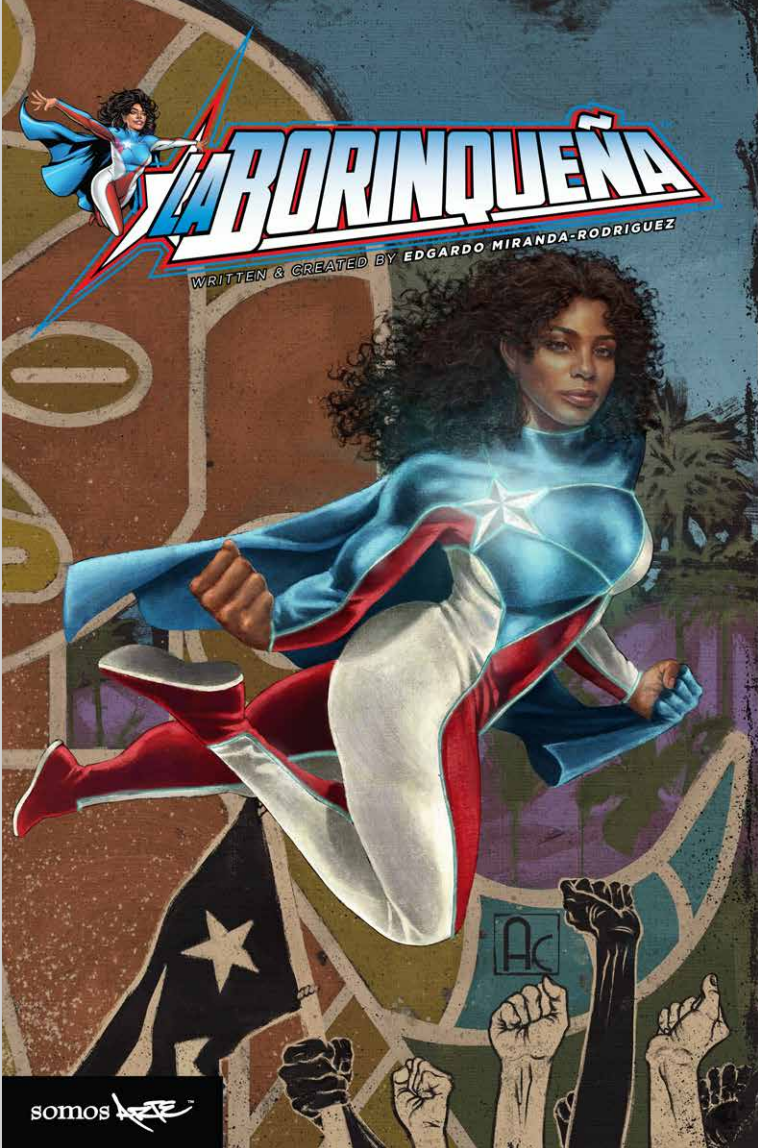
Smithyman: Ariel Jesús Colón’s newly painted cover for the omnibus is stunning. What did you think when you first saw it?
Miranda-Rodriguez: Ariel introduced his work to me before his DC Comics debut with Dark Crisis on Infinite Earths. He is a fellow Puerto Rican living here in the U.S. like me and was inspired by my work. In support of our commitment to philanthropy, he joined the ranks of other artists like George Pérez, Carlos Pacheco, Frank Miller, Bill Sienkiewicz, Tony Daniel and others who donated original La Borinqueña art to our series.
He reached out to me directly and donated a full-color painting that we included in our selection of art for Joel Christian Gill’s Boston University exhibition, Comics Is A Medium, Not A Genre. Ariel then offered to paint the front and back cover for the La Borinqueña Volume 1, with my art direction. I introduced him to the classic Puerto Rican art style serigrafia (hand-made screen printed posters). While visiting Puerto Rico I asked him to visit the master painter’s exhibition Rafael Tufiño: Por Las Calles de Viejo San Juan which led him to do a deep dive into this genre of art and he applied this into his cover in the background for the interpretation of Atabex, the Taíno mother goddess and V•G1GANTE, our giant mecha.
Ariel Jesús Colón: This artwork for La Borinqueña truly reflects my passion and dedication to showcasing the beauty of my roots and heritage. I hope it resonates with others and helps promote diversity and inclusivity in the art world. It represents these fantastic characters with a punch of my style and a kick of serigrafia! Our size may be small, but our impact is felt globally!
Smithyman: You mentioned actress Rosario Dawson earlier. What role is she playing in this new project?
Miranda-Rodriguez: I met Rosario Dawson in 2016 just before our La Borinqueña parade float was set to role up 5th Avenue for the National Puerto Rican Day Parade. Her uncle Gustavo Vazquez would reconnect us after Hurricane Maria hit Puerto Rico in 2017, when she asked how she could support our philanthropic work for Puerto Rico. Since then, she has co-hosted art shows, signings, and even guest starred as herself in La Borinqueña Guest Starring Rosario Dawson that was produced by NRDC. She continues to be an ally of our work and even has her own La Borinqueña costume.
Smithyman: The first issue of La Borinqueña is now part of the Smithsonian National Museum of American History’s permanent collection. When you first created the character in 2016, did you have any aspirations that she would be as impactful as she’s been?
Miranda-Rodriguez: I never would have expected seven years later that I’d have published enough stories to make my first collected hardcover edition. I am in awe that the Smithsonian Museums have supported my work in various forms. From adding the first issue to its permanent collection, exhibiting our costume next to Lynda Carter’s Wonder Woman suit in their superheroes exhibition, to receiving a grant and asked to exhibit art for the Smithsonian Asian Pacific American Center, to having art from our first issue exhibited alongside an actual Taíno museum artifact in the traveling exhibition Caribbean Indigenous Resistance / Resistencia indígena del Caribe ¡Taíno Vive! which is open now at the Museum of Arts and Sciences in Daytona Beach, Florida.
If you visit the Molina Family Latino Gallery inside the Smithsonian American History Museum in Washington, D.C., you’ll find our graphic novels inside their library. I’ve been independently publishing my series for seven years and I’ll also have my first Boss Fight Studio action figure line coming out this fall.
It’s a lot to sometimes take in, to know that the dreams of that child who walked the streets of the South Bronx collecting bottles and cans to buy comics is now making his own comics that are tied to philanthropic work in Puerto Rico, well it’s just all incredible. But I’m grateful to have the support from fans, institutions and journalists like you who see the value in sharing my story with your readers.
Smithyman: Congratulations on your many accomplishments, and best of luck with the campaign.

