A More Innocent Age: Discussing Crowdfunding With Artist Bo Hampton
by Tom Smithyman
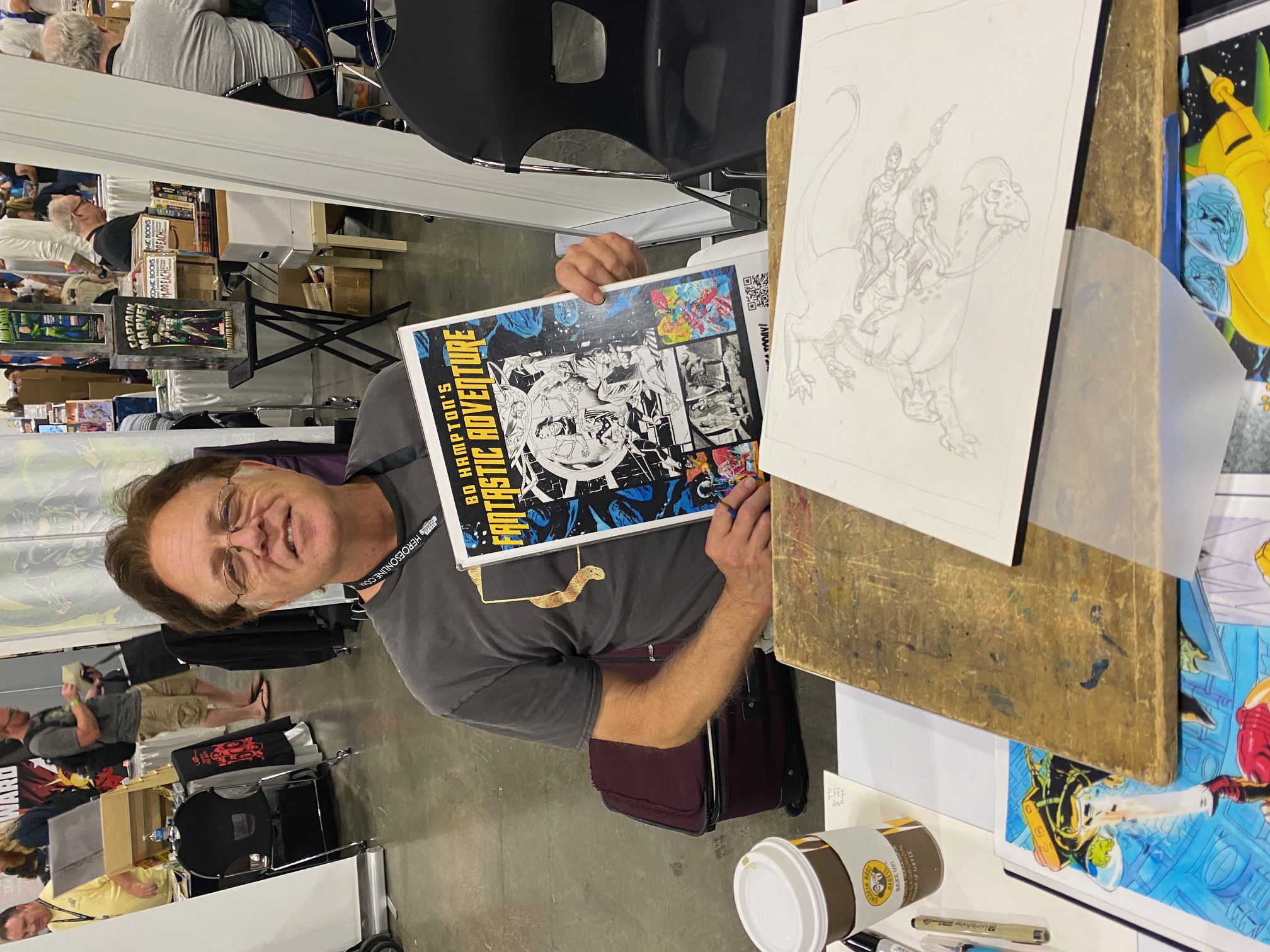
During the recently concluded HeroesCon, comics veteran Bo Hampton launched a new crowdfunding campaign for his upcoming book Bo Hampton’s Fantastic Adventure. I caught up with Hampton on the show floor while he was drawing an illustration of Flash Gordon and Dale Arden. During the interview, Hampton discussed the book, his work with comics legend Al Williamson and his own unique artistic style.
Tom Smithyman: Bo, thanks for taking the time during the show to talk to me about Bo Hampton’s Fantastic Adventure. Tell me about the book.
Bo Hampton: It’s an art book composed of the drawings that I’ve done starting in 2018 lasting through the pandemic and up until now – whatever it’s been five or six years. It’s based on former commissions that people had asked me to do. And stuff that I love to do – just vanity art with nobody watching over my shoulder – just to see if I could sell the stuff. And I sold enough originals that it provided a `page rate’ so that I don’t have to work for a company necessarily. I sold enough of that that I was able to bide my time and put this book out.
Smithyman: You launched the campaign on June 16 at HeroesCon. It seems to be going pretty well, doesn’t it?
Hampton: We met the goal within 12 hours or so.
Smithyman: That’s crazy.
Hampton: Yeah. I’ve been talking to people about it for several years on different sites. And it looks like that process is highly viable for future volumes.
Smithyman: Why did you limit yourself to your work from 2018 to the present?
Hampton: I had been working in Atlanta, Georgia, for the film industry and in television doing storyboards. And it had to the point where it hadn’t completely fallen away but it wasn’t anywhere nearly as lucrative as it had been.
So I started doing stuff like going to more conventions. I had laid off the convention circuit for like 10 years while I was doing all that. So I started selling my artwork again. And I started looking at ways to make money doing comics. But I couldn’t really do comics because to do a continuation of a comic like Lost Planet, which I did in ’83, I would have to ask for a lot of money on Kickstarter to cover my page rate. The solution was for me to do these books where the artwork was set up. Each illustration is pretty frameable – it’s designed to be a frameable item.
So it scratches my itch of staying in comics. Even though it’s not storytelling, it allows me to keep my drawing skills up. And my painting skills have gotten a lot better since I’ve been doing this, because when I was doing comics, it was largely line drawings.
Smithyman: Beyond the immediate financial goals for this campaign, what do you want to accomplish with this book?
Hampton: What I really want to do is to go back to Lost Planet, my baby, which I wrote and drew, as to release a sequel to it called Escape From Lost Planet. But I need to get a couple volumes of this before I can afford to do that.
Smithyman: How much art do you have saved away for future volumes of Fantastic Adventure?
Hampton: I think I have enough for at least one more. The first book is 172 pages, so it’s a lot of stuff. But one of the smart things I decided to do was to bring people into the process, which also allows me to almost double my page count. I’ll show them in-process pencils, which I would like to see if I was a fan. Especially in an art book. I want to see the process. I feel like there’s never enough of that.
Smithyman: You call the book Bo Hampton’s Fantastic Adventure. Why make it singular when you have other volumes planned?
Hampton: The reason it’s singular is because it’s a combination of fantasy and adventure genres – not that I have a bunch of adventures in the books, because I don’t! It’s just illustrations!
I want to tell story. In some of my illustrations – most of them really – it’s not just a standard hero pose. I’ll have something going on that makes you wonder what had happened immediately before or what will happen afterwards. It tells a story, even within a single illustration.
Smithyman: You have created so many illustrations over the last few years. How do you choose which ones to include in this book?
Hampton: I was starting with stuff. I always loved that stuff, and I wanted to see if I could sell it – which I did almost immediately. It’s not that the illustrations were so great, but I had done comics for a long time and people knew who I was – and this was someone new doing that material.
I was intentional. I knew that ultimately I wanted to have a book – and each one of these helped to pay for the book – and I’m going to have fun along the way. It was the only thing I could do that could keep me afloat in order to do what I love to do.
Smithyman: But this is not exclusive Burroughs-inspired work, right?
Hampton: No, I went off on things that were fantasy and adventure. But within that category, I include a lot of stuff like superheroes – the more mainstream stuff that leans more toward adventure. That would be the Silver Age. Challengers of the Unknown. Tales of the Unexpected. Hawkman. All that stuff that I consider to be fantasy-adventure as opposed to pure muscle man-type superheroes. It’s a more innocent age, and it’s what I respond to.
Smithyman: Before you went into the movies, you had a long history in comics, starting with Al Williamson, right? How has that experience informed your work to date?
Hampton: I was his assistant. And it’s another reason I wanted to do this book. After Al’s death, I realized I never talked about it. People need to know how great he was as a person, as an artist, the whole thing. One chapter of this book is just me and Al. I’m going to talk about my experience with him, how I learned from him. He would basically break down pages for me to do pencils of, and they he would either ink them if he had time himself or give them to another assistant. In the case of Crimson Forever, a Star Wars story that I helped him on, it was Tom Palmer. So I couldn’t lose.
He hired me. I was a kid. I had never worked professionally. And he hired me to help him to do 12 pages, which is amazing.
Smithyman: How do you describe your artistic style?
Hampton: It’s a conglomeration of me trying to be Williamson and Frank Frazetta and Wally Wood and failing at it. But failing at it in a way that made me want to continue to work in the vein. In other words, I didn’t get discouraged when I failed. Ultimately, it looks more like me than them. But if I had just chosen Frazetta, like some people do, and I started copying all the surface linework, I would wind up looking like that. And that’s a cop out. They’re not really themselves.
I always try to combine all of those sources as best I can. Whenever you do that, you wind up inserting your own look into it – like the way you like a face. My faces are not really Williamson faces. I couldn’t really do them even if I wanted to.
Smithyman: Bo, thanks for taking the time out of your convention schedule to talk to Comicon.com. I would wish you luck on the campaign, but you clearly don’t need it!
