
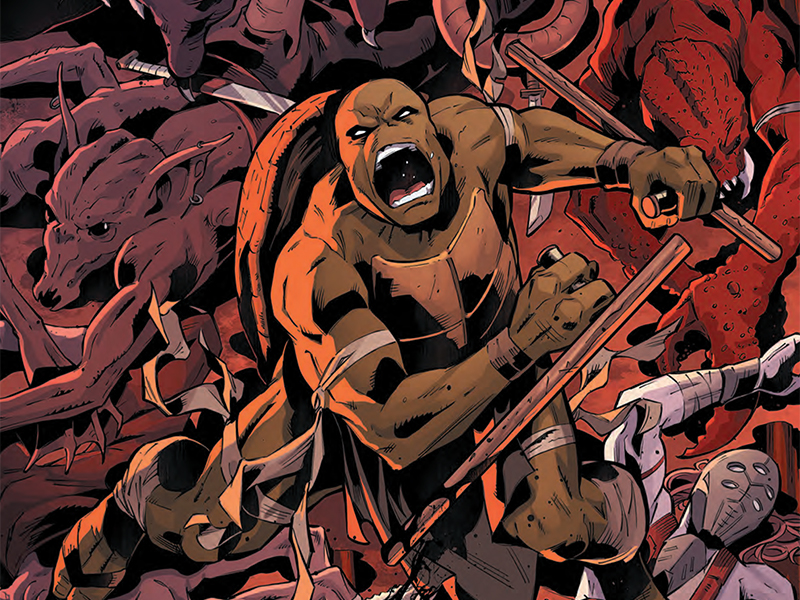
Round And Round Again — Reviewing ‘TMNT: The Last Ronin – The Lost Years’ #4
by Scott Redmond
Overview
Past and present continue to intertwine as Teenage Mutant Ninja Turtles: The Last Ronin – The Lost Years moves towards its anticipated conclusion. Bits and pieces of this series don’t work as well as they did in previous issues but it overall still hits the mark. There is still plenty that could be explored in this world if the creators are so inclined.
Overall
8/10Flashbacks and montages that fill in gaps are pretty common storytelling tools. Sometimes though, they can be too much. That’s the case right now with Teenage Mutant Ninja Turtles: The Last Ronin – The Lost Years.

A series with a mouthful of a title is also one that is trying to do too many things at once. Consequently, none of the things it’s trying to do are being done justice. There is the story in the ‘present day’ with Casey Jones (junior) and the new Ninja Turtles she’s raising. Most of the issue, though, focuses on the lost years mentioned in the title that led Michelangelo into his quest in the original The Last Ronin miniseries.
We’ll start with the present-day stuff. I’ll be honest, there is not enough of this. Personally, I’d rather read a whole mini that is about Casey and these new Turtles. A few pages in each issue that skips through time, seeing the Turtles at different ages, isn’t doing them justice.

In previous reviews, I’ve spoken about the beauty of mixing past and present, and how they inform each other. That is true still, but also, I think it’s leaning more towards anchor than helpful at this point. Tom Waltz and Kevin Eastman created new turtles and characters that are so compelling and interesting that I want to see far more of them. Imagine a full five-issue mini that spent far more time with these characters, while still leaping ahead with each issue.
Part of what makes it work less this time is that many of the beats Mikey thinks about and deals with this issue are repeating. There are literally two whole spreads, like a page apart, where he mentally checklists how he lost each of his family members. The entire first mini was about him dealing with the trauma and getting his revenge (while finding a new family), so having us rehash some of that journey set in the past feels a bit off.

Past and present have similar feelings to them visually, even with different artists behind them. Both feel somewhat rough in some respects, speaking to the darker world that is the setting. There is a bit more smoothness and more detailed emotional work in Ben Bishop’s present-day pages, as there is a bit less action. SL Gallant and Maria Keane are for sure still capturing emotion but have a far more action-oriented heavier narrative load.
Part of what connects them, of course, are the colors from Luis Antonio Delgado. Overall, we can see the same elements that makeup Delgado’s style popping up in both periods. Mixed in are little differences that allow the colors to blend into the differing art styles. Things are somewhat lighter with the present-day stuff, which speaks to the hope that has been rekindled in that time thanks to Mikey and the new Turtles. All the past pages have a heavier darker tone to them since these are rougher times for Mikey and the world at large.
It allows each period to feel unique but also be connected to one another.

One of the connective tissues across the Turtle books often comes down to the lettering, which is commonly done by Shawn Lee. His work brings great energy and personality to every single word that appears on a page. We get little unique flairs at times that let different characters’ dialogue stand out, giving them a unique voice for us to hear.
Teenage Mutant Ninja Turtles: The Last Ronin – The Lost Years #4 is now available from IDW Publishing.


