
Talking ‘Malcolm Kid And The Perfect Song’ With Austin Paramore And Sarah Bollinger
by Rachel Bellwoar
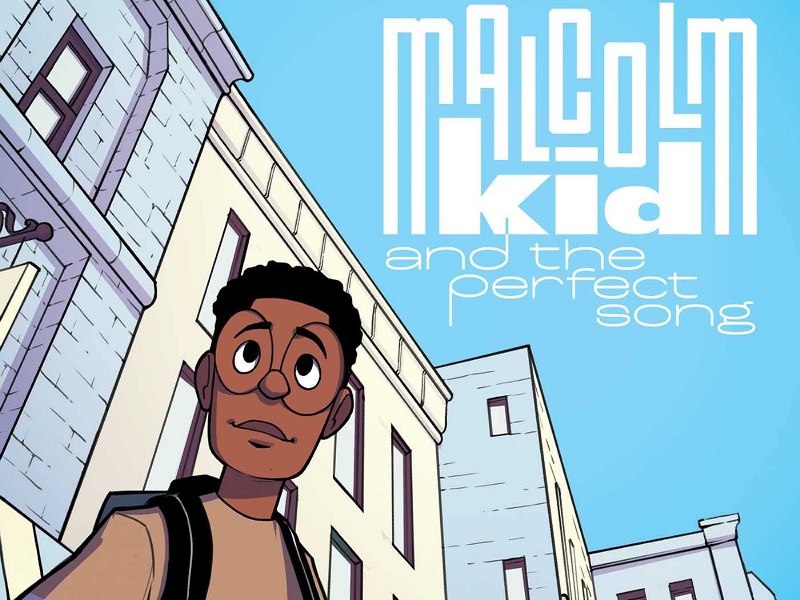
It’s hard not to take having your keyboard break right before an audition as a sign that the universe might not want you to pursue a career in music, yet having a dream isn’t easy and if Malcolm’s keyboard hadn’t broken he would’ve never stepped foot in First Circle. For better or worse, he was meant to enter that store. Is a free, haunted keyboard worse than having a broken keyboard, though? That’s what Malcolm is about to discover in writer, Austin Paramore, and artist, Sarah Bollinger‘s, debut graphic novel, Malcolm Kid and the Perfect Song. With inks by Marika Cresta and letters by Hassan Otsmane-Elhaou, find out what Austin and Sarah had to say about the book (and their candidates for “the perfect song”) in the following interview:

Rachel Bellwoar: While the subject of new friends meeting is well-tread ground, less has been done about lapsed friends getting to know each other again. Why was it important to you to explore that kind of relationship?
Austin Paramore: In some ways, it feels like a stronger bond. They’re not just two kids brought together by circumstance. They’re two kids brought together, pulled apart, and then invited to come back together again. Just the fact that they decide to go on this adventure together says a lot about what they mean(t) to one another. And from there, knowing that context, every moment of laughter or support or even silence feels much deeper than what we see on the page. I really enjoyed being able to add those layers to the relationship.
Sarah Bollinger: I really loved being part of a story like this because, as a military kid, this type of relationship is one I’ve experienced a lot. It takes a lot of vulnerability to recount everything between who we were then and who we are now, and sometimes it’s just easier not to. It was heart-warming to see these kids come back together and be open to listening to one another. Their relationship, like pretty much all the relationships Austin wrote about in this book, really made me cherish my own and about reopening doors I thought were closed. That’s pretty cool.

Bellwoar: Malcolm and January have history, yet instead of spelling that out to readers, it’s more like a dawning realization readers are allowed to come to on their own. It makes for a really satisfying experience, but was it hard (as the creators) to step back and let readers catch-on?
Paramore: Not at all. I wanted to give readers the space to dive into context clues and squint into details. This isn’t really a mystery book, but I think leaving those gaps and breadcrumbs invites the audience to lean in and say, “wait, there’s something going on here”. And hopefully when they find out what that something is, it feels like a reward for being curious.
Bellwoar: The reason Malcolm and January reunite is because January feels responsible for Malcolm’s keyboard breaking. The store they go to for a replacement, however, couldn’t be more suspect. Was it fun to play with how far to take things, given they don’t have the funds to be choosy, but there are so many red flags?
Paramore: So much fun. I’ve always loved the random energy of corner stores like that – where you look around and ask yourself, “… what exactly is the business model here?” For a simple soul like Malcolm, though, it’s torturous. He’s a surface level kind of guy, so trapping him in a store full of questionable decisions and sketchy backstories is hilarious. Especially when there’s a brave personality like January there to egg him on.
Bollinger: Visually, I loved that there weren’t really any limitations to what could be in the shop. It was fun to smoosh together different ideas and find the right balance between “this is weird” and “seems legitimate”.
Bellwoar: Ultimately Malcolm’s new keyboard turns out to be haunted by the spirit of its previous owner – a jazz musician named Midnight who tells Malcolm his story. True to his reluctance to share, though, it’s really through the art (not Midnight’s narration) that the details come out. What was it like to find the right balance between words and art for that sequence?
Paramore: That was another exercise in stepping back. I really didn’t have much specific visual direction for that chapter. I’ve learned that when working with an artist you trust, sometimes it’s best to just step back and let them do their thing. And this was another example where the end result was much better than anything I would’ve drawn up.
Bellwoar: I remember laying these panels out feeling like I was being told exactly what to do, but I guess Austin’s descriptions just made it so easy to imagine this sequence play out as a film. I went in with the mission of capturing that cinematic memory while still taking advantage of comics as a medium.
Bellwoar: How did you come up with the concept of the dream world where Malcolm has all of his conversations with Midnight?
Paramore: I always pictured it as a sort of purgatory, where Midnight was forced to spend eternity with his obsession. And the more I thought about it, the less I felt like that space needed anything besides him and a piano. So we stuck with the empty space – which, as you can imagine, is not the most exciting setting for a graphic novel – but Sarah was able to work her magic and literally make something super cool out of nothing.
Bollinger: I think the design of this space really came together once we nailed our color story for the book. We knew we would be working with a limited palette, and as we were laying out options, we started assigning meaning to particular tones. It made that space so much more interesting and ultimately gave an extra layer of depth to how Midnight’s story is told.
Bellwoar: Where did the idea to use phone symbols to convey Malcolm’s energy level and thought process come from?
Paramore: You can’t really tell a story about modern high schoolers without involving phones in some way. Teens today, for their whole lives, have had messaging, cameras, social media, GPS, and thousands of other formerly precious tools within arm’s reach at all times. Of course, that’s going to influence the way they think and communicate. So, it made sense for Malcolm’s world to reflect that reality – that phones are basically an extension of the self now. Hopefully, our young/teen readers feel like Malcolm is speaking their language.

Bellwoar: To free Midnight’s soul, Malcolm needs to play the perfect song. What song do you consider perfect (or that comes pretty darn close)?
Paramore: You don’t want to send me down this rabbit hole… I’d have to say the extended version of John Coltrane’s “My Favorite Things, Pt. 1”. Or maybe Nas’s “Made You Look”. Or maybe “Erase Me” by Lizzy McAlpine. I could do this all day…
Bollinger: That’s a tough one! I guess the perfect song for me is one that resonates no matter how I’m feeling, and one that makes me feel like I’m hearing it for the first time even though it’s the thousandth time I’ve heard it. And for me, that’s probably “Oh Lord” by Foxy Shazam. There’s more when I really think about it, but that’s at the top of my “never skip” list.
Bellwoar:: Thanks for agreeing to this interview, Austin and Sarah!
Malcolm Kid and the Perfect Song goes on sale August 2nd from Oni Press.
