
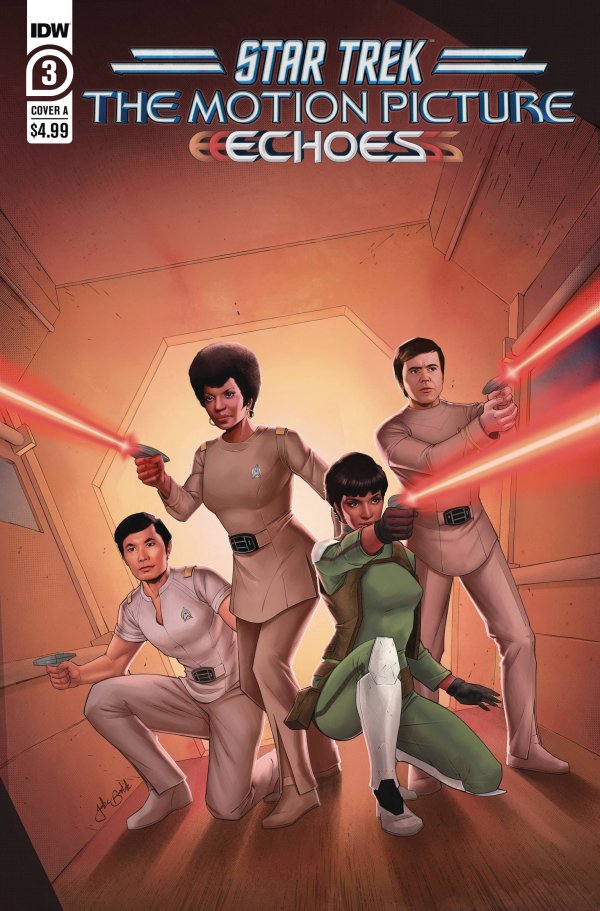
Review — Pity Poor Chekov In ‘Star Trek: The Motion Picture – Echoes’ #3
by Tom Smithyman
In Star Trek lore, Pavel Chekov has a knack for getting hurt. A lot. 
In Star Trek: The Motion Picture, he seriously burns his hands thanks to electrical feedback from his bridge station. In The Wrath of Khan, the Russian first officer is captured, and an eel-like creature is inserted into his ear, nearly killing him. In The Voyage Home, he falls off the deck of an aircraft carrier – appropriately the USS Enterprise – and almost dies.
You get the picture.
So it’s no surprise when writer Marc Guggenheim borrows that cliché in Echoes. This time, Chekov is dying – again – thanks to his Romulan captors. Hikaru Sulu and an alternate reality version of Nyota Uhura must figure out a way to escape Romulan space so Dr. McCoy can patch him up. Meanwhile Captain Kirk and the real Uhura are trying to destroy a weapon of mass destruction that threatens the rest of the galaxy.
After a few issues, Guggenheim’s script is starting to feel a bit tired. It may be the natural dip in the middle chapter of his story. It doesn’t help that his Kirk sounds a lot more like the Chris Pine quippy version of the character than William Shatner’s confident approach. Guggenheim, though, does nail Spock’s logic as well his ability to stretch the truth while convincing himself and those around him that he never lies.
Oleg Chudakov’s illustrations are more problematic, primarily because he is drawing beloved characters. The Chekov doppelganger, Akris, looks nothing like the lieutenant from the series or the movies. And at certain points, you have to rely on the word bubbles to determine the identity of the person speaking.
In the future, maybe the creative team can pick on someone besides poor Chekov, or at least draw him to better resemble the actor.
Star Trek: The Motion Picture – Echoes #3 is available today at your local shop.
Overview
While this miniseries’ overall plot is interesting, Star Trek purists will chafe at some overly familiar plot points as well as illustrations that bear little resemblance to the actors who played the characters.