
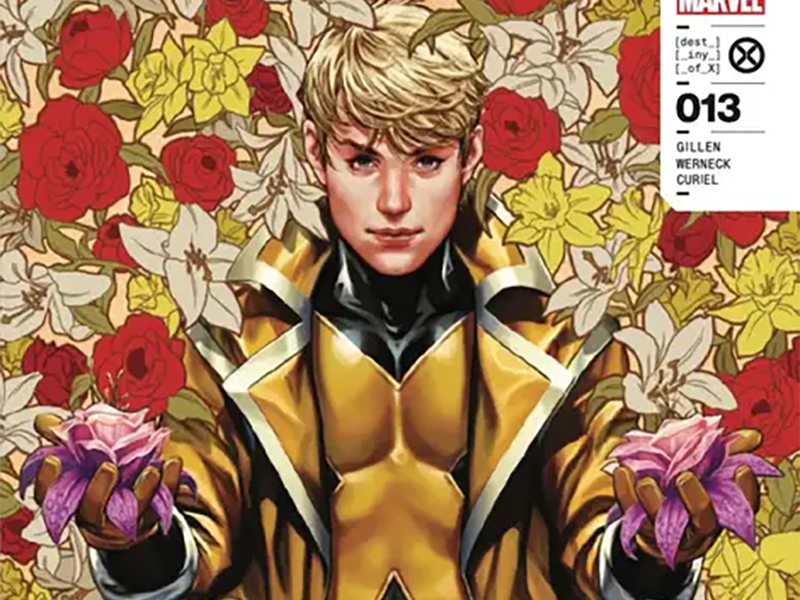
A Fallen Leaf And Krakoa’s Reckoning: Reviewing ‘Immortal X-Men’ #13
by Scott Redmond
Overview
A moment long overdue is the focus of the latest issue of Immortal X-Men, but as usual, it only digs an even deeper hole for the council and Krakoa to fall into. Another really solid issue that hammers home how broken these people are, and speaks to how the idea of utopia is doomed if built upon old-world thoughts. One of the clearest Fall Of X prelude issues so far.
Overall
9/10The Quiet Council is dead, long live Krakoa. At long last, Krakoa’s illegitimate government body must pay for their sins. With most of the council compromised, perceived to be compromised, or missing there was only one call to make.
Unfortunately, like many of their calls, it seemingly was the wrong one.

From day one it was clear that the Quiet Council, and Krakoa as a whole, were a broken system. A ‘utopian’ society secretly created by three figures and a government built of the ‘elite’ were never a winning formula. When Immortal X-Men was launched it was promised as a place to explore this broken part of the society and that has most definitely been accomplished.
Fall Of X is on the way and currently seems to be more a theme than an overall event with any one focus. We know that much of it is that Orchis and others have been plotting against the mutants and their moves are about to bear fruit. Out of all the pieces that have led to this point I would argue this series has done it best. Through these thirteen issues so far, we’ve witnessed the council fracture more and more. We, the audience, are all too aware of who the real compromised villains on the council are, but it didn’t matter. As this issue points out, the entire council and many of the ‘chosen’ mutants have been the problem all along.
A series about the council often means a lot of scenes in the chamber around the table. Lots of arguing and talking, with some actual physical fighting at times. Lucas Werneck and David Curiel have been the hands bringing many of these issues to life. It takes the right spark to make scenes of people sitting around a table as compelling as a drag-out brawl. They accomplish this quite easily every single time.
Werneck nails the emotions and body language allowing us to fully feel what is happening. This is key since the format of these issues is often that they are semi-being told through one character’s point of view. We can’t hear the thoughts of the others, but we don’t need to, as we can see everything they don’t verbalize.
Personally, I really like Werneck’s style because it bridges that debated gap in comic art. It has a lot of that semi-realism to it in the detail and depth of the characters. On the other hand, it also has a lot of those more animated pulled-back from reality sort of vibes.

Curiel offers a color palette that highlights the lushness and brightness of Krakoa. It provides that spark of hope that contrasts with what the council actually has been about. Moments like Exodus and Storm using their powers are where the colors take a leap forward in brightness. Dipping into the realm of colors that are beyond what we normally see to offer the fantastic of this world. That allows the rest of the colors to be denser and toned down to create that sort of realistic vibe I mentioned.
Everything in this issue has been a long time coming. Everyone from Xavier, to Doug, to Krakoa itself, has been hiding things and trying their best. It wasn’t enough, though, as everyone working against one another means there never was a Krakoa nation to begin with. As Doug explains, all the rank-and-file mutants we never spend time with, have no trust or feeling about Krakoa as a whole.
Like many of Xavier’s past work it’s a dream with very little substance to back it up. Kieron Gillen has been one of the writers that has excelled at exploring Krakoa and what it means. Showing us the flaws and why the so-called utopia was basically doomed from the start. It’s almost funny in a way that this book has been the one to pick up threads from the very beginning as well as those unexplored in other titles.
One of my frustrations, and likely for others too, was how much of Krakoa was being left unexplored. A lot of more action-oriented stuff was highlighted over how this nation might legitimately work. Gillen took all that and found a logical legit way to point out that it wasn’t working. There wasn’t much to explore because everything about this nation still hinged upon Capitalism and the old-world ways. It wasn’t a self-sustaining nation, its government was corrupt, and the people lost faith in the systems.
Sounds pretty darn familiar, don’t you think?

Doug Ramsay is the perfect point of view for this one, being the voice of Krakoa, but also the outsider of the council. Someone that understands every language, including body language.
Gillen and Clayton Cowles put that to great use with the way that Doug’s thoughts are presented here. They are brief and often vague in a way that lets the body language, actions, and words of others do the talking. In the previous issue, we got the detached ones of Colossus because he’s trapped within his own mind, but these are more personal. Because in many ways Doug is of Krakoa now and the secrets of the others and his own have harmed Krakoa.
As much as we feel and hear the bile and animosity and dejected hope in the words of the others, we feel Doug’s pain and understanding. Truly one of the beauties of these sort of POV issues has been how Gillen and Cowles execute the perspectives through the lettering. Visually the issues are of everyone, and the artwork must match that. Through the words though we get that focus and it’s creative in how it’s done each time.
Immortal X-Men #13 is now available from Marvel Comics.
