
SDCC 2023: Chatting With ‘Robotech: Rick Hunter’ Writer Brandon Easton About The New Book, Interim Technology, Vince Grant, & Roy Fokker
by Erik Amaya

There’s something special that occurs when two Robotech fans chat about the series. And one of the pleasures of Comic-Con International: San Diego was the chance to sit down with Brandon Easton, writer of the upcoming Robotech: Rick Hunter. The new series, set sometime after the final battle of the First Robotech War and the destruction of the SDF-1 (and SDF-2), centers on the famous Robotech Defense Force captain as he takes on new duties and faces a new foe. Is it the beginning of a new conflict between the Micronians and the Zentraedi? A first barrage of their Masters? Or something else entirely? While Easton held various plot details secret, he was ready to chat about his love of Robotech, the importance of Vince Grant as a recurring character in the various sagas, Roy Fokker’s death in the original series, and Rick’s new opponent — a character some fans will remember from an unlikely source.
Erik Amaya: How does your Robotech story begin? When did you first read or see it?
Brandon Easton: 1985. I was born in the seventies; a kid of the eighties. And by the time Robotech had hit, we’d already had about a year or so of Transformers and about two years of G.I. Joe and He-Man. It was a bunch of boys-oriented animation. But yeah, I got to see Robotech the first time it came on, fell in love with it, and I’ve been a part of that fan base pretty much since 1985.
Amaya: Did the death of Roy Fokker prepare you for the death of Optimus Prime?
Easton: I’ll tell you what the difference was. With Robotech, it was so much more mature than anything I’d ever seen in terms of it was sequential. You could not miss an episode because when I did miss an episode here and there, so much stuff had happened. I was like, ‘good God, what happened?’ Half the ship would be destroyed, someone would be missing, and somebody fell in love and you missed it all.
So when Roy died, I did not expect it. I did not have the [same] emotional attachment of Roy Fokker. I mean, I loved the character. I thought he was a very good character, but there was something detached. Almost in a weird way, I knew that the original producers of the original Macross had plotted his death. And even in Robotech, there was something that felt like he wasn’t going to make it. He always would talk about being a soldier, and ‘Rick, this is what being a soldier’s about.’ But what wound up happening was, as Roy and Claudia got closer and closer to their marriage, I had a feeling that wasn’t going to happen. I just didn’t know if they would break up because it was so soap opera-y.
But the fact that he died right on her couch, I mean, that was insane. So, no, it didn’t prepare me for Optimus Prime, but it definitely was a shock. But it didn’t feel unnatural for that world. Whereas on Transformers, Prime had gotten blown up to pieces at least three or four times during season one and season two. So when Megatron and Prime fought in the 1986 movie and Prime died, it was like, ‘What? He can’t die.’ But he died. And it was a different vibe.
Roy’s a fantastic character. And looking back on him, especially after writing this, I think the most important point about Roy is his impact upon Rick and I do deal a little bit with that in the later issues about what Rick actually felt about all of this.
Amaya: That actually brings me to Rick. My abiding feeling of him is he is this guy who doubts and he expresses those doubts. To me, it’s always funny that, especially in the “Phantasam” episode, he considers himself the guy who crashes all the time, even though he really only crashes right before that incident. And then even in the final form of the Sentinels animation, there’s that similar scene where it’s just the montage of him doubting himself. Is it tough to balance that with the fact that he still has to lead people? Or does it make him a better leader for the fact that he’s so close to his doubts?
Easton: This series gave me the opportunity to fill in the gaps of who Rick Hunter is in terms of how he actually feels about his role in the war. There is a idea that he never had a childhood. I mean, pretty much his whole life from the moment he landed on Macross Island has been in war. He’s not known a life without it. So I feel like this is an opportunity for him to think about what is his life like. Because if you take the war away, what does he really have left?
It’s an interesting question whether you’re talking about the animated versions or talking about the novels, which did a really great job of it. Even the Sentinels novels — which I guess are non-canon now — really dug into his doubts about being a leader. Because if you remember the novels, he actually resigns as commission as Vice Admiral and becomes a pilot again, which Lisa was not happy about. I looked at the Sentinels novels and the Sentinels comic book series as a guide in a lot of ways on what we could do with Rick in that space between end of ‘Macross ‘and the beginning of ‘Southern Cross.’
Amaya: And speaking of that gap, from a writer perspective, is it a boon to have this space where you can do this stuff with these characters? You can establish how Vince becomes more important in the group dynamic?
Easton: I think this is the most fertile ground of all Robotech storytelling potential, the space between the end of ‘Macross’ and the beginning of ‘Southern Cross’ — or technically the Sentinels when they launch. There’s this wide gap. You have the ascendancy of the Army of the Southern Cross. You have the end of the RDF. You have the beginnings of the REF. You have all this weird stuff with Dr. Lang, which everyone forgets about Dr. Lang.
You have all this weird stuff with the Zentraedi, what they’re up to. And also the fact that Breetai and Exedore don’t know that the Robotech Masters are on the way. And I feel like this moment in time sets up everything because you don’t really get the real impact of ‘New Generation’ without understanding Jonathan Wolf. You don’t get any of this unless you understand Edwards. You don’t get any of this until you understand what Minmei and Janice Em were up to. All that stuff can be set up perfectly in that space in between, because we don’t know a lot. Rick and Minmei are not together, obviously. So what was going on in that space?
I mean, even in the Sentinels animation, she says it’s been a long time [since they saw each other]. So clearly, there’s been a break between the two, where even though they didn’t end up romantically involved, they were very close friends. So they didn’t even speak for a very long time. I think that’s a story within itself. What happened to all the misplaced Zentraedi, because at the beginning of Sentinels, there’s really not a whole lot of Zentraedi left. They are there. There’s some that go on a mission. But overall, there’s not a lot. So what happened to them all? Did they die? Did they leave? Who knows? Right?
So I think this is probably the most important time because there really isn’t a lot of space between the end of ‘Southern Cross’ and the beginning of ‘New Generation,’ because soon after Zor blows up the burial mounds, the Invid come. So there’s a little tiny bit of space, but basically Earth’s like, ‘we don’t have anything left.’ And then the Invid just wipe out whatever’s left.

Amaya: What about building that relationship between Vince and Rick and the others?
Easton: Well, here’s something that people don’t think about. The fact that Vince was on SDF-1, no one thinks about this. I don’t really get too much into it, but there will be a reference to the fact that Rick and Vince had conversations on the SDF-1. There is a big scene where Vince proves how incredible he is. I wanted him to be established because in the Sentinels comics and novels.
I think one of the bigger parts of this book is I definitely wanted to establish Rick and Vince’s relationship and show how valuable Vince is to Rick because he’s providing something that Roy can no longer do, which is be a voice of reason. Rick is heavily emotional. He’s not a logical person. Max is a much better pilot because he’s more logical, he’s more mathematic. Rick is all heart, which is good and bad. So I think Vince’s role is to be that brother, best friend, and mentor for Rick in some ways.
Amaya: Is creating interim Mecha part of the appeal of telling stories in that pre-Sentinels era?
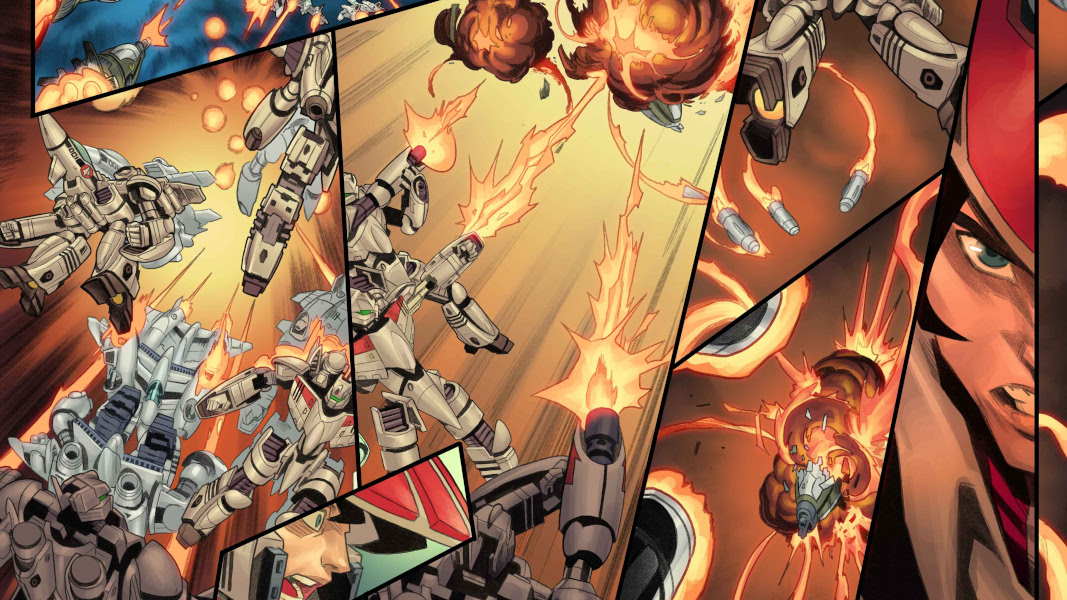
Easton: It makes sense if they use some Master’s technology to make the Alpha and Beta fighter. But they never had any variable fighters [prior to that] that connected to each other. All you had was the big jet packs, but you didn’t have a super space jets. The YF-4 was nice because I like to think that we can make a little nod to Macross sequels. But I really liked the fact that we left the Veritechs behind and went to the YF series because we don’t really get to see the YFs very much. They’re mentioned. They’re in the RPGs. There’s pictures of them, but we don’t ever see them in action.
The RPGs tell you when they were used, why they were used, and why they were taken out service, if they were. The Destroids were taken out of service because they were just too hard to maintain. And that’s the kind of stuff that I think the fan base wants to know about. Interim Mecha, what was happening? Did we see a hover tank? How long were they developing a hover tank? Since so much of the Robotech wars were in space, then you had this Zentraedi uprisings in South America, you needed more ground-based stuff.
So suddenly, you have the hover tanks being developed, but mainly for the Army of the Southern Cross, not for the RDF or REF. I think this, again, going back to how fertile this time is, we could play around with prototypes and seeing in that halfway point the visual evolution.
Amaya: What do you think makes the Southern Cross leadership such great foils?
Easton: This is my take on it, and you’ll see a little bit more of this in the series. I think Leonard’s problem is that he lost something very important to him at one point. And because of that loss, he becomes the worst bigot you can imagine, which happens in the real world. Somebody either is afraid of something or they lose something and it pushes a prejudice. I think that the ‘Southern Cross’ animated version of Leonard is more simplistic than the novel or the comic book version, though.
The novel version, they get into why he’s so hateful. They get into what he’s lost, especially in the Malcontent Uprisings novel. He loses his wife, his Zentraedi girlfriend, and his half-Zentraedi child — and Miriya is the one that killed him! So without that backstory, he’s just a snarling, nasty xenophobe. But with the backstory, it makes him more complicated. And it doesn’t make you hate him less because he’s very hateful and his hate makes him lose. The only reason they lost is because he wasn’t thinking clearly. They could have defeated the Masters if they were smarter about it.
Emerson and all those other guys were like, ‘Dude, you calm down.’ He’s like, ‘No, we’re going to wipe him out.’ And then of course, Zor Prime does what he does and the story ends. And if Leonard was a little bit smarter and listened to Emerson and Dana, things would’ve turned out differently. And they could have maybe built up the forces to stop the Invid threat. Maybe the Invid would’ve never come because Zor Prime wouldn’t have blown up the burial mounds. So Leonard’s stupidity from his hatred is what makes him, I think, a great foil. But I think that you got to look past the animated version, even though that’s canon. There’s more to him. And I think that we’re going to do get a little bit of that here in Rick Hunter.

Amaya: And what of Rick’s Zentraedi opponent in the story?
Easton: Zeraal. He was in the Robotech: Battle Cry video game which was on the Game Cube. He’s a villain within canon, and in the final battle [of the game], something happens to him. So if you go and watch the YouTube video of what happens, and then you watch this, you’re like, ‘How is he here? Something’s not right here.’ And that’s pretty much where I can leave that without ruining anything.
Amaya: Is it fun to build off of all these things? You have Battle Cry. You have the Malcontent Uprisings novel. Is it great to have this wealth of resources with which you can say, ‘Oh, I can plug this stuff in and it can solve a problem?’
Easton: Absolutely. Oh my God, so much of my ability to construct a story is based on Tommy Yune‘s resources from Harmony Gold. And Tommy has been just completely generous with all this source material. I mean, as a fan, I had some of it, but I lost it over the years. But there’s some material, and I’ve been to the Robotech archives at the Harmony Gold building. I’ve been there twice. There are things that I forgot and Tommy will be just offhandedly recall it I’m like, ‘Holy Christ. That’s right.! We can put that in there. We can do this, we can do that.’ And I ask him a lot of questions and I’m always like, ‘Am I able to do this?’ And he’ll qualify it. He’ll say, ‘Well, you can do this part, but you can’t do that because this no longer exists.’ Or we can’t use that. Or it’s a licensing issue.
So we have to always keep that in mind because it’s the IP and the complicated legal background of Robotech. But yeah, these sources have been invaluable — priceless sources — and they’ve helped me tell a story.
Robotech: Rick Hunter #1 arrives in stores on August 2nd.


