
Ten Years In The Making — Benjamin J. Morse Talks Crowdfunding ‘August: Purgatory Underground’
by Tom Smithyman
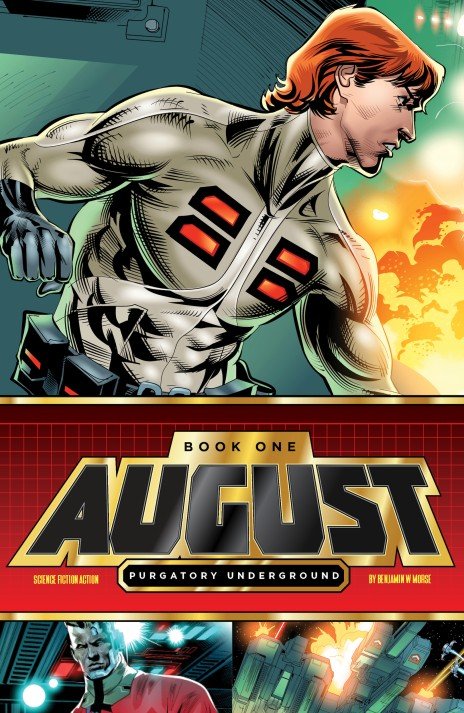
When it comes to creating comics, Benjamin J. Morse is typically a one-man team. The creator writes, illustrates, colors and even letters his books, including We Are Scarlet Twilight. The one area he needs help with is crowdfunding some of his creations, so today he’s launching a new campaign on Zoop to fund a hardcover version of August: Purgatory Underground. In this Comicon.com exclusive, Morse discusses his inspiration for the character as well as his process for bringing the story onto the printed page.
Tom Smithyman: So I guess you just HAD to start a crowdfunding campaign for August: Purgatory Underground in the month of August, huh?
Benjamin J. Morse: Well, I hope it’ll be catchy! The team at Zoop suggested this initially, and I loved the idea!
Smithyman: Seriously, though, why launch a crowdfunding campaign at all? The individual issues were already published through Red 5. What’s the benefit of a crowdfunded hardcover?
Morse: A couple reasons: We’re still looking into when or if we’ll do a direct market collection, but if we do, the plan is to just do the story itself. But having worked on this story for almost 10 years, I had a lot (and I mean a LOT!) of artwork – designs, previous drafts, sketches – and I really wanted to find a way to collect that.
Additionally, the published story was four issues, but I’d worked on drafts and designs, and in some cases final pages for a 12-issue and seven-issue version of what became Purgatory Underground. And I think it’s going to be fun to see some of the alternate directions the story might have gone and show some characters that didn’t make the final cut. A lot of those faces will turn up in future installments, so it’s nice to show their originally planned first appearances here!
Smithyman: As part of the hardcover, you are releasing a 13-page prequel story. That hasn’t been published before, right? Can you give us some background on that?
Morse: That hasn’t been published previously, and it’s one of the parts of this collection I was most excited about including! That 13-page scene takes place a few months before August’s main story begins, and it’s made up from a few different drafts of the comic. Somehow, they still all fit together in continuity with each other and the published story. And to me, it was really nice to see that one scene play out with the different art styles I’d tried out over the years I was developing it.
When I wrote the four-issue version, I needed to condense some scenes, and this one didn’t really give us establishing information that other scenes weren’t already covering. But I think it’s a great short “episode.” very much akin to the mini-adventures we see at the beginning of an Indiana Jones or James Bond movie.
To give some background, August was a space opera hero fighting in a galactic civil war until a disaster wipes out Mars, and he’s blamed for it. This new prequel scene gives us a look at what August’s life was like prior to the accident at Mars and has what I think is a pretty shocking ending that also shows how that tragedy is going to affect August moving forward.
Smithyman: What was your inspiration behind Captain August? From a character as well as a visual perspective, he feels like an updated pulp hero – a Flash Gordon or Buck Rogers but with more of an edge.
Morse: He’s definitely inspired by those characters, and his world draws upon a lot of that, visually. From a motivational or character perspective, I wanted to take a very uncomplicated hero and see what would happen if their adventures took a darker turn – to bring some ramifications into their actions.
I’d read in interviews with Vince Gilligan about Breaking Bad that his idea for Walter White was to take Mr. Chips and turn him into Scarface. My idea, which isn’t quite as drastic, was to take a character like Dick Grayson in the 60’s Batman show or Luke Skywalker in A New Hope – and turn them into someone like Steve McQueen or Clint Eastwood. I didn’t want to make August turn into a different person – he’s still very much a hero. But I wanted to reveal more of his real character in how he reacts to being made a scapegoat for something that wasn’t really his fault.
Smithyman: Talk about your drawing style. It feels like you have been influenced by 1980s cartoons.
Morse: I absolutely was trying to bring a lot of the look of 80’s cartoons into this. In fact, any time I could make something reflect that and still make sense within the story, I put that in. My “meta” take on the larger August story is that it was a cartoon a lot like Masters of the Universe, Voltron or Transformers. It had an epic conflict between two forces that never really gets resolved, and that Purgatory Underground is a follow up comic resurrection of that franchise that revisits the characters after the main conflict had ended – hopefully showing that the resolution of that conflict had changed the characters and their world in very drastic ways.
It was nice to refer to characters that would have been main players in the previous incarnation of August referred to in Purgatory Underground – I really wanted to make it seem like people were missing to give the world some depth and history.
Smithyman: You write and draw the series. How does your creative process work? Do you write everything first and then draw? Do the illustrations lead to changes to the script?
Morse: I generally go back and forth, and make changes as I’m drawing. I did a lot of that with Scarlet Twilight. With August, I actually had things plotted out pretty tightly to make it work in four issues, and I don’t think I deviated from my page-by-page breakdown much. My process here was to plot out the pages and panels tightly, sometimes with placeholder dialogue, create the art and then do the dialogue and other scripting. And as far as finalizing, I’m tweaking dialogue constantly, right up until I send something to press!
Smithyman: Is it difficult being a creative team of one? Do you ever write yourself into a corner then struggle to find a way out? Who do you turn toward when you hit those creative struggles?
Morse: I’ve never found it that tough being a team of one creatively, though the workload can certainly be daunting at times! But in terms of writing myself into a corner, that’s something that usually irons itself out as I’m working up to the plot issue I’m having. I think that, doing all of this on my own, I end up spending so much time on the story (whether that’s writing, art, design or lettering) that an idea to resolve something usually will come to me when I’m doing chores or taking a walk.
I think if I was just doing one creative role, I wouldn’t have those ideas come to me. I’d be moving onto the next project instead of spending so much time immersed in one comic, and those ideas wouldn’t really have time to develop. 
Smithyman: A lot of creators would love to have their creations hit the big screen. Are there any Hollywood actors you could envision playing August?
Morse: I’d love to see that! I think a lower budget, down and dirty 70’s-inspired August film would be amazing! I’m not sure there’s any actors that are the right age now that I think would be a great Captain August. This might seem out of left field, but when I was developing this around 2011 or so, I thought Michael Cera would have been perfect for the role. I think it’d need to be someone we’re familiar with in a very different context and use the impression the audience has of them to show how much dramatic change August has been through just before the story begins!
Smithyman: Well, after his star turn in Barbie, Cera is pretty in demand right now. Good luck with the campaign!

