
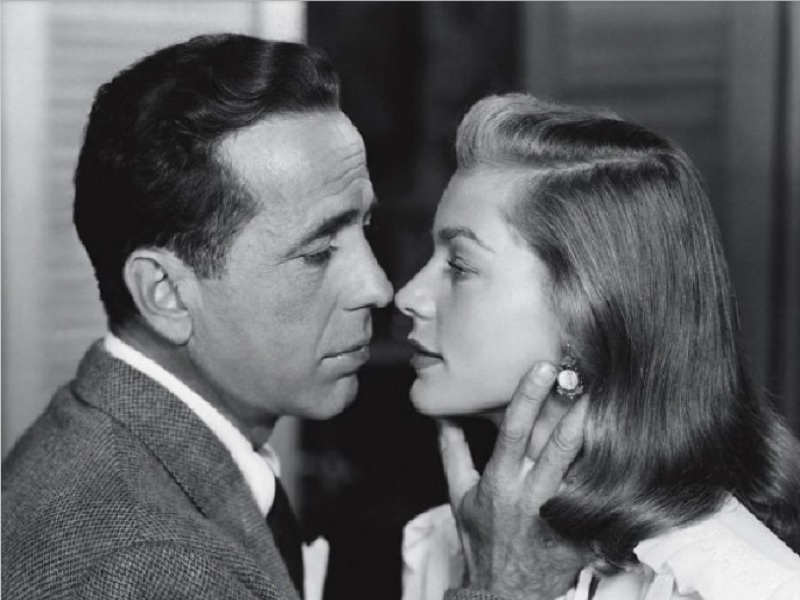
Talking ‘Bogie And Bacall’ With Author William J. Mann
by Rachel Bellwoar
Whether you know them from their on-screen chemistry or their off-screen marriage, Humphrey Bogart and Lauren “Betty” Bacall remain two of Hollywood’s biggest and brightest names. Together they would star in four films together. Separately their careers were just as impressive. For his latest book, Bogie and Bacall, William J. Mann covers them both and I’m so happy I got to ask Mann about it:

Rachel Bellwoar: For me it was Key Largo, but was there a film (or films) when you first fell in love with Bogie and Bacall?
William J. Mann: I didn’t fall in love with Bacall until writing the book, but with Bogie, of course, it was Casablanca. Just a perfect film. Everything about it. I also loved him in Maltese Falcon. It wasn’t until I knew more about Bacall’s backstory that I truly appreciated her in To Have and Have Not and fell in love, so to speak, with the Bogie-Bacall team. Key Largo is number two on my list of B&B films.
Bellwoar: Having written other star bios in the past, how did you decide Humphrey and Betty would be your next subjects?
Mann: To be honest, it was my editor’s idea. There had never been a Bacall bio, let alone a joint bio, and the last major Bogart bio was twenty-plus earlier. So the time seemed right—especially with the knowledge there was new archival material available.
Bellwoar: What was the appeal or benefit of doing a joint bio versus covering their lives separately?
Mann: My interest in writing about stars is to look at their images, their legends, and understand how and why they were created, how they were sold, and why they have endured. Bogie and Bacall have been called Hollywood’s greatest love story — so seeing them in context with each other was in many ways the logical way to approach their story. Plus, it was much more fun that way.
Bellwoar: How important was it to you to make sure that previously downplayed figures like Bogie’s ex-wives or sister, Pat, weren’t passed over this time?
Mann: I was struck by how much misogyny was layered onto depictions of Bogie’s wives, and to a lesser extent onto Pat, by may of the chroniclers—and that goes back to the contemporary news and magazine coverage. John Huston was especially unfair to Mayo Methot in his memoir—one of the greatest filmmakers of all the time but truly nasty toward many women. I did not want to repeat that. All of Bogie’s wives were fascinating, creative, ambitious individuals, and I wanted to give them their due.
Bellwoar: Repetition doesn’t always make something true. What was it like realizing that some of the stories that have been repeated about the couple in past bios or Bacall’s memoirs don’t necessarily hold up under scrutiny?
Mann: Well, that was something I realized long before this book. It first became apparent when I was writing about Katharine Hepburn, and it continued with Elizabeth Taylor, Barbra Streisand, Marlon Brando, and even the Roosevelts. Public images are always very different from private realities and the tension between them is something I find very interesting. The same was true with Bogie and Bacall.
Bellwoar: In going from Bogie’s section to Bacall’s, the difference in how their careers got started couldn’t be more striking. Whereas Bogie had to work up from being a supporting player, Bacall was the female lead in her first film (To Have and Have Not). Do you think Bacall’s career ultimately suffered for her getting such a major (if successful) role so early?
Mann: I think the problem was being Mrs. Bogart and being typecast so early. She is fantastic in To Have and Have Not and she never really topped that performance. Bacall did not have the acting range of Bogart, who could do almost anything and make any part believable, with so much depth. Had she started in smaller parts where she wasn’t immediately contrasted against Bogie may have helped her to expand her range. But she refused those sorts of parts from Warner Bros., calling most of what they gave her outside of Bogart inferior. I don’t think all the projects she refused were inferior — they just weren’t the big showy parts she thought she deserved after THAHN — so she has to shoulder some of the responsibility for her career stagnation.
Bellwoar: I never realized the severity of Bogart’s alcoholism or that Bacall’s iconic voice was a product of her training herself to speak lower. Was there anything that especially surprised you to learn about the two stars?
Mann: It was until I really started researching that I understood how aristocratic Bogie’s background was, or how his early stage image was so different from his later tough-gay movie persona. His whole image was recreated from scratch after The Petrified Forest— from rich boy, Broadway dandy to cynical working class hero. Just what a change that was and how strategically the studio engineered it was a revelation.
Bellwoar: Besides co-starring in The African Queen with Bogie, Katharine Hepburn would become a major role model for Betty. Did researching Hepburn for your book, Kate: The Woman Who Was Hepburn, come in handy for this one?
Mann: Very much so. There’s so much in common between Bacall’s image-crafting and Hepburn’s. She really followed the same playbook. She adored Hepburn. Her letters are filled with gushy compliments and flattery. She even wrote the way Hepburn did—with lots of dashes — no periods. She wanted more than anything to become the sort of institution Hepburn became.
Bellwoar: You mention in chapter six that Bogie “…was more in line with the leading men of the previous decade, such as Ramon Novarro, John Gilbert, Nils Asther, and Rudolph Valentino….” Do you think he would have fared better in the silent film era (or gotten noticed quicker)?
Mann: That was the sort of image that made him popular on stage but the suave, debonair lover has an expiration date. After about 35, it becomes harder to maintain. Bogie didn’t age well. If he had acted in silent films he likely would have disappeared soon after talks started. As it was, he came into his depth as an actor by becoming the tough, dangerous, cynical yet (usually) honorable hero that we all know and love.
Bellwoar: Before they realized the severity of his cancer, Humphrey and Betty had planned on doing more pictures together. Melville Goodwin, USA would go on to become Top Secret Affair, starring Kirk Douglas and Susan Hayward. Was Joel Sayre’s screenplay used at all for the version of Underworld, USA that was directed by Samuel Fuller?
Mann: If it was, it was not credited. Columbia and Harry Cohn did try to be supportive of Bogie during his illness at the end, keeping various film projects on the books in the hopes he got better. But Underworld was assigned away once Bacall dropped out.
Bellwoar: Thanks for agreeing to this interview, William!
Bogie and Bacall: The Surprising True Story of Hollywood’s Greatest Love Affair is on sale now from Harper.


