
The Work Behind The Work: Discussing ‘Old Dog: Dossier’ With Creator Declan Shalvey
by Tom Smithyman
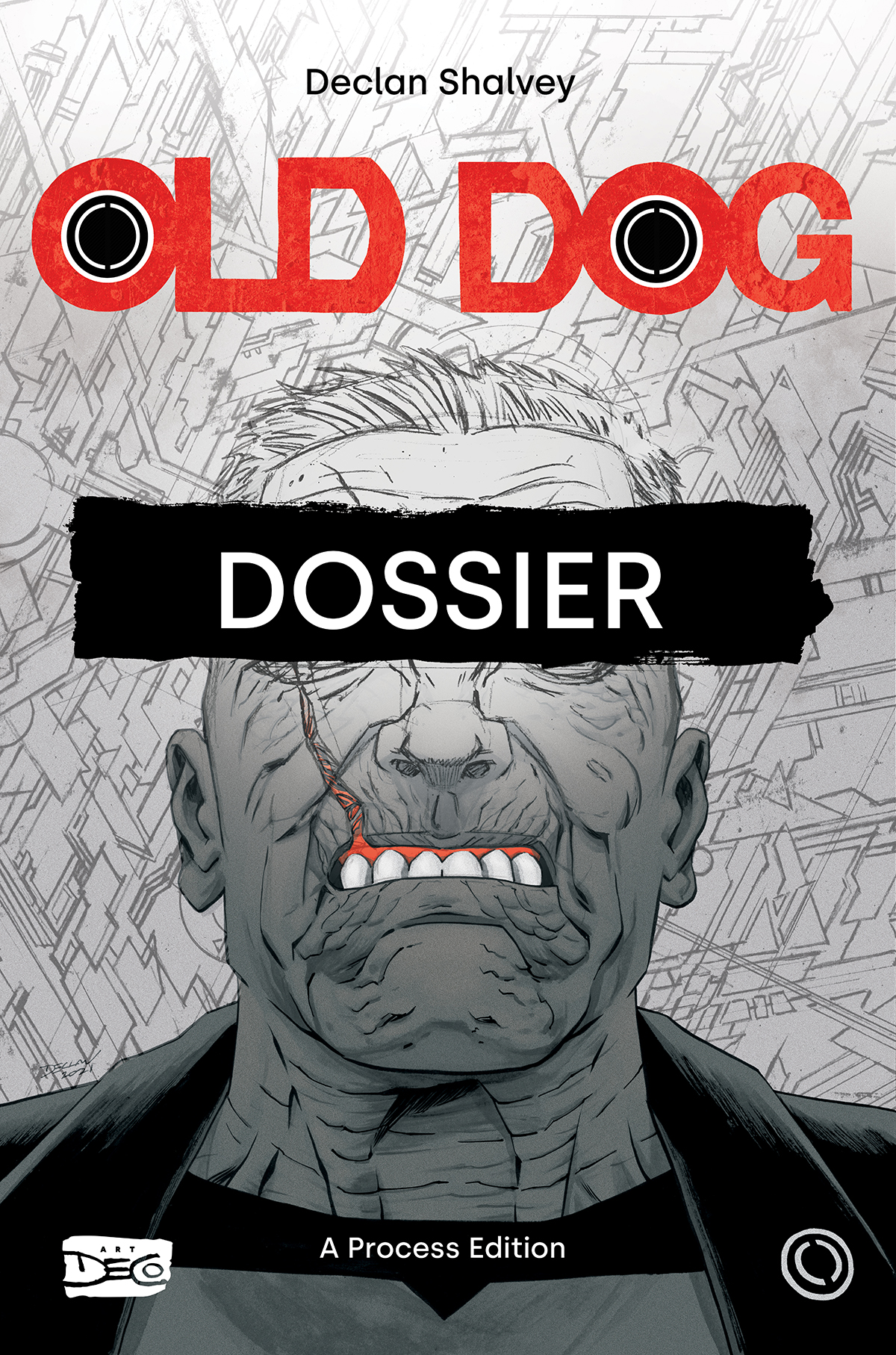
Declan Shalvey has a lot on this plate these days. He’s writing Aliens, drawing lots of variant covers, wrapping up Time Before Time. In his spare time, he writes Old Dog, about a CIA operative who wakes up after being in a coma for eight years. He recently launched a crowdfunding campaign on Kickstarter to create a process edition of Old Dog. In a Comicon exclusive, Shalvey gives a wee bit of insight into his creative process and discusses why he considers himself to be an artist/writer and not the other way around.

Tom Smithyman: You’ve also had a successful crowdfunding campaign for a Time Before Time process book. Why do you think fans are interested in what’s going on behind the scenes in a comic book series?
Declan Shalvey: Ha, I’m not sure they are! I just know that I am. I really enjoy reading about an artist’s approach and seeing the work behind the work. I don’t expect it to be a huge audience, but enough of one to justify putting something like this together. Those who follow my work do always seem to like it when I share process posts on my newsletter, or on Twitter/Instagram etc. So I felt there was a decent crossover with my audience and process junkies to give it a try. The Time Before Time Process Edition was a way for me to dip my toe in the crowdfunding space, with an eye to do that with Old Dog down the line. Now here we are.
Smithyman: What is your creative process like? And how did you come up with the idea for Old Dog?
Shalvey: To find out Tom, you’ll have to get the Old Dog: Dossier! Ha, sorry, couldn’t resist. I do get into it in the Dossier, but in short it was a confluence of things; wanting to do more Moon Knight-esque action storytelling, an affinity for spy/espionage fiction and wanting to draw an old, grizzled face in every panel. Those elements were all floating around my brain for a while until I thought of the title, and then the story clicked into place for me. I tend to think in genre first before I have a story.
Smithyman: You’ve had considerable success as an artist, as a writer and doing both. Do you consider yourself an artist who writes or something different? And how does that affect the way you approach a story, whether it’s written or illustrated?
Shalvey: Honestly, probably an artist who writes… I’m more comfortable drawing, it comes to me naturally. Writing is something I find harder to do, but it’s opened up a whole new avenue of storytelling for me, to be able to generate projects, as opposed to searching for a suitable project.
As a fan of artists, I enjoy writing something for them, which is inspiring on an artistic level, so it all feeds itself. As a result, I tend to describe myself as an artist/writer, as opposed to a writer/artist. That’s not to try to downplay myself as a writer, just that I like to put my visual-sense foot first, as I think initially in visuals when it comes to my storytelling.
Smithyman: You are incredibly popular right now, drawing covers for Ghost Rider, Ribbon Queen and Damn Them All, then writing Alien, and finishing up writing and covers for Time Before Time – not to mention Old Dog. You’re clearly not big on taking time off. How do you bounce from project to project without bouncing off the walls?
Shalvey: I guess I like to keep busy? Ah, I wish I could say I’m always on top of things, but every assignment has different deadlines, and balancing them all can be tough. All gigs scratch various itches, I like to be the tip of the spear of a project, and writing provides that …seeing other people interpret your scripts is fun and exciting.
Making Old Dog is ultimately incredibly satisfying, but everything leading up to that is very tough with it all being on my shoulders. Covers are great because I can “switch off” to a degree and just be an illustrator, that’s my total responsibility there.
Yes, balancing all that is tough, but it also means I’m quite creatively satisfied. The work-for-hire stuff enables the creator-owned work, and the creator-owned work means I have an avenue to do what I want if I’m feeling frustrated with work-for-hire stuff, etc. Ideally, I’d like to clear some time to concentrate on one project, then the next, but various deadlines are often looming and to be fair, I’m never bored.
Smithyman: The saying, of course, is that you can’t teach an old dog new tricks. None of us is getting any younger, but have you gone against conventional wisdom and picked up any new tricks lately?
Shalvey: I have, actually. When I was working on Bog Bodies I taught myself how to use InDesign so I could design and assemble my own book, and since then I taught myself how to color, first with covers and then on interiors, making Old Dog the first book where I’ve been able to do everything on the book, aside from lettering. Maybe I’ll do that next. Or maybe I’ll just stick with the excellent Clayton Cowles!
Smithyman: Old Dog kicks off with CIA operative Jack Lynch waking up from a coma after eight years. If you suddenly woke up and someone told you it was 2031, what is the first thing you would do?
Shalvey: Oh man, that’s a good question! Ultimately, I think I’m a better person than Jack Lynch, so I’d immediately try check in on my family and friends. See if anyone is still up for a pint.
Smithyman: That sounds like a great idea! Good luck with the campaign and all the other projects you’re working on.

