
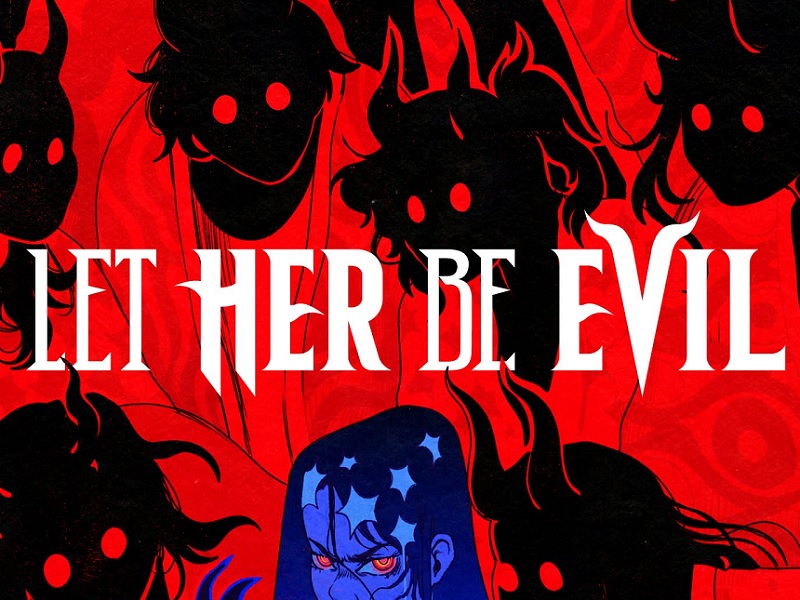
Talking ‘Let Her Be Evil’ Anthology With Editor Cassandra Jones
by Rachel Bellwoar
When a man is evil in fiction most people don’t bat an eye. When a woman is evil they’re either hated or given some backstory to make it better. That’s the way it usually goes, anyway, but Let Her Be Evil isn’t having it. Instead the new anthology from editor Cassandra Jones is living up to its title and staying firm on letting its female characters be as villainous as they want to be. For more on the anthology (which starts crowdfunding today on Zoop), check out this interview with Jones:

Rachel Bellwoar: What made you choose this project as your first foray into comics, and how did the idea for this anthology come about?
Cassandra Jones: I was lucky enough to have Heather Antos as a mentor when I started exploring editing comics. She suggested taking on an anthology as a way to kick-start my career because I’d have the benefit of working with tons of different people and doing the dang thing. In short, it was a way to jump into the deep end to see if I could learn fast enough to sink or swim in the space. I’ve been doggy-paddling my little heart out over the last eight months, and I’ve gained so much knowledge from the kind, talented creators involved in LHBE.
The idea for the anthology came before the idea of an anthology itself. I was watching Doctor Strange in the Multiverse of Madness and found myself so disappointed in the film’s inability to allow Scarlet Witch to be as horrible as she was obviously meant to be that I shouted “Let her be evil, dammit!” through a mouthful of popcorn. Later, when I was considering a theme for the anthology, I realized creating a whole slough of stories where women were given the narrative space to actually be evil–not an antihero, not a pitiable figure, not a vengeful icon–but evil would be the exact kind of challenge that would get my ass in gear.
Bellwoar: In what ways has this experience been different from your work in traditional publishing?
Jones: The differences in grammatical style are fascinating and there are storytelling considerations, like page turns, that must be made in a visual medium that just aren’t present in straight prose. The biggest difference is working with a larger cohort of creators on a singular story. In a book, the writer and editor are working closely to craft a story, but on a comic, the creative onus is shared by the writer, artist, colorist, letterer, and editor. The collaborative spirit involved in comics sets them apart, and in my opinion, is what makes them special.
Bellwoar: When pitching this theme to people, were you met with any resistance or confusion, or was it a more a breath of fresh air, to be able to tell stories about “unapologetically wicked women”?
Jones: People have been overwhelmingly on board. The comics community is ready, and excited, to tell the stories of women like those in LHBE. I hope people who read the anthology are inspired to think more deeply about the motivations of their villainesses and go on to write bad bitches with nuanced motivations.
Bellwoar: Given that there’s been so much reluctance to tell stories about women who are actually evil and not antiheroes, was it hard to break the habit of trying to explain or come up with excuses for their behavior?
Jones: A bit. The number one feedback I gave on scripts for LHBE was to remove a man from the equation of villainesses’ inciting incidents. It’s tempting to base a woman’s evil in the abuse of a man or the death of a child, because they’re, unfortunately, relatable and understandable motivations. However, insisting that women are only evil once violence has been done to them robs them of their agency and puts them on a weird pedestal as paragons of morality. What about all the women who want power because they’re damn sharks? Or those who want to amass treasure because they’re greedy? Male villains are allowed to have motivations based on flaws in their character all the time and be likable, but when women have the same impulses, they’re lambasted as the most terrible shrews and wretches who ever shrew-ed or wretch-ed (here I think of the treatment of Walter White versus Skylar White in HBO’s Breaking Bad). I’m not saying every villainess’ story ever needs to avoid these motivations, but that there is a huge gap in not only comics, but also TV, film, and books where unredeemable female characters could be living and thriving; the more we see them in fiction, the less we will feel the need to unnecessarily excuse their behavior away.
Bellwoar: Let Her Be Evil is set to include seventeen stories. Was there a submission process or did you already have certain creators in mind that would be the right fit?
Jones: There was an open call to submission for scripts and portfolios February through April. I offered early submitters free script feedback and the chance to resubmit a second draft. In my opinion, this willingness to provide free critique helped pull in a lot of creators who otherwise might not have submitted–however, if you plan to do the same, be prepared for the amount of work it entails. In the end, I gave feedback on over 100 pieces and received 200-ish submissions. I had a megamind Excel document from which I tracked everyone’s status (first submission received, second submission received, feedback given, accepted, rejected, maybe, etc.) contact information, and links to their portfolio, and once I had a finalized script I would trust my gut on if it was a “yes” or “no.” Usually, I had one feeling one way or the other for both scripts and portfolios and trusted my intuition. The tricky ones were those that hovered in the “maybe” category. But, when it came down to it, the hard “yeses” were the ones who duked it out to the top as my seventeen stories.
Bellwoar: Did you play any role in pairing writers and artists up, or were the creative teams already formed from the start?
Jones: Almost all of the teams in the final anthology were formed by me. There are also creators who took on making their entire comic A to Z. (They aren’t human. Be scared.)
Bellwoar: Why do you feel that crowdfunding was the best route to go with this project?
Jones: It seemed the likeliest chance to bring the book into the world.
Bellwoar: Having gotten a sneak peek at some unlettered art from the anthology, one of the things I was most excited to see was that it looks like a few of the stories will be experimenting with genre. Did you always want to leave it up to the creators, to set their stories in the real world or play around with fiction?
Jones: I left it up to the creators! When selecting stories, I did my best to have a little bit of everything: sci-fi, fantasy, Western, historical romance, horror–they’re all in there.
Bellwoar: Thanks for agreeing to this interview, Cassandra!
Let Her Be Evil‘s crowdfunding campaign with be starting October 10th on Zoop. Click here to sign-up to be notified when it launches and for a full list of contributors.