
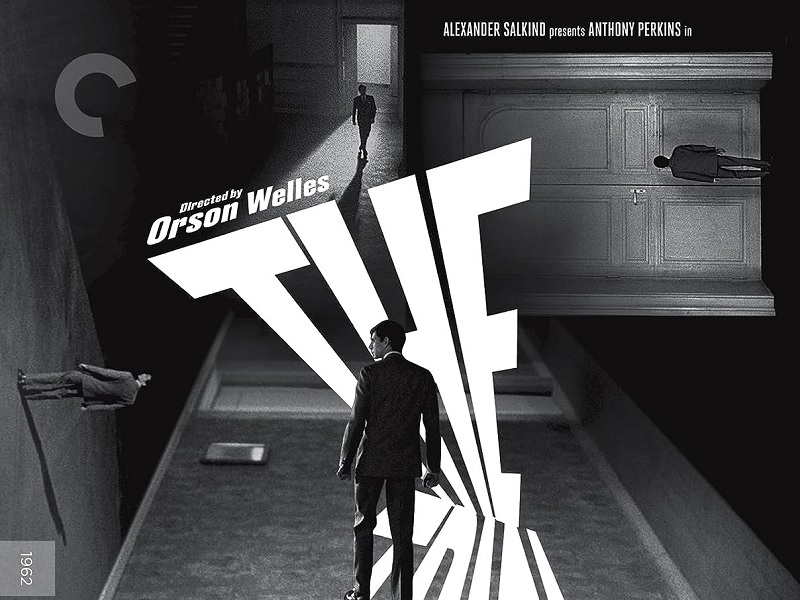
The Plight Of The Accused: Reviewing Orson Welles’ ‘The Trial’
by Rachel Bellwoar
Imagine… It’s the middle of the night. You’re asleep. Suddenly you wake up and, a moment later, a stranger walks in through your bedroom door.
Surely the home invader is in the wrong, right? But what if that home invader than has the gall to start asking you questions, interrogation-style, as if they’re the ones that are due answers? Enough to put a person on the back foot, right? Maybe even enough to stir up some self-doubt?

Josef K. (Anthony Perkins) certainly isn’t feeling too confident when this happens to him in the opening moments of Orson Welles’ The Trial. Based on, or “inspired by,” Franz Kafka’s unfinished novel of the same name (after listening to Joseph McBride’s commentary it sounds like Welles found “inspired by” to be more accurate), Josef isn’t able to get much out of the home invader (Arnoldo Foà), who’s allegedly an inspector but never provides any identification. He does learn that he’s under arrest (though for what crime is never revealed). For now, at least, he doesn’t have to go to jail. In fact the inspector makes out like they’re doing him a kindness by going out of their way to not interfere with his routine (like a vague accusation isn’t going to affect his ability to function, when the vagueness is the worst part).
Basically, Josef doesn’t know how seriously to take the guy, and if his reactions sometimes seem overly calm and accommodating, it’s also a baffling situation where there is no “right way” because the whole thing shouldn’t be happening in the first place. This is the legal system that Josef is confronted with in The Trial – not one that makes sense and is designed with clarity and fairness in mind, but one where the stakes couldn’t be higher yet no one has a straight answer and it takes everything to avoid despair.
If the first half of Welles’ film is stronger than the second half, part of that comes down to story fatigue. This is a premise that’s frustrating by design, but there’s also something to be said for the claustrophobia of the early sequences in Josef’s apartment building and the false sense of security being at home provides. In an archival interview, the director of photography, Edmond Richard, talks about how the ceilings of the set were deliberately kept low (Welles was originally supposed to film on additional sets in Yugoslavia but, when that plan fell through, they filmed at a train station instead).
It’s not just the locations that change, though (and change sharply – McBride talks about how Welles creates disorientation through the editing in his commentary), but the people. Some of Josef’s most interesting interactions are with his neighbors and it would’ve been neat to see those relationships evolve once the arrest doesn’t go away. Maybe leaving them behind is true to Kafka’s novel, but it still feels like a missed opportunity.
Bonus Features:
McBride (who’s written three books on Welles and was directed by him in The Other Side of the Wind) provides the commentary and, given his expertise, the conversation is definitely Welles-focused (which makes sense but I would’ve loved to learn more about other aspects of the film, like the set design in Josef’s bedroom). Having gotten used to the horror stories of studio interference on Welles’ films, it was a relief to know that Welles was given full creative control here, including final cut. McBride goes over Welles’ post-synchronization process, the film’s international cast (which is at least partly due to the film being co-produced by Italy, Germany, and France), Welles’ characterization of Josef and his decision to change the ending.
There’s definitely some overlap between this commentary and the post-screening Q&A Welles gave at the University of Southern California in 1981 that’s included as a bonus feature, too. The Q&A has no subtitles but the sound is surprisingly good and the best part is how much Welles appears to want to be there and engages with every question.
My personal favorite bonus feature is the interview with Richard, who talks about lighting and timing the filming of the amazing scene where Suzanne Flon’s character is dragging a suitcase with a leg brace on just right so that the street lights would be on by the time she reached them.
There’s also an episode of Viva Le Cinéma! in which Welles and actress Jeanne Moreau have a conversation. It’s only the two of them together and The Trial (which Moreau has a small part in) doesn’t come up until the end, but it’s a very enjoyable watch, where Welles talks about his father and some of his early theater roles.
Last (but not least) author Jonathan Lethem provides the booklet essay, which considers how The Trial has been dismissed by critics.
The Trial is available on Blu-ray and as a 4K UHD/Blu-ray combo from Criterion.
