
Talking ‘Depths’ With Co-Writer Wells Thompson
by Rachel Bellwoar
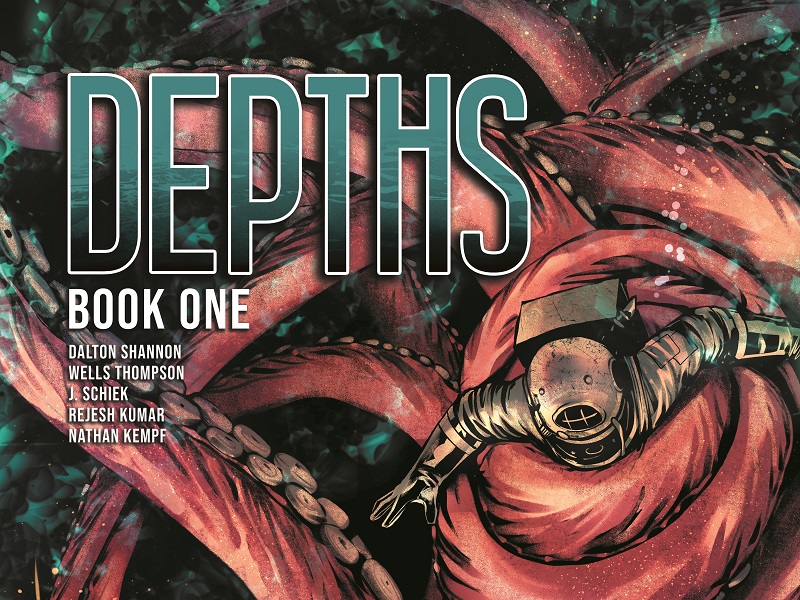
In the ocean no one can hear you scream… which is why, after three years, James is having a hard time keeping the search for Emil alive. Under normal circumstances there wouldn’t be much reason to hope that a person could survive underwater that long, but Emil wasn’t wearing just any ol’ scuba suit, anymore than Depths is your average graphic novel. Written by Wells Thompson and Dalton Shannon, with art by J. Schiek, colors by Rajesh Kumar and letters by Nathan Kempf, Depths starts its crowdfunding campaign today on Zoop and you can find out more about it in this interview with Thompson:

Rachel Bellwoar: How did you connect with the other creatives on this project, and when did the idea for this story first emerge?
Wells Thompson: This was the first project Dalton and I wrote together. We were both a year or so out of college, feeling disappointed about the direction of our creative opportunities, and decided to band together. It took us a few months to get a version of the script we really liked and had to shelf it for a few years to get the right team and funding that the book deserves. Nathan, the letterer, we’ve worked with on two of our other books, MechaTon and Frankenstein the Unconquered, and he’s so versatile that we knew he could knock out whatever we threw at him. J. Schiek, the artist, we met online and collaborated on a variant cover for MechaTon; we really enjoyed his noir-like style and thought the art would be appropriately heavy to match the mood. Rajesh Kumar, the colorist, was a suggestion of J’s and not someone we’d worked with before, but after seeing the murky, claustrophobic colors he added to J’s line art, we knew he was the right guy for the job.
Bellwoar: What made you decide to set Depths in the 30’s, instead of the present day or the future?
Thompson: It was just something that made sense for the themes and tone of the book. We knew the suit was an old diving suit with a sci-fi/magical realist twist (it can stay underwater indefinitely), and the era of the lost generation and great depression fit in really well both aesthetically and thematically with a book about grief, loss, and survival. It also helped make the stakes more real; we have much better underwater exploration technology now than we did in the 30s, so the search for Emil feels a lot more desperate and hopeless than it would if it were set in the future or even the present day.

Bellwoar: Did you always have a clear idea of what you wanted Emil’s scuba suit to look like or were there multiple iterations?
Thompson: Emil’s suit was the formative image: An ancient diving suit navigating the ocean floor in darkness with little more than a headlight to guide him, a knife constructed from coral at his side, and a pack on his back like an astronaut that turns the water into breathable air. That element of the story was rock solid from the beginning, the only question was how an artist might interpret it and whether we should see Emil’s face underwater. In our first short story with the character in Descent into Dread, Serg Acuna included an open face window so we could see Emil emote, but in Depths, Schiek is sticking with the classic look and obscuring Emil’s face.
Bellwoar: In the preview pages Emil talks a lot about his father. Why was that a relationship you wanted to circle in on?
Thompson: I suppose it was partly a way for Dalton and I to explore our relationship with our own fathers, but more broadly, the book is about grief and loss and we needed a conduit for that. Emil loses his dad and has really conflicted feelings about it, up to blaming himself for his father’s demise. He, like many men both of his time and today, feels like he never understood his father and a large part of the reason he created the diving suit was to get into his dad’s head. And probably a little bit to impress him as well (even though he’s not around to see). Relationships are ultimately what I’m always writing about and the more we explored this dynamic between father and son, the more mysterious and compelling it became.

Bellwoar: We also meet Emil’s best friend, James. Given that James bribes Emil with a drink to get him to talk to him, is theirs the healthiest of friendships?
Thompson: Probably not, but not for lack of trying. James is Emil’s best friend from childhood, so when they’re together, some small part of them are still interacting as teenagers and little kids. They’re both brilliant, but together, they don’t always make the best decisions. James is a really old school Gatsby/Hemingway type, so the degree to which he actually believes in alcoholism as a disease or enabling behaviors is a bit of a question mark. Of course, not being aware of that may come to hurt him when he’s searching for his best friend and he doesn’t have a healthy way to cope.
Bellwoar: Like space, so much of the ocean remains unexplored. Was it fun, not having any restrictions on your imagination?
Thompson: On the contrary, this was one of the more intensely researched books I’ve written. In space, you can make up whatever you want; aliens aren’t a real feature of the world we live in, so you can make them look and behave any way you want. Every obstacle Emil faces is either real or closely derived from real things living in the ocean and real ways the ocean operates. Rogue tides, sea snakes, giant squids, and shipwrecks are all realities of the ocean and, while they are extraordinary, they weren’t imagined. That research, I think, makes the action and stakes a lot more intense and definitely more visceral; it’s all stuff that, theoretically, could happen, right down to the depths that certain animals live in and the behavior of tidal patterns in the Atlantic.
Bellwoar: Thanks for agreeing to this interview, Wells!
The crowdfunding campaign for Depths starts October 23rd on Zoop.
