
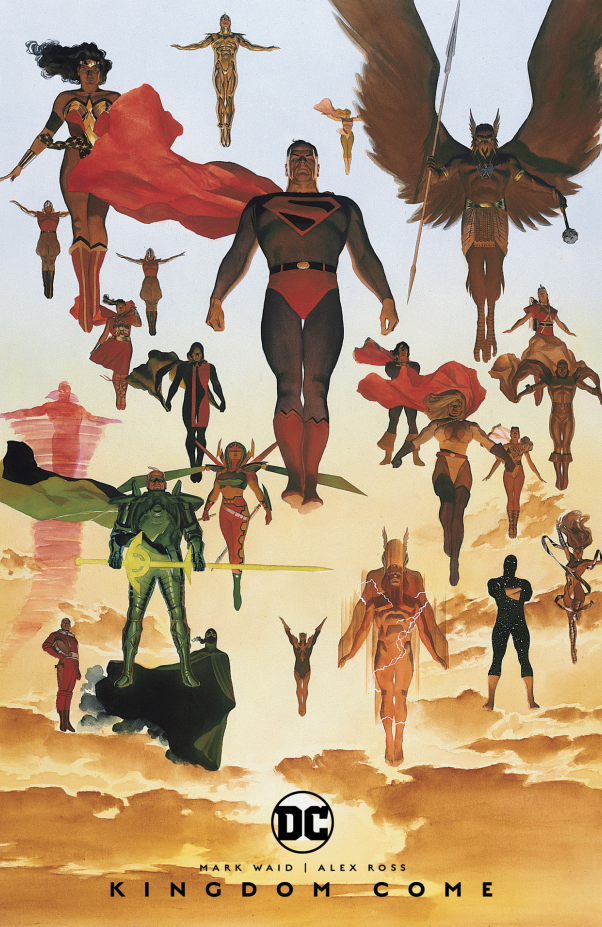
New To You Comics #134: The World Needs Hope In ‘Kingdom Come’
by Tony Thornley
Everyone has different tastes in comics. Here at New To You Comics, we explore that as Tony and Scott dive into comics that, well, it’s right there in the column title. This week, we revisit one of the greatest dystopian comics ever published.

Kingdom Come was published at a time that comics was trending towards extreme ultra-violence. Mark Waid, Alex Ross, and Todd Klein didn’t just create a story that was a satire of the industry at the time, but was also a tribute to the best of DC Comics’ characters and themes. It was an instant classic.
Years in the future, humanity has become stagnant as superhumans wage war across the planet. When a horrific tragedy kills millions and turns the heart of the United States into a wasteland, the Justice League returns from self-imposed exile, led by Superman and Wonder Woman. But a new rebranded Legion of Doom waits in the shadows, ready to bring about the downfall of the Justice League and take over the world.

Tony Thornley: On my hell Scott, I remember liking Kingdom Come, but I’m so glad to have reread it. That may be an absolutely perfect comic book. I mean, there’s a bit of language that’s ableist as of today, but wouldn’t have been at the time it was written (just due to not understanding mental illness at the time). But that’s it. That’s the only fault. Otherwise, hot damn, this was a great read.
Scott Redmond: I’m also quite glad we read this one. This is one of those books that I definitely read when I was able to fully dive into comics regularly as an adult in the early 2000s. It came highly recommended amongst others, so read it from the library. I haven’t read it since, so revisiting it was quite a trip. It’s for sure one of those products of the 90s that actually aged quite well as you said. Many things from that era (and others really) can make such a claim.
Tony: This is a story that’s as much an allegory and satire as it is an excellent Justice League story. I think creating and using Norman McCay as the narrator gives us an “in” that you don’t get often in this genre of stories. Instead, Waid and Ross turn it into a story about faith and hope in our heroes, and the human cost of what these superhero universes would be like.
Waid gets the universe he’s writing in say well. Not a single character ever feels out of character. Superman is a paragon of hope, Diana is the voice of reason, and Batman is one step ahead of everyone. But Norman is the heart of this story. He shows the readers that there’s still a place for man in the middle of this super-war.

Scott: Quite honestly, most of the time that DC stories are centered on the so-called “Trinity” I find it quite forced. Not this time. As you said, there are legit reasons to center things on the three characters, and it all just works so well. I totally forgot about the Norman aspect but it holds this together and gives that necessary outside perspective we need.
Even when characters are mostly there as background nods to the legacy aspect of the universe, they don’t feel wasted or out of place. Calling things a love letter to anything gets overused these days but this genuinely fits into that space. It understands both the issues about these characters and comics in general, while also celebrating the things that make us love these characters.
Tony: Did you read the backmatter? The story started with a treatment from Ross, and Waid was brought in because of his knowledge of DC. It never feels like it’s JUST that though, it comes from love of the characters and universe, but also in service of telling a great story.
I think I had forgotten all of the really great moments, and so many of them were a synthesis of Waid and Ross. Superman’s return from exile is still one of the greatest full page splashes in comics history, and it’s completely wordless. Captain Marvel arriving on page, Batman putting on his armor… It’s full of great moments, but they’re not just moments for the sake of it. All of them drive the story.
And Billy Batson using his magical lightning against Superman? That still gives me chills, and it’s executed perfectly by both Waid and Ross.

Scott: They often talk about the idea that art should tell a story one can discern even without a single word on the page. Classic peak Ross very much was that. Iconic looking moments, tons of montage sort of sequences, but none of them are gratuitous. Choosing to tell this story in a way where often we’re just visitors to a moment alongside Norman, as time flies by, was an inspired one. We don’t need to see every single moment, the ones chosen tell the entire story for us.
Tony: Yeah, Ross was such a good storyteller at this point. Now, he’s kind of shifted into not doing more pinups only. Here though there’s a thoughtfulness in how he lays out the page, even with all the easter eggs and nods he puts into the background.
Scott: I imagine, even if by the same team, if this was a modern story it would have been like six or more issues. With more time spent really diving into moments and unnecessarily dissecting them further. Probably more time spent really saying “Hey what has _____ been up to?” This is just the right amount and punches perfectly.
Tony: Yeah, the story length was perfect. Four extra-sized issues in and out. And that backmatter is WAY worth spending the time to sit down and read. We don’t talk about it at all when talking about these collections, but this is full of incredible amounts of information.

So I think we’re on the same page. What did you think though?
Scott: Overall just a truly solid piece of storytelling from start to finish. There are comics that are called classic or pointed to as things someone must read just because they are from a prior time or a pillar to other stories. Then there are comics like this that are well deserving of being put on the pedestal they have been.
Tony: I think I agree completely. I might need to make a re-reading of this an annual thing.
And that’s our show. Come back next week as Tom and I revisit an early entry from the column- Memetic by James Tynion IV & Eryk Donovan.
