
New To You Comics #135: The Internet Destroys The World In ‘Memetic’
by Tony Thornley
Welcome back to the end of days! All through November, New to You Comics has exploring dystopian themes. (I mean hey, it beats talking politics over the Thanksgiving table with crazy Uncle Frank, right???) And yes, it’s December 1st, but what’s more dystopian than taking over something much brighter than itself! But anyways in this case, Uncle Frank may have been right: The internet does indeed destroy the world in Memetic.

While we have different tastes in comics, one theme that constantly pops up is the end of the world. Memetic, with a creative team of James Tynion IV, Eryk Donovan, Adam Guzowski, and Steve Wands, explores how those end times come about – in only three days.
Tom Smithyman: Let me just start with this. If you’re looking for a happy ending, look elsewhere. To be fair, Tynion teases us throughout the three-part series that our heroes may be able to save things. But – spoiler alert – things don’t go well for the human race. We’ll get back to that shortly, but let’s start at the beginning.
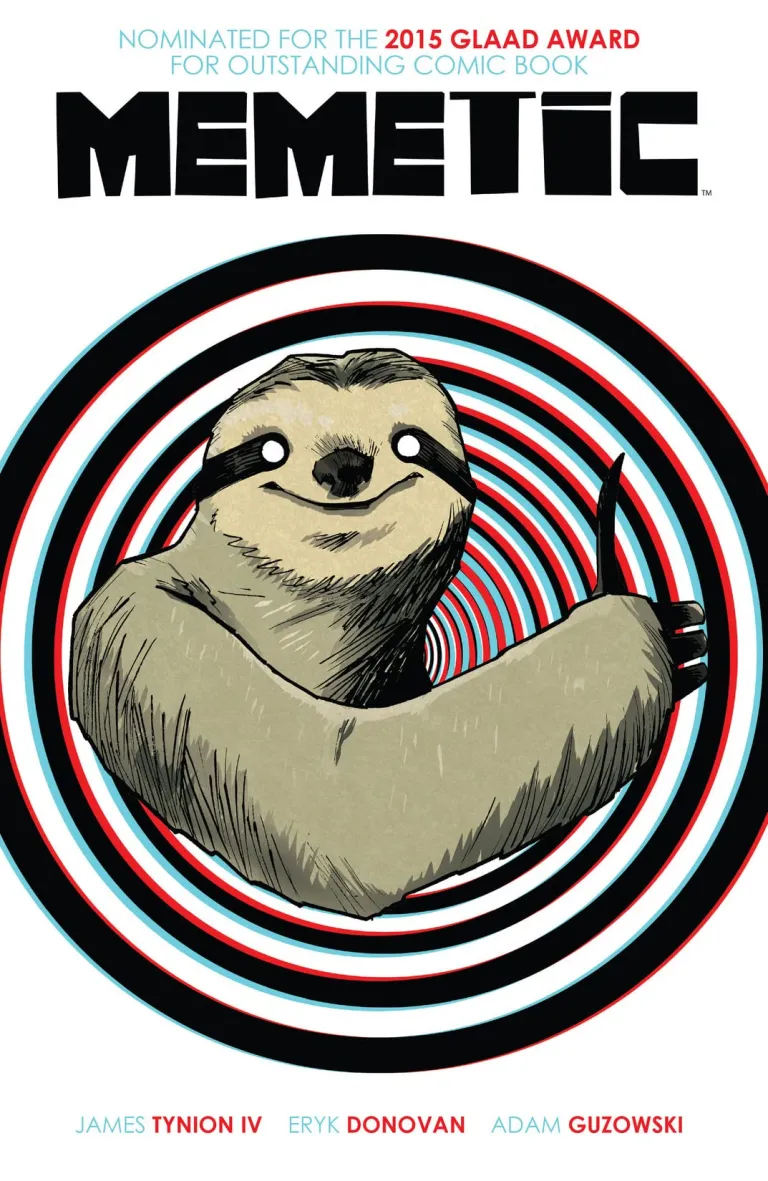
At the beginning of the first day, the world is enthralled with the latest viral meme – emphasis on viral. It’s a smiling sloth set against a series of concentric circles. It’s adorable! Everyone starts sharing it. Literally everyone. They feel compelled to do so. But Tony, this is no cute cat video.

Tony Thornley: I mean this is the first part of Tynion’s Apocalypse trilogy. As much as you might hope something generally positive happens, Tynion makes it clear- and you know it at the back of your head- that it’s going to get worse.
Smithyman: I found the story, as ultimately depressing as it was, to be engaging. Sure, people were dropping like flies, but the main characters were interesting and hung in there until the end.
It’s interesting to view this story through a few different lenses. The first is the pandemic. This series was published in 2014, long before the world heard of Covid. At the time, most of us had never experienced anything close to what the characters in Memetic went through. Now though, there’s a sense of familiarity with some aspects of the story. And the fact that the meme is able to mutate hits a little too close to home. We all have that shared experience of avoiding other people as if our lives depended on it. Ironically, for many of us, the internet got us through the pandemic as opposed to killing all of us.

The other thing I wanted to mention centers around Tynion. His popularity has exploded since Memetic was first published. But looking back on the book now, it feels like Memetic is a first draft of one of his more recent series W0rldtr33. That’s not meant as an insult. The books are different enough, but W0rldtr33 also deals with internet-related violence. Peering at the so-called “undernet” causes viewers to go on a killing spree. And, there’s definitely an end-of-the-world vibe going on at the end of the first story arc. One big difference is that Memetic was meant only as a limited series, while Tynion has bigger aspirations for W0rldtr33. That’s a series we’ll have to explore soon, Tony, along with another end-of-life-as-we-know-it Tynion story Nice House on the Lake.
Thornley: You say all that, and you’re exactly right. This was written in a more innocent time when conspiracy theories were crackpots talking about aliens. Now it’s Q Anon and misinformation. The memes are equally insidious as in the comic but not nearly as cosmic. Brendan and I took a look at this book early in the life of the column, and I actually think it hit harder this time.

And in that way, this story shares tons of DNA with The Department of Truth too. The power of an idea, and just as much about its power to destroy rather than build. Its an incredibly powerful concept, and its fascinating that Tynion’s been able to build several very different stories around that concept. So many stories are about the building and creative power of ideas. Tynion is able to capture the side of ideas that are terrifying.
Smithyman: Donovan’s artwork seems pretty simple and a bit cartoony at first, but in the later issues, I found it growing on me. By the time I got to the towers of flesh in the third issue, I thought his style worked well for this particular story. The naked people, blood streaming from their eyes, just kinda works with Donovan’s style. I think it may help to make the story seem a bit less dour than it actually is. Still, the towers of flesh are disturbing, and even more so when Aaron becomes part of them in the end.
One question on his art, Tony. Do you think he styled the Maker after Andy Warhol? They look a lot alike to me.

Thornley: I didn’t notice that before, but I think you’re absolutely right. And Warhol is a perfect visual basis for the character, considering how he played with concepts and ideas.
Donovan has such a knack for storytelling. The brainless screaming hordes are just as terrifying as the world falling apart. And the pages that second issue- starting with Ryan’s fate in a beautiful full page splash, then building and building worse, with the issue ending as the cast realizes the meme mutated and everyone is doomed. He paces the pages just right so every big moment has this weight. It’s the artistic equivalent of setting up a joke and delivering the punchline. Except the punchlines here are pure horror.

Smithyman: Getting back to Tynion for a minute, I find it interesting that he keeps revisiting these dystopian themes. I mean, beyond his superhero work, he’s certainly known for his horror creations. But clearly, he has some deep-seeded anxiety about the internet – perhaps rightfully so. Maybe it’s a fear of the unknown or perhaps he’s felt the wrath of too many trolls on social media. Fandom can often delve into the toxic, after all.
Thornley: Yeah, he definitely seems to doesn’t he? I’m thinking of Nice House’s horrifying revelation of the world ending. Even though Tynion and his team executes that moment better in Nice House, you can see him using the same concepts and storytelling tools here. The idea here may be information is a double-edged sword. Maybe that we shouldn’t romanticize the power of stories and ideas- they’re just as dangerous as they are beautiful.

Smithyman: Dystopian November has come to a close, Tony. What do you have planned for December?
Thornley: We’re going Christmas, naturally! And Scott and I are going to start with Grant Morrison & Dan Mora’s Klaus! Then I think you and I are back the week after with a very Gotham Christmas story!


