
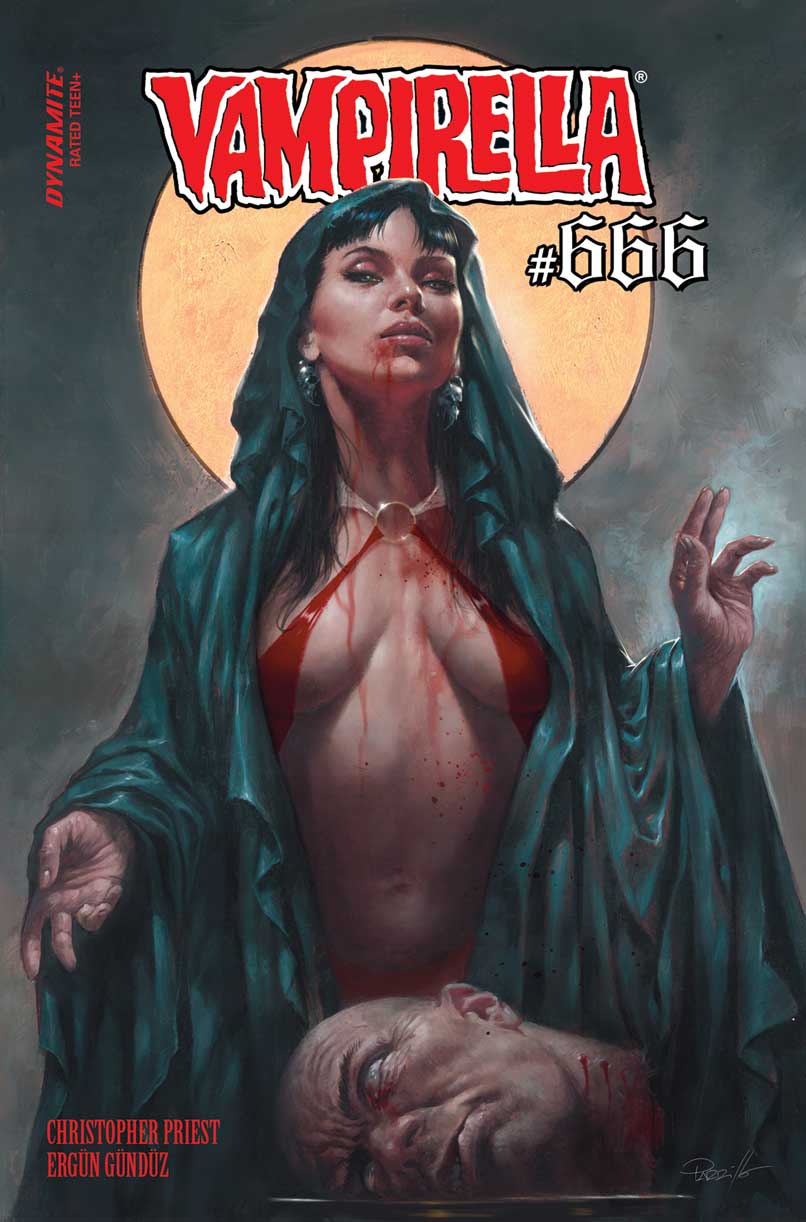
Back To Basics: Discussing ‘Vampirella’ #666 With Writer Christopher Priest
by Tom Smithyman
Christopher Priest has written Vampirella for several years now, putting the character through pregnancy and even losing the child. With February’s appropriately numbered Vampirella #666, Priest launches the next phase of the iconic character’s story. In a Comicon exclusive, Priest discusses his plans for the daughter of Drakulon and what he would change if he had the opportunity to go back to Warren Publishing in 1969 and create the character from scratch.

Smithyman: You have really put Vampi through a lot, haven’t you? Are you going to go easier on her this time, or do hard times make for a better story?
Christopher Priest: Both. A long time ago MD Bright and I did a Wonder Woman story about a happy suburban housewife and mom who receives an unexpected visit from WW. It turns out the housewife is actually Hippolyta, queen of the Amazons, and she’s been ensorcelled by Circe to believe she is Helen Hunt in Mad About You.
It’s a really fun and funny story that quickly decerebrates into a heart-tug as WW goes to extreme measures to snap Hippolyta out of Circe’s spell. But Hippolyta is clinging to the fantasy because she is now so invested in it. It is the happiest she’s ever been in her very long life. Believing this stranger – WW – means, “I lose everything!”
With Vampirella #666 artist Ergün Gündüz and I are working along the same themes. Yes, we’ve been really tough on Vampi so we decided to make up for it by giving her everything she’s ever wanted: community, career, love. Only none of it is real.
We have wound the clock all the way back to the debut of our 50th anniversary series, undoing all of the heartache and tragedy Vampi has suffered along the way. How did this happen? What must Vampi give up in order to put things back and is she willing to sacrifice those things? Tune in to find out.

Smithyman: Six hundred and sixty-six issues is a lot! Were you surprised to learn there have been so many issues centered around Vampirella over the years?
Priest: Kind of. This is a character who has existed well under my radar for as long as I’ve been reading comics. I mean, I saw the Warren magazines, might have read a couple, but the early Vampi stuff was fairly frivolous and jokey, and I was more into the O’Neil/Adams Batman/Green Lantern-Green Arrow types of stories.
Plus I could never bring one of those magazines into my mom’s house. No way.

Smithyman: So what do you have cooked up for #666? Is it something darkly satanic or will you go in a completely different direction?
Priest: For personal reasons I (almost) never go “satanic”. Most publishers get antsy when you start talking about God or, worse, featuring God as a comics character. I kind of feel like, if I’m not allowed to put God in the comics, then I won’t put the devil in either. For whatever reason, Satan is fine, thumbs up. But God makes everyone nervous.
Dynamite Publisher Nick Barrucci and I actually had that conversation. Without hesitating, he said I could write about God if I wanted to, and I’ve tested his patience with my proselytizing in Vampirella. For those who’ve never read the series, there’s a LOT of theology and preaching going on in that book, Reverend Priest hanging out his minister’s shingle every chance he gets.
For #666, Vampirella gets a kind of soft reboot as we go back to basics. If you’ve never read a Vampirella comic before, this is a perfect place to jump in. If you’ve been with us since our 50th anniversary run, you will have an added layer of narrative because everything in #666 should seem familiar to you, except, whoa, wait, isn’t that person dead?
I wanted to go back to basics so we have literally done that, gone back to the beginning of our 50th anniversary run, except now everything has changed… for the better.

Smithyman: You’ve been writing this character for several years now. What keeps you coming back to her?
Priest: There’s been 600+ periodicals published featuring this character but the amount of deep-dive characterization is likely a small percentage. I don’t mean this as shade on any other writers, just pointing out an awful lot of what’s been done with Vampi has been more about working the costume, frivolous T&A and kind of over-the-top occult stuff. There’s really nothing wrong with that.
The approach I take with her tends to be a more sober and “hard” look at the character and her mythology. There’s an awful lot of space for doing that because fairly little has been done to take the franchise seriously as opposed to taking the lighter and more satirical approach.
I am grateful Dynamite still affords Ergün and me the opportunity to continue our journey with the character. There are literally worlds of potential.

Smithyman: Given your tenure with Vampirella, do you think you are building a lasting legacy with the character?
Priest: Oh, this is comics. Nothing ever lasts 🙂 I think Dynamite Entertainment has, per capita, less stick up the ass than most comics publishers, which means they’re looking to explore differing interpretations of the character rather than enforce a rigid continuity.
So I don’t really know how long any “legacy” we may have will endure, I’m just happy to be invited to the party.
Smithyman: In the 90s, you wrote a short story that Alan Davis illustrated, which will be included in this issue as well. What can you tell us about that tale?
Priest: It was a real challenge, which is why I took the gig: communicating a character’s motives without the use of captions or dialogue. This is compounded by the visual fact of the protagonist’s obvious vampirism, which is typically portrayed as evil or nefarious.
For those (few but hardy) Priest fans who followed me over to Harris, they may have been wondering who Vampirella is beyond the skimpy costume, which is all many comics fans actually know about her – she’s a half-dressed female vampire and therefore fails many of the superhero religious tests that might make her a stronger draw (pun intended) for mainstream comics fans.
So, for that Harris issue, those folks were reading their very first Vampirella and didn’t really know who she was or what her motives were, or even what her complete power set was or what the rules of her universe were. And I had eight pages to tell them, with no talking and no captions. “Go.”
And now the guy who dragged me into that mess is one of the most powerful veeps at Marvel. If I’d known that, I’d have started sucking up way earlier.

Smithyman: You are clearly very fond of Vampirella, but if you were able to go back to her beginnings in 1969, is there anything you would change about her?
Priest: Well, yes and no. I think the basic construction and premise of the character works just fine. But I am a kind of literalist Superman The Movie Act One and Avengers: Endgame guy and Warren Vampirella was a little too Barbie-Green Hornet for me.
My curse (and a major reason I am rarely offered prominent mainstream work) is I tend to look at this stuff very hard and take things very literally. How does Clark Kent ever get a job since he can never take a physical? And that just makes comics editors crazy.
In order to do their jobs effectively, editors have to believe in this stuff in ways I no longer do. It reminds me of how, at age 14, I used to irritate my church deacons by asking them questions about plot holes in the bible (“Yeah, but, where did Mrs. Cain come from…?).
The audience for superhero stuff is, or is presumed to be, hungry for escapism, while I am the kid whose life was changed forever by Stan Lee’s “Harry’s on drugs” story, which took place in my actual city, populated by well-grounded characters like Robbie Robertson – a credibly-written Black father figure I could admire – and Peter Parker struggling to get a voucher in so he can pay his rent. These characters felt real to me in ways Jimmy Olsen never could.
So, later, when the guy pulled on his mask and swung away across the city, I bought it. I gasped. I could see myself in that character. That’s the experience I remember, and that’s what I try to write.

With Vampirella, I’ve had the blessing of working with a veteran editor and old friend, Matt Idelson, father of Everett K. Ross, at a company that welcomes a variety of creative expression for this character. Therefore I am permitted to write my “literal” or Avengers: Endgame interpretation of the character without damaging or harassing other writers who want to take different approaches. And that’s smart business.
Would I change anything about the Warren years? Yeah. I’d keep it faithful to the premise while grounding it in as much Zack Snyder/Jeph Loeb Netflix Daredevil “reality” as I could.
I think the more real you make the world, the more seriously you take the subject matter, the more grounded, the “drier” you make the narrative, the more the larger-than-life elements “pop.” And that’s why we are all here, that “pop.”
But if everything is hyper-realized, if there’s a dozen or more spider-people running around Gotham with bat ears, then nothing stands out. It all gets lost in the noise.
Smithyman: And we can all agree that there’s plenty of noise out there. Thanks as always for talking about this milestone in Vampi’s story.
