
From The Team Behind ‘Loving Vincent’ — ‘The Peasants’ Reviewed
by Rachel Bellwoar
Marriage can bring people together. It can also be forced upon them. In DK and Hugh Welchman‘s The Peasants (their second feature-length collaboration following Loving Vincent), Jagna (Kamila Urzedowska) would’ve been more than happy to go on living with her mom (Ewa Kasprzyk), unattached and making cut-outs in her spare time. Given that Boryna (Miroslaw Baka) holds most (if not all) of the power, it’s easy to forget that marriage wasn’t his idea either, but if it weren’t for the prodding of other people he probably would’ve stayed single, too, or at least waited awhile before getting married again so soon after the death of his first wife.

Photo credit: ©Julia Spiwakowa. Courtesy of Sony Pictures Classics.
Once land rights are brought into the picture, though, stances start to change and (despite the complication that the real person Jagna is having an affair with is Boryna’s son, Antek (Robert Gulaczyk), they eventually get engaged.
The path for Antek and Jagna was never going to be easy (Antek is married with kids) but, besides the obvious flaws, they’re not a couple the film is necessarily asking viewers to root for either.

Photo credit: ©Vladimir Vinkic Courtesy of Sony Pictures Classics.
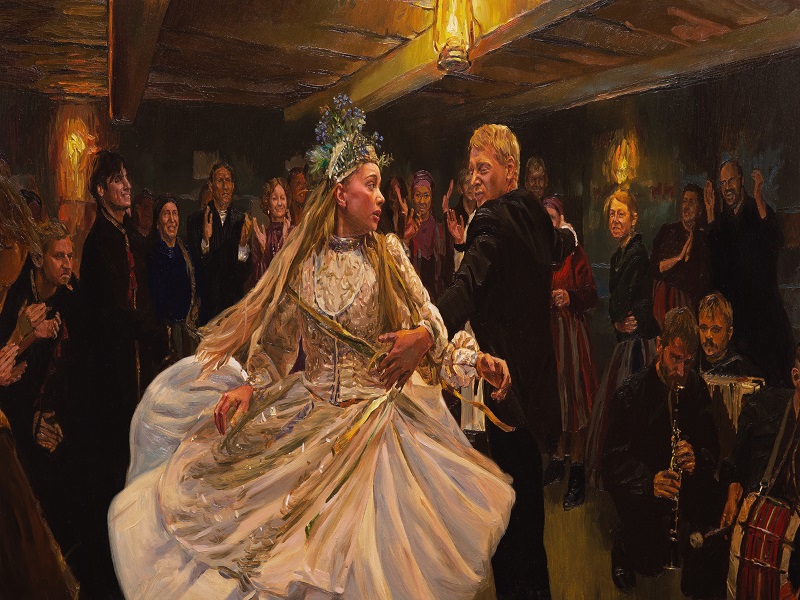
Based on a classic Polish novel by Wladyslaw Stanislaw Reymont, The Peasants uses the same oil-painting animation technique that was employed for Loving Vincent. The story takes place over the course of a year, so all four seasons get to play out across the Polish countryside.
The film’s strongest scenes are the ones that involve dancing. It’s in these moments that the animation really shines, especially when paired with Lukasz Rostkowski’s boisterous music. There’s a weight and unexpected roughness to the movements that goes against the gentleness of the occasion and speaks to these relationships being more physical than emotional.
As beautiful as the animation is, though, the question of whether it really serves the story in this case or if a live action version (as was filmed in order to do the animation) would’ve been just as successful does rise up. With Loving Vincent the animation offered the chance to see the world through Vincent Van Gogh’s eyes and see his paintings come to life. It was also interesting to see how the animators would have the subjects of Vincent’s paintings come to resemble the cast members who played them.
The Peasants, on the other hand, doesn’t really take advantage of what animation can do that other mediums can’t. That isn’t to say that all animation has to be fantastic and that a straightforward story about everyday people can’t, or shouldn’t, be told in this way. Yeah, they could’ve added in some martial arts to the fights but that wouldn’t have been appropriate. There are some missed opportunities, though, especially in terms of Jagna’s cut-outs which could’ve been used in a more abstract way to get across Jagna’s point-of-view and show why they offer her an escape. Instead they remain flat.
Still, to anyone who’s ever looked at a painting and wondered what it’s inhabitants’ lives were like, it does feel pretty brazen for a film to be so honest about the potential ugliness behind beauty and how brutal small town life can be.
The Peasants arrives in theaters starting January 26th in the US from Sony Pictures Classics.

