
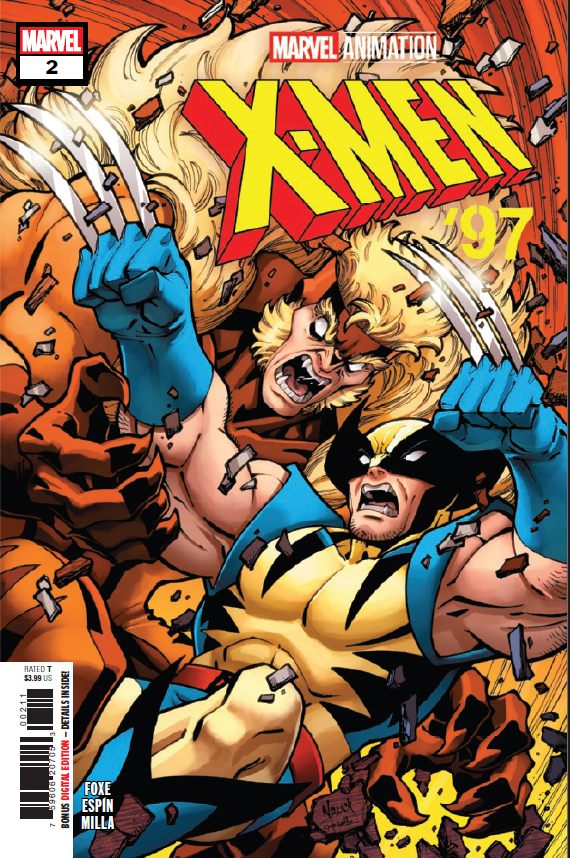
The Sinister Seven For The Win In ‘X-Men ’97’ #2 — Review
by Austin Gorton
Summary
X-Men ’97 #2 finds a better balance between supporting the animated series and standing on its own, but remains a slight, quick read.
Overall
5/10After dancing between the raindrops of continuity a bit inelegantly in its inaugural issue, X-Men ’97 #2 seemingly settles the series in as a proper companion to the animated version of this world. This issue strikes the right balance between supporting the cartoon and developing an identity of its own. It does this in a couple of key ways, by establishing a narrative arc of its own and taking advantage of its native medium.

X-Men ’97 #2 opens with Mister Sinister watching news footage of the X-Men’s defeat of the Nasty Boys in the previous issue. With the rising popularity of the X-Men threatening the near-culmination of his plans (a reference to the events of the third episode of the X-Men ’97 animated series), he decides it’s high time that the public is reminded that they should fear and hate mutants, and sets his “Sinister Seven” to the task. In doing so, writer Steve Foxe establishes a narrative arc for the series beyond “filling in the blanks left by the animated series.”
Now Sinister’s efforts to undermine the public’s faith in the X-Men and their efforts to stop are poised to serve as the book’s overall plot. That the outcome is already largely known — the X-Men are still mostly celebrated as the cartoon opens, roughly nine months after this story takes place — doesn’t really matter: there’s plenty to be entertained by in seeing how Sinister ultimately fails.
The deployment of the Sinister Seven — consisting of Hazard, Sienna Blaze, and five of the comic book Marauders, including Sabretooth — is another example of how X-Men ’97 #2 steps into its own. With the X-Men split up across the issue, Foxe is able to deploy all the villains at once. Scott and Jean are at the mansion. Storm and Wolverine are at Harry’s Hideaway, the local watering hole, where Wolverine is moping about Jean’s pregnancy. The rest are returning from the Dazzler concert. Meanwhile, Hazard is attacking the mansion, the Marauders are attacking Wolverine and Storm, and Blaze is taking down the Blackbird. This is the kind of crosscutting the animated series rarely does, weaving back and forth between three different sequences, but one common to comic book storytelling.

At the same time, the particular villains being used fit firmly in the wheelhouse of both series’ mid 90s settings. Blaze and Hazard are of a similar vintage and scale of the X-Cutioner, and the Marauders are tied to the kind of big late 80s stories from which the animated series draws inspiration. Hazard in particular is wry choice, given later stories which established a connection between him and Mister Sinister in the comics.
X-Men ’97 #2 is far from perfect, however. Salva Espín‘s art isn’t demonstrably different from the first issue, yet there’s a slightness to it here that makes the issue feel almost weightless, utilizing straightforward layouts that rarely feature more than two characters in a panel. This all contributes to the fact that even by the standards of modern comics, this is a remarkably fast read, with pages filled with large panels and few words; the whole thing can be consumed in a matter of minutes. And while it’s in just one panel, there’s a drawing of Jean in which she appears so dead-eyed and robotic it is going to haunt my nightmares.

Of course, X-Men ’97 the comic can’t truly escape the pull of X-Men ’97 the animated series; the conclusion of X-Men ’97 #2 promises the comic’s biggest tie-in to the cartoon yet. But the issue-ending cliffhanger and what it sets up feels more compelling now, at the end of this issue, than it would have at the end of the first, with at least some work having been done to help the comic stand on its own as something more than a series of footnotes in support of the cartoon.
