
Characterization In The Buffyverse — ‘Angel’ Season 1, Episode 13
by Benjamin Hall
This is part of a bi-weekly series concerning the characterization of Buffyverse characters. The first installment in this series can be found here. Arguably the best place to begin reading this series is at the beginning, but that is up to each reader. As a reminder this column will cover major and some minor characters from the shows Buffy The Vampire Slayer(1997-2003) and Angel (1999-2004). Other Buffyverse media, such as the graphic novel Spike: Into The Light (2014) are not pertinent to this series. Also there will be no referencing real world events that have direct relation to either show in this bi-weekly series.

This week: Angel (David Boreanaz) must help a female demon by the name of Jhiera (Bai Ling). But the help she needs is with a revolutionary war.
(Warning of spoilers from this point on!)
(Trigger warning for mentions of non-consensual acts)
Angel uses gadgets again in this episode (previously seen in Season 1, Episode 1, ‘City Of’). Where he gets these gadgets will never see explanation, but it does raise more questions about his funds. He also, again, demonstrates a desire for coffee in this episode despite previously saying it affects his nerves (Buffy The Vampire Slayer Season 3, Episode 20, ‘The Prom’). Angel, apparently, can drink alcohol without undoing his curse. This is odd since the euphoric effect alcohol causes in the brain should give him “a moment of happiness.” It is worth mentioning that this “moment” will be triggered by chemical means four episodes from now. Finally, he denies being able to dance despite thinking of the moves in his fantasy.
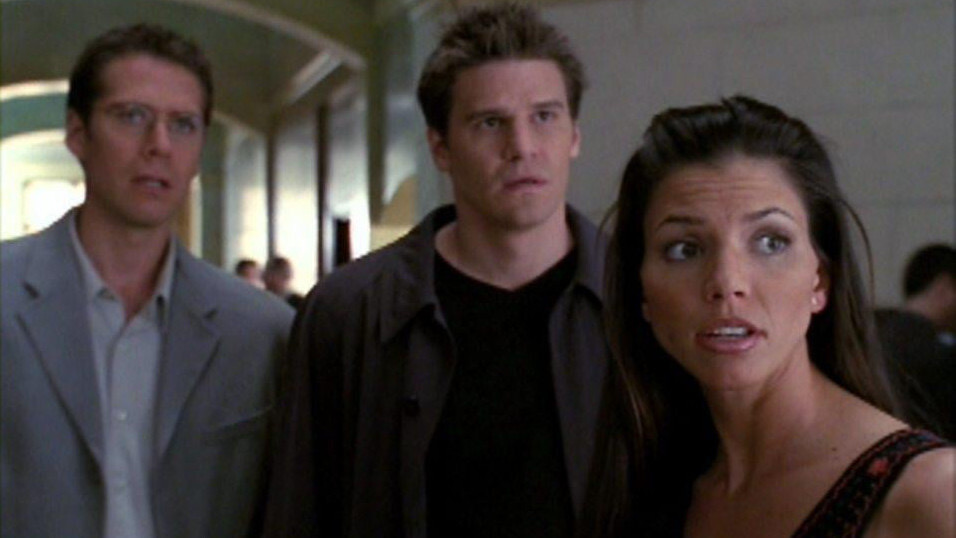
Wesley Wyndam-Pryce (Alexis Denisof) officially joins Angel Investigations, but it occurs because he’s broke. This is rather weird considering his overall appearance. Yet, he may just be running out of money at the start of this episode. His appearance at the party shows him being over-enthusiastic and a bit socially awkward. Nevertheless, there is a hint of the Wesley to appear in future seasons with his taking the initiative to locate Tay (Colby French) and his men.
Cordelia Chase (Charisma Carpenter) essentially just insults people and briefly becomes a hostage. She serves little to no purpose in this episode and has no growth.
Jhiera displays the stereotypical pompous attitude of royalty and she feels a strong attraction to Angel by the end of the episode (as her glowing mark shows). Also, she seems to be a good warrior. Additionally, besides the power to burn, she may have some telekinetic ability. Both are scene in the episode’s various battles. But most importantly, she is essentially running both a revolution and an underground railroad for her people.
Mars (Sean Gunn) is simply a spa owner helping Jhiera out. The only other thing one gets from his characterization is an allegory of those who provide refuge for ex-slaves.
Tay and his Demon Henchman (Chris Durand) are slavers — specifically of the type who mutilate genitals to keep others subservient. They are also obvious allegories for real life individuals who do this and deal in human trafficking. It is worth mentioning that according to Wesley’s research, Tay and his minion are supposedly amazing fighters. However, they really don’t display any notable fighting skills, especially in comparison to Jhiera. Finally, and arguably, Tay presents only a little more personality than his minion.
Shari (Heather Stephens) is mainly just a refugee who, again, becomes a victim Tay and the other men of her dimension. Yet, there is a bit of interesting characterization to her since she immediately knows English.
Laura (Tracy Costello), Diego (André L. Roberson), the Security Guard (Lucas Dudley), the Girl (Honor Bliss), the Demon Girl (Alison Simpson), and Peter Wilkers (P.J. Marino) all serve to flesh out the universe. Some have small amounts of personality and others are plot devices, but none are actually important in the Buffyverse.
This episode tries to use Jheira and her people as allegories for the purpose of social commentary. Unfortunately, the characterization on the allegory front is too slim for the point to really work. This also causes the plot to feel like it should recur for a whole season. But the lack of follow-through, or even an unambiguous ending, severely blunts the intended commentary. So while this episode attempts important characterization, it ends up failing that and showing any growth.

