
It’ll Only Hurt A Little: Reviewing ‘Detective Comics’ #1081
by Scott Redmond
Overview
It’s the beginning of the end as Batman finds himself on a perilous journey of discovery far from Gotham, as ‘Detective Comics’ #1081 continues the series stellar instant classic of a run. Three intertwined yet quite different stories fill the pages, with rich colorful gorgeous artwork and deep character beats. A reminder of why so many of us fell in love with this character, his world, and the medium.
Overall
10/10Batman and Gotham. Forever linked, the city and vigilante sworn to protect it. What happens when that link is severed?

An epic journey that could leave both man and city irreparably altered has begun, as the third and final act of Gotham Nocturne kicks off with Detective Comics #1081. A twofold story from Ram V, Riccardo Federici, Stefano Raffaele, Lee Loughridge, and Tom Napolitano. It’s followed by another exploratory backup story from Dan Watters, Hayden Sherman, Triona Farrell, and Steve Wands.
An issue with essentially three (connected) stories in one, all of them top-notch amazing. Can’t beat that sort of deal. I’ve said it time and time again but there are almost no words for just how much this comic book series just rocks. Every bit of the series just works. Telling such a prolonged deep, character-rich, off-the-beaten-path, creative story in a monthly format is no simple feat.
Yet, every single person involved with this series since the run began makes it seem like a breeze.

Batman is on a journey, one that should be quite familiar to those who have been here all along. Various parts of this issue are callbacks to the pieces that Ram V so carefully laid out. A journey across the desert was the tale that Talia told Damian back in issue 1064. In fact, the focus of that fable, Farhad I Parethes, shows up to help guide Bruce because he traveled the same desert in order to fight an Azmer. Hmm sounds pretty familiar.
Balancing all that came before was apparently so simple, that he decided to toss in some new beats as well. Doctor Hurt, from the classic Batman R.I.P. storyline, fully emerges both in the desert to confront Bruce but also in the backups. Our aforementioned two-fold story status is because at the same time, we get a whole full story with Renee Montoya as the Question.
I love that these two stories normally would be completely separate stories, perhaps one main and one backup. They have their own titles after all. Instead, they are intertwined in a way that just feels right, sliding from one to the other without a breath. Showcasing what Batman must endure and what is happening to Gotham as his memory slowly is wiped away from the city he loves so much.

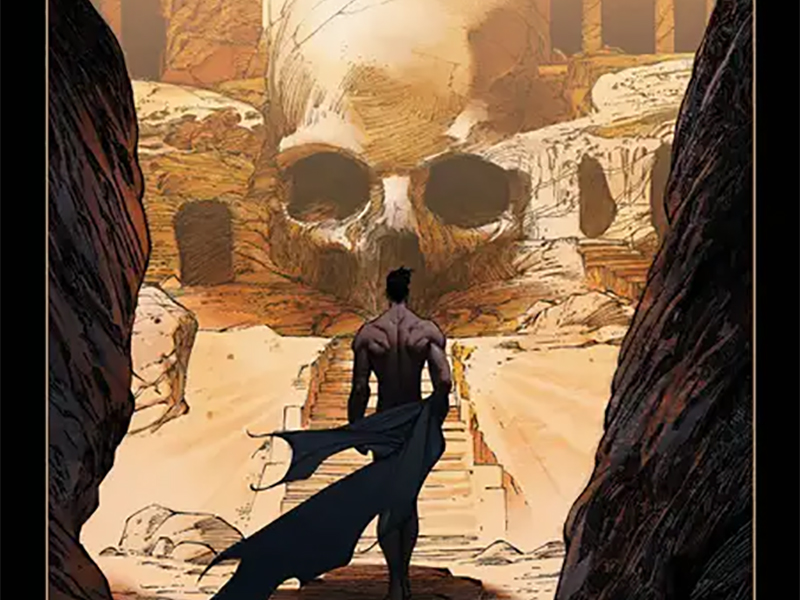
Two stories rightfully work with two different artists, to capture each tone. Federici previously came onto the title for the detached Knight Terrors side issues, once again perfectly tapping into the surreal and fantastical. His is a very dense, deep, and very fine art sort of style. Some of the vistas and moments could almost be lifted from the page and placed on a canvas and one might swear it was a painting all along.
Batman’s journey has a very dream quality to it, and Federici captures that. Enough depth and power is brought that it allows the dreamy to also feel grounded and tangible.
Raffaele is no stranger to the story either, having worked on the Knight Terrors as well along with a few previous issues in the run.
While Federici’s art is fine-tuned to the dream aspects of the story, Raffaele’s is perfect for the grittier real street stuff. It’s got rougher edges, some of them sharp, complimenting the nature of the story. It shares a great depth and weight, letting the city have a really lived-in feeling as we move through the space.

I love how different the panel choices are here. In the Batman-focused pages things are large and take up a lot of the page, feeling epic in scale. With Montoya/Question, it’s kept tight as the panels are very much close-ups, keeping the viewer right in the thick of everything happening. We’re active participants in one and passive observers in the other, as one story is very open and the other more personal.
Colorists juggle many things, and Loughridge does so superbly here. Creating two very different color sets for each story, using some of his own style choices to marry them together. It’s a seamless transition though where even though the palette greatly changes it’s never jarring or off-putting. A lot of color is drained from things in the first story, with lots of browns and whites and other colors dominating. Giving things a dreamy but also sandy, desolate feeling. Opposed to the darker, heavier, slicker feeling that comes from the city-focused story.
Capping off the double-duty work would be the lettering from Napolitano. Making swift changes to the captions, dialogue, and more to let each space have a unique voice. A very smooth and regular appearance comes from those in Gotham, while the desert ones are irregular in shape, have wavier text, and even feel like they are slightly fading at times. Visual cues create a different sound for each in our heads, a dreamier or more distant feeling to one as opposed to a more standard affair.

As noted above, Doctor Hurt is the focus of the backup, in a very intriguing way.
Watters and Ram V are natural compliments, which explains their friendship. We know that Hurt is obsessed with Batman, more his connection with Barbatos, but it’s interesting to see that he has focuses outside the Dark Knight. The man just spends his time doing horrific things to others either out of some sheer joy or study. From marrying and ghosting someone to convincing someone to be a superhero and letting them fall so they become paralyzed. As a villain we’ve only seen a handful of times, it’s kind of refreshing (in a horrific way) to see a villain with more fertile ground to explore.
Sherman and Farrell worked together previously on a backup in issue #1074 of the series. That one followed the Ten-Eyed Man and got really trippy.
We still see some of those really unique visuals here as panels overlap, pieces of characters burst out of the bounds of panels, a variety of shapes are assumed by panels, and more. Sherman’s style has some rougher qualities to it that really pop more with the outside-the-box display choices. Characters and moments feel larger-than-life, especially since the focus is on people telling us their heartbreaking stories.

Colors run the spectrum, with a lot of heavier elements added in to make them stand out even more. Usage of a lot of white, as characters are often white silhouettes against the rest of the page, is such a cool look. It gives the vibrant colors even more power and things have an eerie beauty to them. Farrell makes the abnormal and normal aspects of the story balance perfectly.
Wands has done a tremendous job through so many backup stories of this series. Finding ways to up the game with whatever artists he becomes paired with. Allowing all the voices to be personal and heard, changing up fonts and boxes/balloons along the way. Everything sings in harmony as it flows through the pages, capturing the feeling without getting lost in the shuffle of ‘oddly’ shaped pages.
Detective Comics #1081 is now available from DC Comics.
