
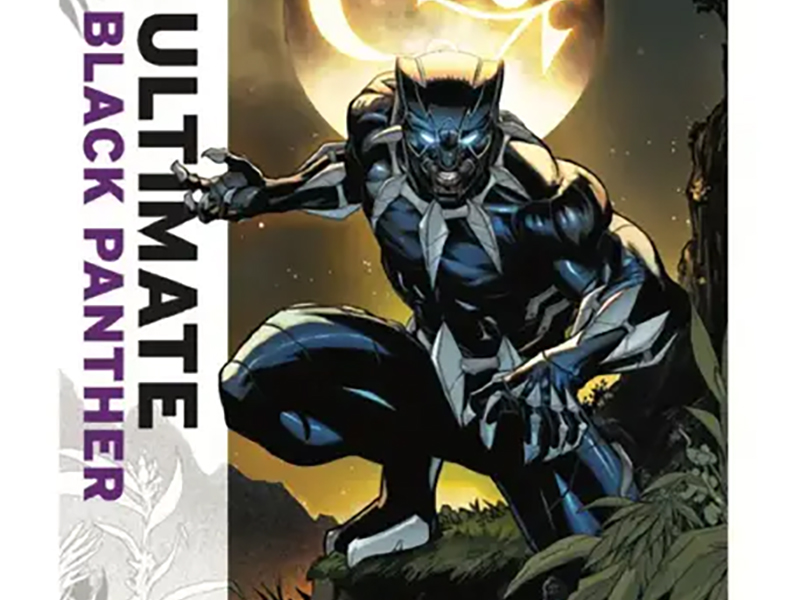
Same Panther Flavor, New Panther Wrapper: Reviewing ‘Ultimate Black Panther’ #1
by Scott Redmond
Overview
Marvel’s reimagined top alternate universe continues its rebirth with ‘Ultimate Black Panther’ #1, an issue that exists. A lack of defining differences or emotional beats leaves an issue that should or could be a revelation a bit cold.
Overall
7.5/10Universes have been ultimized once more, and it’s time for a familiar Black Panther in a new world to rise.
Gods, kings, mutants, freedom fighters, secret cities, and more are ready to answer the call in Ultimate Black Panther #1. The second new Ultimate Universe debut issue comes from the team of Bryan Edward Hill, Stefano Caselli, David Curiel, and Cory Petit.

Well, that was certainly a series of events.
This, of course, is not inherently a bad thing. Hell, life itself is a series of events. Things happen, in succession and lead to something (or don’t), followed by other moments. In a comic book, chiefly those in this genre, events happen all the time. In a debut issue, though a bit more substance beyond a series of slightly longer montage scenes might be helpful.
As a comic, this is the epitome of fine. There is nothing to make me dislike it, but there is also not much to make me excited for what comes next. Somewhat confined by the elements in play that came from Jonathan Hickman’s Ultimate Invasion precursor series, Hill does what he can with this character. For a bold new alternate universe initiative, this book plays it safe with little to separate it from any middle-of-the-line Black Panther story.
I was expecting something more than a sort of run-of-the-mill origin issue (without the actual origins), maybe with a bit more meat on the bone or bite.

All the characters we know are here and are just introduced matter-of-factly because we know them. T’Challa is the King and Black Panther, with his sister Shuri by his side, and Okoye is his Queen (sleeping in separate beds) as well as the former head of the Dora Milaje. Everyone is stoic, many of them (including Shuri) seem keen to jump into war and lack any real passion beyond even just the seeming shell of a marriage.
Who or what this version of T’Challa is as a person still is not clear. Same with Killmonger and Storm, we know they are freedom fighters, but not much else. No one’s desires or pasts or any concrete emotional beats are explored. Instead, this totally fine issue feels like a checklist of bullet point foundational points that had to be finished in one issue.
Our only real elements of change are that some are in different spaces than normal, marriages or alive rather than dead.

Oh, and the whole thing where the continent of Africa, full of various cultures and countries and peoples, is mostly one big giant conquered space. Treating a continent full of countries like one massive homogenized country is a bad stereotypical trope within American society, both in media and in the way many view it personally. Yes, in this universe the Maker’s hand-picked powered beings effectively carved up and colonized the world (even if their presence isn’t known by most). Yet, this still stands out as feeling egregious because of its retread stereotype nature.
Caselli has a style that is very much superhero friendly. It’s got the presence and dynamic that many of these stories require. There is a bit of a more whimsical styling mixed in, which in this case doesn’t quite fully fit what is on the page. Pages of explosions, people being burned alive, and dire grimness that doesn’t hit with the full impact.
In a way having this sort of standard type of style fits the fact that this book is pretty much standard Black Panther fare. There is enough detail and depth to allow the characters to form on the page and let the moments of action soak up power. Nothing really major happens that shows off any dynamic range or kinetic energy, it’s a lot of people standing around talking (with changing set pieces around them). There aren’t any pages that will make a reader gasp or cheer or want to pin up, but that’s because the story itself doesn’t offer any opportunity for such a page.
Even the appearance of Storm doesn’t hit the way it should since she’s not named (only called “Windrider”) and is hidden in shadows.

Colors shift from darker heavier palettes to those which are a bit more vibrant, adding some pops of color in Wakanda mostly. Despite shifting around the different areas of the continent, there is a real baseline of skin tone with everyone being pretty much the exact same shade. It’s not a deal-breaking sort of thing but it fits the issues that Marvel, and others, have had for years when it comes to darker skin tones. Tending to skew towards the lighter in all cases, even for characters who very previously had and should have darker tones.
Curiel does fine overall like the rest, finding the right colors for most of the elements (the skin tones aside). Again, there just isn’t anything that really stands out as the whole comic just sort of exists.
While there isn’t a ton of action, there are a lot of conversations to be had. Petit makes sure they flow and don’t overwhelm most pages. As previously noted the characters are mostly lacking real emotions and passions beyond a small contingent, and that is felt in the words too. Normally Petit can infuse any dialogue or captions with the character beats, letting their voices grow and shine. Unfortunately, there isn’t much for him to add so the words don’t have the punch they might otherwise.

For a debut issue, this is just fine. Checks the proverbial boxes, hits tones that are more movieverse Panther/Wakanda than comic book Panther/Wakanda, and puts the players on the board. Hopefully, there is more to come that will shock the system and make this something more. Just fine is a status that only works for so long.
Ultimate Black Panther #1 is now available from Marvel Comics.
