
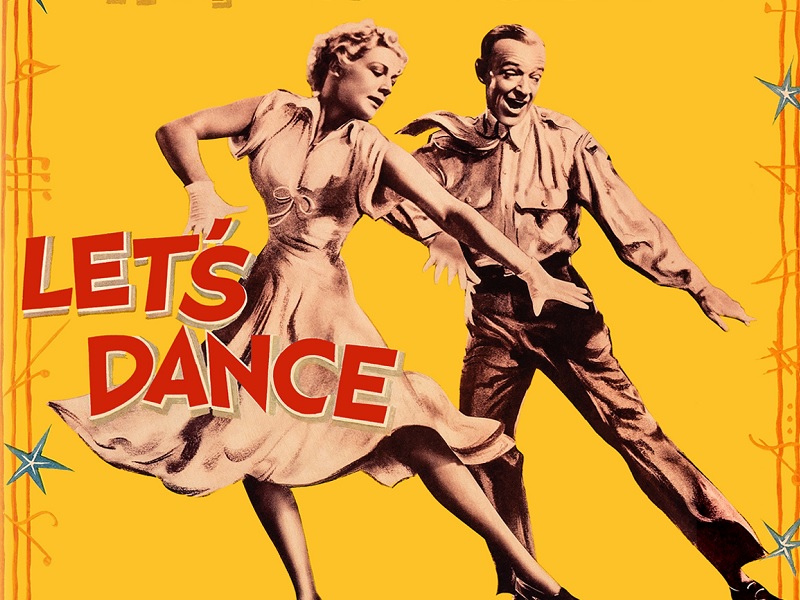
Betty Hutton Patters And Fred Astaire Dances: ‘Let’s Dance’ Reviewed
by Rachel Bellwoar
In the canon of Fred Astaire films, Norman Z. McLeod‘s Let’s Dance isn’t one that gets routinely discussed. Even compared to other Astaire films not co-starring Ginger Rogers, Let’s Dance is the “I’ve never heard of that one before” of musicals.

Whelp, as I brought up in my review of Dangerous When Wet, it’s always a good sign when a musical gets right to the singing and Let’s Dance does that. Betty Hutton‘s Kitty and Astaire’s Don are performing in a USO show for the air force. Another good sign: while Astaire has plenty of (amazing) solo dance numbers in this movie (including one where he’s monkeying around on a piano that feels appropriately improvised – Don is supposed to be workshopping a new number – but was probably choreographed to the nines), it’s Hutton who first appears onstage alone to deliver a fast-paced patter song (credit to film historian Lee Gambin’s commentary, for reminding me “patter” is the right word to use).
It’s a great number (not only does Hutton spit out these lyrics like it’s nothing but she does so while making like the leaning tower of Pisa and holding her body at crazy angles) but it points to the fact that Let’s Dance is going to be more about her character than Astaire’s. Kitty and Don love each other but, knowing that Don is a dreamer who keeps changing careers, Kitty decides to marry someone else. Five years later and viewers are told that Kitty’s husband died in the war and she’s now a single mother. Her husband’s great-grandmother, however (played by Lucile Watson in what’s essentially the mother-in-law role but for some reason not), has very rigid ideas about how her great-grandson (Gregory Moffett) should be raised and wants to takeover custody.
In his commentary, Gambin talks about how the film feels like a carryover from the women’s pictures of the 1940s and was Paramount’s attempt to replicate the success of MGM’s Easter Parade with Astaire. He also brings up that the film doesn’t have a lot of musical numbers for its length (which could have to do with it being a diegetic musical instead of an integrated one). Quality beats quantity, though, and if the film can be said to have a fault it’s that it makes Kitty’s sister-in-law (Ruth Warrick) and alternate love interest, Tim (Shepperd Strudwick), too likable, so that when they get jilted it hurts.
Allan Scott (who worked on a number of Astaire and Rogers movies) wrote the screenplay and I actually found myself scribbling down lines of dialogue in my notes. There is a conservative slant to the film at times (like the suggestion that you don’t need a lawyer if you’re telling the truth), but the supporting cast is a joy to watch, especially the extreme lengths they go to rally around Kitty. There are also multiple references to cowboys (Let’s Dance came out the same year as Hutton’s star turn in Annie Get Your Gun).
Even for Edith Head, the gowns in this film are exquisite and Hutton (who Gambin describes as a female Danny Kaye) is delightful. It could be argued that she doesn’t need to rely on comedy as much as she does. The song, “Why Fight the Feeling,” is a perfect example of this. While Hutton adds a comedy edge, her voice could’ve carried the song on its own. Her skills as a comedian are second-to-none but they sometimes feel like a crutch.
Let’s Dance is available on Blu-ray now from Kino Lorber.

