
Talking ‘The Jaguar’ One-Shot With Keryl Brown Ahmed And Tango
by Rachel Bellwoar
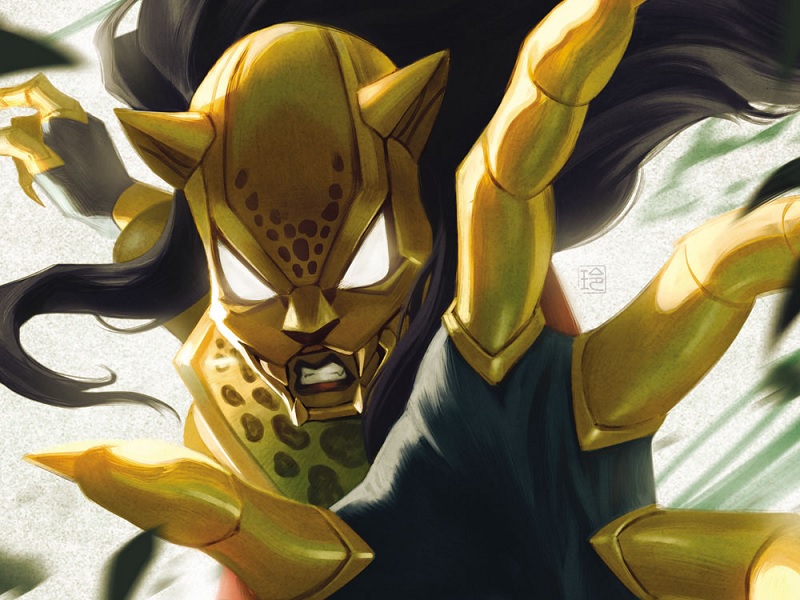
As a cat expert, Ivette couldn’t be better suited to help uncover what’s been targeting the Pampas cats of Northern Peru, but is work the only thing calling Ivette to visit the country that her parents were from? That’s what writer Keryl Brown Ahmed and artist Tango are about to untangle in their one-shot, The Jaguar. With colors by Ellie Wright and letters by Jack Morelli, find out more about their fresh take on the Archie Comics Silver Age hero in this interview with Brown Ahmed and Tango below:

Bellwoar: How has writing and drawing for Ivette been different from writing for Ethel (in Keryl’s case) or drawing for Midge (in Tango’s case)?
Keryl Brown Ahmed: The Jaguar feels like a total 180 from Big Ethel Energy because it’s so action heavy. Ethel is essentially a romantic dramedy—no punches thrown; no helmets donned. I do think they share one similar element, which is that, although Ivette and Ethel are in their 20s, they both experience a belated coming of age.
Tango: One of my favorite things about working with Archie characters in general is that there’s such a strong sense of nostalgia attached to so many of them. Pretty much all my friends can recall growing up with some Archie digests around. So, with the Toybox of Terror one-shot, I got to draw some of the core Riverdale kids and it was such a bucket list experience.
When Archie’s art director Vincent Lovallo reached out about The Jaguar I was introduced to [Archie’s superhero team] The Crusaders for the first time. Fortunately, research is genuinely one of my favorite parts of any project. Learning that these characters have such a long history and the list of contributors stretches all the way back to icons like [Alex] Toth and [Steve] Ditko was a real trip. As a superhero fan it feels like being trusted with a torch that’s in your care for a small stretch and there’s a real sense of responsibility to do right by it.
Bellwoar: Of all the places Ivette’s work could’ve sent her, what made you want to set this one-shot in Peru, a country with so much personal significance to her?
Brown Ahmed: This one-shot is adjacent to an origin story for Ivette—kind of an in media res origin story, if you will—so it made sense to send her to the place where her powers originate. She’s in a new place that is significant in her family history, which lends itself well to learning about herself.
Tango: Keryl taking the story back to the origins of the Jaguar totem in Peru was a great way to honor the history of the original Jaguar mantle, while also telling a very honest story about how disconnected Ivette feels about her own culture when she arrives. These things are a part of her, but I wanted it to come across even in her body language and the way that she carries herself that Ivette is still working out where she fits in to all this ancient history.

Bellwoar: One of the things Ivette is very self-conscious about is not being able to speak Spanish. Did you always want to place readers in the same position as Ivette, by not translating the dialogue when other characters speak Spanish?
Brown Ahmed: I chose not to provide translations for a few reasons: one, I think they can look clunky on the page; two, I don’t assume one way or another whether readers of this comic speak Spanish. If they do, they’ll understand the lines, which is great, but it won’t give them some secret insight into the story that the rest of us are missing; three, readers who don’t speak Spanish will be placed in Ivette’s shoes when reading those panels. It’s more immersive and, as one of my friends said when I was deciding whether to include subtitles, “This may be a hot take, but I think not including subtitles is a great statement—if you understand the words, you understand; if you don’t, you don’t. There’s no reason to be offended either way.”
Bellwoar: It’s not unusual for superheroes to wear masks, but Ivette hides her face when she’s not the Jaguar, too. How did hair become a means to communicate Ivette’s shyness?
Brown Ahmed: Ivette hiding her hair was borrowed from The New Crusaders, published around ten years ago. Ivette was introduced as Ralph Hardy’s successor in that series, and she’s very shy and withdrawn due to her childhood trauma. I always got the sense in that series that she just wanted to fade into the background (which made becoming the Jaguar even more complicated), and I felt that contrasted nicely with the ferocity of her in Jaguar form. I also just love big hair, so it was a great excuse to give my protagonist an awesome hairstyle!
Tango: I really appreciate knowing that Ivette’s “hair story” reads clearly. Many women I know have used their hair as a form of self-expression, or to signify changes in their lives. Hair is also one of my favorite things to draw and I saw the opportunity here to play with every phase she goes through in this issue. It was the perfect detail to visually emphasize Ivette’s shifting relationship to the world around her.

Bellwoar: Besides introducing Ivette as the new Jaguar, readers are reintroduced to Ralph Hardy, who was the original Jaguar. Did you always want to acknowledge the character’s legacy in this one-shot, and what was it like getting to completely redesign the Jaguar suit?
Brown Ahmed: I chose to include Ralph Hardy to acknowledge the legacy and lineage of the character. I think it helps readers understand Ivette’s history. I also have been lucky enough to have several mentors throughout my life who have made a great impact on my career and character, so including Ralph here was a small way for me to honor them.
Tango: There are Crusaders fans who have followed this character through several iterations over the years. From Ralph, to Maria, to Ivette, and I’m so grateful they’re still open to new incarnations. Character design is always a treat for me, and it was a dream working with Vincent and the Archie crew on updating Ivette’s costume. My main goal was to streamline the suit to walk that line between something modern and something that also wouldn’t feel totally out of place standing next to Ralph Hardy’s original Jaguar look. I’m a very big fan of keeping it classic.
Bellwoar: How a hero puts on their suit can be as iconic as the suit itself. Where did the idea to have Ivette get dressed on the run come from and (to single out a favorite detail) were the Jaguar spots always part of the new design?
Brown Ahmed: Truthfully, I had Ivette get dressed on the run to economize space in the script! It also provides for a great full-panel page, and the quick change emphasizes the urgency Ivette feels in the moment. Coming from TV writing where you’re constantly told to eliminate “shoe leather,” a.k.a. mundane actions that don’t do much to advance the plot, it’s my instinct to condense actions instead of drawing them out over several panels, but I have to remind myself that sometimes, especially when you have an artist as talented as Tango, it can actually enhance storytelling in comics!
Tango: I love the running costume change. That was in Keryl’s script from the start. Characters doing anything on the run always make for such a fun visual and I look forward to any page that allows me to design around action. It’s such a great moment.
The spots were in the previous version of her suit, and a detail in Ralph Hardy’s original Jaguar design. I don’t think the look would’ve felt complete without them.

Bellwoar: Thanks for agreeing to this interview, Keryl and Tango!
The Jaguar is on sale now from Archie Comics.

